People often ask me what MY personal style rules are.
This is hard – as what they are really asking is:
Antonio – can you tell me exactly what to do so I don’t have to think about it.
Unfortunately it’s not that easy.
Situation, environments, culture…

All of this goes into our personal style.
What I wear to a presentation in Las Vegas during the summer is very different from what I wear around town here in Wisconsin during the cold winters as I taxi my kids to school!
BUT…
If I had to lay out the style rules I live by, they’d go something like what I have laid out in this detailed article.
Again, these are the “general rules” that guide my personal style, and my writing on style for others.
It’s not the only way to think about style.
But it’s the way I’ve found best after years of experimentation, and it’s certainly a good starting place.
1. Give A Damn
It all starts here.
If you don’t care how you look, you’re never going to look good. You can put on the best clothes in the world and you’ll still look like a kid dressing up for a school play.
Attitude is everything, in style and in life. I start my personal style journey every day by giving a damn about who I am and what I represent — my business, my family, and my values.
Caring about those things strongly makes me care strongly about how I present myself. I give a damn. I dress like I give a damn.
It all starts here. And without this rule, no one’s ever going to get much of anywhere — in improving his wardrobe, or in anything else.
2. Know Your History
This is an important rule for anyone who wants to really understand his clothes, as opposed to just trusting experts to tell him what to wear.
You need to have a little understanding of and respect for where modern styles came from.
That’s both a philosophical and a practical consideration. If you just try to memorize “do and don’t” rules, it gets overwhelming. There’s too much to handle.
You could, for example, memorize the “rule” that trouser cuffs are informal, and that business suits should always be hemmed without a cuff.

Or you could understand the history of the trouser cuff — as a working man’s protection against fraying and mud, especially when working with horses and carriages — and know that its associations are with labor, not with business.
At that point you don’t have a rule to remember. Instead, you have an understanding of what your clothes mean, which in turn tells you when they would or would not be appropriate.
So with all of my outfits, I strive for an understanding of the style’s history. Where our clothes came from matters, and it still influences the messages they send today — whether the people receiving the message understand why or not.
3. Don’t Be Afraid To Lead
I always tell my readers and my clients that they can’t be afraid to be the best-dressed guy in the room.
Because I’ll tell you what — if you take the time to care about your appearance, it’s going to happen.
And that’s not a bad thing.
It takes getting used to. You may initially feel “overdressed,” particularly when you’re the only man wearing a jacket or a suit as opposed to a shirt or sweater.
Learn to embrace it. People may treat you differently — but the differences will be overwhelmingly positive. Turns out that most regular people assume a man in a sharp jacket or suit is someone important, and treat him accordingly.
That’s a good thing. It’ll open doors for you. But you do have to accept and embrace your new role as someone people look to as a leader, especially if you’ve never thought of yourself as one before.
4. Know Your “Why” – Break Rules On Purpose
This is a lot like my rule about knowing your history.
Fashion doesn’t have a lot of fixed yes-or-no rules. And the few that it does have can be broken stylishly (and have been).
But you need to know what you’re doing, and why. Otherwise you just end up looking silly.

I think “Fedora guys” are a great example of why this rule is important. You probably know them — guys who own one black fedora, and wear it with everything.
They look out of place when worn like this. Sorry, guys, if you’ve ever done it, but there it is.
That’s because fedoras are dress hats. They’re deeply associated in our minds with suits.
Wearing one with a T-shirt doesn’t make you look like an innovator — it makes you look confusing and a little off-putting to people’s habits of thought. And wearing one all the time tells people that you don’t understand any other headgear options.
It’s not that you have to follow the rules all the time. It’s that you have to understand how the rules work in people’s minds, and what they’ll see if you break them. No one gets to rewrite style overnight. Even celebrities and designers get mocked if they push too far, too fast.
Have some respect for the existing traditions. They’re there for a reason.
5. Understand Clothing Fit

This is my first rule for actually buying clothing, and I’ve said it many, many times here on this site and elsewhere: the fit of your clothing is its most important feature.
Not everyone wants to hear that. It’s not the most glamorous aspect of fashion. There are lots of numbers and measurement, and it can seem kind of boring.
But trust me on this one — the most expensive suit in the world isn’t going to look good on you unless it fits your body right. If you don’t have the right fit, everything else is wasted effort. Plain and simple.
A good fit should flatter your body. It will draw attention to the parts of you that you want to highlight (usually the face, chest, and shoulders), and it can also minimize aspects you’re not as fond of (a large midsection, for example).
Take the time to get to know your body, and have a tailor help you get accurate measurements. Learn to say “no” to clothes with a style you like, but a fit that can’t be adjusted to suit you. It really does matter.
The Five Fit Checkpoints I Use In Every Fitting Room

Here’s the part most guys skip: you can’t say “no” to a bad fit if you don’t know what a good one looks like. So here are the five things I check, in order, before I even glance at a price tag.
The shoulder. The jacket’s shoulder seam should land exactly where your shoulder ends and your arm begins. Not past it, not short of it. This is the one thing on a jacket a tailor can’t fix cheaply — everything else is an adjustment, the shoulder is surgery. Wrong shoulder, put it back on the rack.
The collar. Your jacket collar should sit flat against your shirt collar with no gap behind your neck. A gap there means the jacket is fighting your posture, and it will show up in every photograph anyone ever takes of you in it.
The sleeve. The jacket sleeve ends at your wrist bone, with about half an inch of shirt cuff showing underneath. That sliver of white is the difference between a man who owns his jacket and a man who borrowed it.
The button. Fasten the top button and slide a flat hand between the button and your chest. If a fist fits in there, it’s too big. If nothing fits, the lapels pull into an X and announce it to the room.
The trouser. Slight break — the fabric touches the top of your shoe and creases once. No break at all is fine if you meant to do it. A pool of fabric on your shoe is never on purpose.
#rmrs-fitcheck *box-sizing:border-box;margin:0;padding:0;
#rmrs-fitcheck
–navy:#14213d; –navy2:#1f335c; –cream:#faf6ec; –cream2:#f1e9d6;
–gold:#c9a24b; –ink:#2a2a2a; –line:#e2d7bd;
font-family:-apple-system,BlinkMacSystemFont,”Segoe UI”,Roboto,Helvetica,Arial,sans-serif;
color:var(–ink); max-width:760px; margin:32px auto; padding:0 4px; line-height:1.5;
-webkit-font-smoothing:antialiased;
#rmrs-fitcheck .cmp-title
text-align:center; color:var(–navy); font-size:22px; font-weight:800;
letter-spacing:.2px; margin-bottom:4px;
#rmrs-fitcheck .cmp-sub
text-align:center; color:#6b6250; font-size:13px; margin-bottom:18px; font-style:italic;
#rmrs-fitcheck .cmp-scrolloverflow-x:auto; -webkit-overflow-scrolling:touch;
border-radius:12px; box-shadow:0 6px 22px rgba(20,33,61,.12);
#rmrs-fitcheck table
width:100%; border-collapse:collapse; background:var(–cream);
min-width:520px; font-size:15px; overflow:hidden; border-radius:12px;
#rmrs-fitcheck thead th
background:var(–navy); color:#fff; padding:16px 14px; text-align:left;
font-size:16px; font-weight:700; vertical-align:middle; border:none;
#rmrs-fitcheck thead th.cmp-attrbackground:var(–navy2); width:30%; font-size:13px;
text-transform:uppercase; letter-spacing:.6px; color:var(–gold);
#rmrs-fitcheck thead th .cmp-housedisplay:block; font-size:12px; font-weight:600;
color:var(–gold); text-transform:uppercase; letter-spacing:.6px; margin-top:2px;
#rmrs-fitcheck tbody th
background:var(–cream2); color:var(–navy); font-weight:700; text-align:left;
padding:12px 14px; font-size:13px; text-transform:uppercase; letter-spacing:.4px;
border-top:1px solid var(–line); width:30%; vertical-align:top;
#rmrs-fitcheck tbody td
padding:12px 14px; border-top:1px solid var(–line); vertical-align:top;
color:var(–ink);
#rmrs-fitcheck tbody td:first-of-typeborder-left:1px solid var(–line);
#rmrs-fitcheck tbody tr:nth-child(even) tdbackground:rgba(201,162,75,.06);
#rmrs-fitcheck .cmp-bottom thbackground:var(–navy); color:var(–gold);
#rmrs-fitcheck .cmp-bottom tdbackground:var(–navy); color:#f4efe2; font-size:14px;
#rmrs-fitcheck .cmp-note
font-size:12px; color:#8a8071; text-align:center; margin-top:12px; line-height:1.5;
@media(max-width:520px)
#rmrs-fitcheck .cmp-titlefont-size:19px;
#rmrs-fitcheck tablefont-size:13.5px;
#rmrs-fitcheck thead thpadding:12px 10px; font-size:14px;
#rmrs-fitcheck tbody th,#rmrs-fitcheck tbody tdpadding:10px;
| Checkpoint | It FitsBuy it or tailor it | It Doesn’tPut it back |
|---|---|---|
| Shoulder seam | Lands exactly where your shoulder ends and your arm begins. | Hangs out past the shoulder, or bites into it. A tailor can’t fix this cheaply. |
| Jacket collar | Sits flat against your shirt collar, all the way around. | Gaps away from your neck, or bunches up behind it. |
| Sleeve length | Ends at the wrist bone, with about half an inch of shirt cuff showing. | Swallows your hand, or rides up your forearm. Cheap fix — but fix it. |
| Front button | Buttoned, a flat hand slides between the button and your chest. | The lapels pull into an X, or you could fit a fist in there. |
| Trouser hem | Touches the top of the shoe and creases once. One clean break. | Pools on the shoe in folds, or floats above the sock line by accident. |
| Bottom line | Everything here except the shoulder is a cheap trip to the tailor. | Wrong shoulders are the one deal-breaker. Walk away. |
Photograph yourself in the fitting room mirror, front and side. The camera catches slack and pull that your eye forgives in person.
6. Buy Clothing That Will Be In Style Years From Now
I like to focus on a “timeless style,” both in my personal life and in my advice to other men.
Certain looks are always going to be dependable. Men might not wear suits as much today as they did in our grandfathers’ time, but the suits our grandfathers wore would still mostly pass muster today.

That’s a goal worth striving for: having clothing that your grandchildren could wear fifty years from now without looking out of place.
I always urge men to focus on pieces that are both classic and associated specifically with men: suits, blazers, sports jackets, and trousers, both dress and casual.
Steer clear of exaggerated trends and “this year’s hot looks.” Think about some of the trends that defined earlier eras: huge lapels, ultra-skinny ties, padded shoulders, and so on.
You wouldn’t want to wear those today. They’d look dated and awful. So why wear this year’s equivalent? It’ll be just as outdated in a few years. Keep your look timeless and classic, both for your sake and your budget’s.
7. Buy the Best Quality You Can Afford
Treat your clothing like an investment. Look for a good return on your money. It’s better to buy one item that lasts ten years than ten that last one. A serious wardrobe requires serious budgeting. You don’t have to be rich, you just have to be realistic.
That said, I do always stress the idea of buying the best clothing you can afford. Not everyone needs luxury tailoring!
Realistically, if you aren’t drawing the kind of salary that covers Savile Row bespoke — a two-piece starts around £7,500 at a house like Huntsman these days — you’re probably not working in an environment that expects one, either. There’s nothing wrong with wearing made-to-measure, or even off-the-rack clothing adjusted by a tailor.
Spend the money you need to. If you’re traveling in high-powered circles, that’s going to be more money. If you’re upgrading a social wardrobe for hanging with your friends, it’s going to be less. Be sensible — but be willing to make at least a little bit of an investment.
A clever shopper can look like a high-powered exec in nothing but thrift-store castoffs and ready-to-wear retail clothes. It just takes time — and adjustments by a skilled tailor! Remember, the fit is everything.
How To Spot Quality In Thirty Seconds

“Buy the best you can afford” is useless advice if you can’t tell what “best” looks like hanging on a rack. So here are four checks I run, and not one of them requires you to recognize a single brand name.
Read the fabric label before the price tag. Wool, cotton, linen, silk, cashmere. A little synthetic for stretch or wrinkle resistance is fine — I’d rather have two percent elastane in trousers I actually move in. But when polyester is the majority of a jacket, you’ve bought something that won’t breathe, won’t press, and won’t age. It’ll look exactly the same in year five as it did in year one, and that is not a compliment.
Turn it inside out and look at the seams. Tight, even stitching with the raw edges finished off means somebody cared. Loose stitches, frayed edges and puckering mean the factory was racing a clock.
Follow the pattern across a seam. On a checked or striped jacket, the pattern should line up where the panels meet — especially at the pockets and down the front. Matching a pattern wastes fabric, which is precisely why cheap manufacturers don’t bother. It’s the fastest tell there is.
Pinch the chest of the jacket. Roll the fabric between your fingers just below the lapel. Feel a soft third layer floating between the outer cloth and the lining? That’s canvas, and it will mold to your chest a little more every year you wear it. Feel one flat, papery sheet instead? That’s fused — glued together — and it will bubble after enough trips to the cleaner.
8. Practice Wearing Your Best
The average guy doesn’t have a lot of ready-made excuses to wear a suit and tie. Unless you’re a lawyer or a banker, that’s an outfit that’s mostly reserved for special occasions.
Get in the habit of wearing your best clothes as a matter of routine, and it’ll take a lot of the mystery (and the mental resistance) out of dressing well.

It’s easy to get into a mental paralysis with good wool jackets and slacks. They’re expensive, they’re a little harder to maintain than cotton shirts and jeans, and they make us feel more out of place. Try to teach yourself that they’re just clothes — clothes that look good on you.
If you don’t have business occasions to wear anything fancy, dress up for a social occasion. If you belong to a church, Sunday morning services are always an appropriate time to wear a suit and tie (even if most of the congregation dresses to a more relaxed standard). Evenings at the theater or sit-down musical concerts (not rock concerts!) are similarly good occasions to break out your best.
Even day to day errands like running to the grocery store can be done in wool slacks and a blazer, rather than jeans and a sweatshirt. There’s no law against being well-dressed at the supermarket. People will just assume you’re coming from some important meeting or other — and probably treat you with a little more respect without even realizing that they’re doing it.
9. Know Your Environment

Different situations call for different clothes. I love my worsted wool suits, but they’re not the right choice every time! A good dresser keeps his environment in mind — both the physical and the social aspects of it.
Physically, you want to be comfortable. That means lighter clothes in warm weather, thicker layers in cold, and a good fit all the time.
Changing your wardrobe seasonally adds a little expense when you’re first building it, but over time you’ll end up saving wear and tear (and sweat damage) as you spread your usage out over more weather-appropriate options.
Socially, you want to look respectable at all times, without inviting trouble. And yes — wearing an expensive business suit to a dive bar in a bad part of town is inviting trouble!
Make the effort to fit in while looking sharp. That means jeans and even T-shirts, when jeans and T-shirts are appropriate. Just make sure they’re nice jeans and T-shirts: well-fitted, in good repair, and flattering to your body.
If you’re always wearing the same basic outfit, rethink your strategy. Odds are you need a little variation, in one direction or the other.
10. Make Everything Interchangeable
The more of your existing wardrobe a new item goes well with, the more use you’re going to get out of it.
That’s a principle that’s guided my style (and my style advice) for years. I try to stay away from anything that’s completely single-purpose, with one or two unavoidable exceptions like tuxedos. Apart from those very purpose-specific outfits, everything I own is as interchangeable as possible.
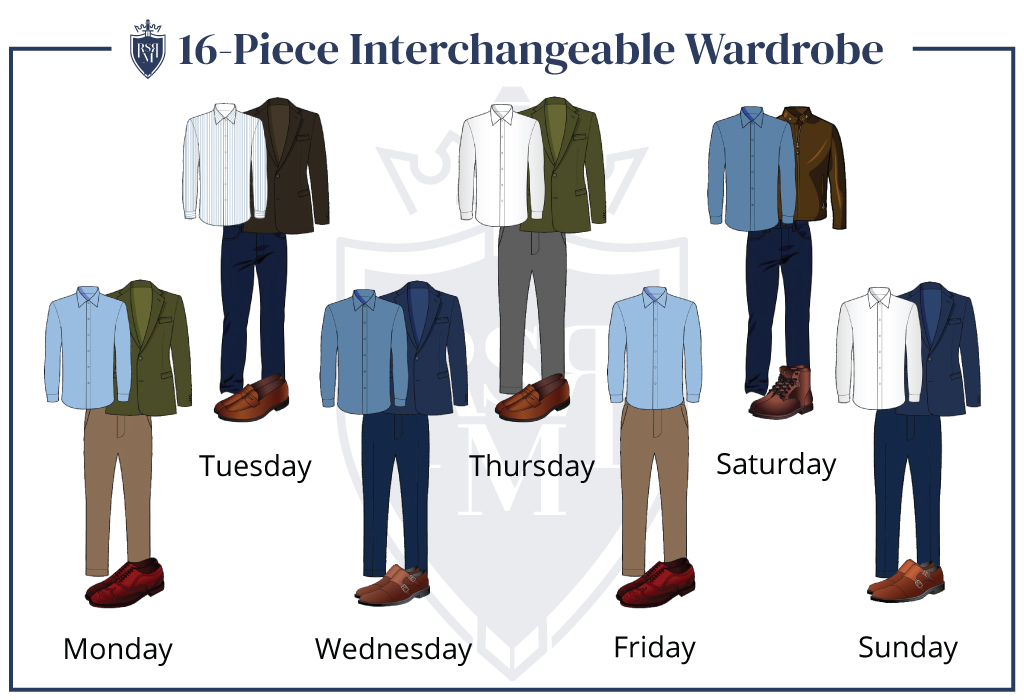
That way I can mix and match to get more mileage out of individual pieces. A dark blazer that goes with gray wool trousers is great. If the same blazer also looks good with jeans, so much the better!
This is very easy to achieve if you stick to simple, solid colors for most of your base pieces. There’s nothing wrong with a little pattern and texture here and there, but if you make sure that most of your big items aren’t overwhelming on their own, you’re free to liven them up with smaller accents when you want to make the look unique.
If you want the short version of which colors those are: navy, charcoal, mid-grey and khaki below the waist; white and light blue above it; brown leather on your feet and around your waist. Every item on that list works with every other item on that list. Build your core out of those and you’ll almost never pull two things off the rail that fight each other.
The pieces that break the system are the memorable ones — the olive sport coat, the burgundy loafers, the patterned shirt. Buy those last, and buy each one knowing it only earns its hanger if it works with three things you already own.
I think of it this way: if everything involved is interchangeable, then three jackets, three pairs of trousers, and five shirts gives me forty-five unique outfits (3 x 3 x 5 = 45). And that’s before I take belts, shoes, neckties, and other small items into account!
It never works out quite that perfectly, of course. There are always some matches that just don’t quite work. But if your items are interchangeable, every new one has a multiplicative effect on your wardrobe instead of an additive one.
Bonus Rule – Take Care Of What You Own

I wrote those ten rules years ago and left this one off the list. That was a mistake, so I’m adding it.
Every rule above is about acquiring — care about it, understand it, fit it, pay for it. Not one of them is about keeping it. And a good wool jacket treated like a gym towel will look worse in eighteen months than a cheap one somebody actually maintains.
Five habits do most of the work.
Clean your good clothes less than you think. Wool jackets and trousers do not belong at the dry cleaner every month — the solvent is hard on the fibers, and over-cleaning is what wears a suit out. Brush it down after you wear it, hang it up, give it a day to air, and send it out when it’s actually dirty. For most men that’s a few times a year, not a few times a month.
Buy cedar shoe trees and put them in the day you buy the shoes. Leather holds whatever shape you leave it in. Trees push the creases flat while the leather is still warm and pull the moisture out before it can crack. A pair runs under thirty dollars and adds years to shoes that cost ten times that. Almost nobody does it.
Never wear the same shoes two days running. Give a pair a full day to dry out. Two pairs rotated will outlast three pairs worn into the ground.
Get hangers that fit. Wide, contoured wood for jackets and coats — a wire hanger leaves a dent in the shoulder that never fully comes out. Fold your knits instead of hanging them, or gravity pulls the shoulders into little points.
Learn to press a shirt. Not the whole shirt — the collar, the cuffs and the front placket, which is all anybody sees under a jacket. Two minutes. The gap between “he owns a nice shirt” and “that guy has it together” is usually just that.
A man who does those five things looks better in a modest wardrobe than a man who does none of them looks in an expensive one. It’s the cheapest style upgrade on offer.
The 10 Style Rules To Live By, At A Glance
So there you have it — my top ten style rules. Those are the ones I follow personally, and the ones I use to guide my own wardrobe choices. In list format, they are:
1. Give a Damn – Care about your appearance.
2. Know Your History – Be aware of the menswear that came before yours.
3. Do Not Be Afraid to Lead – Know that sometimes you’ll be the best-dressed man in the room.
4. Know Your Why – Realize that “rules” are there for a reason, even if they can sometimes be broken.
5. Understand Clothing Fit – A good fit should always be your first priority when purchasing new clothing.
6. Buy Clothing That Will Be In Style Years from Now – Avoid temporary trends and fluctuations of fashion.
7. Buy the Best Quality You Can Afford – Treat your clothing like an investment, and shop slowly but smart.
8. Practice Wearing Your Best – Make excuses to wear the good stuff, instead of letting it get dusty in the closet.
9. Know Your Environment – Dress appropriately, whether that means dressing up or dressing down.
10. Make Everything Interchangeable – Expand your wardrobe with clothes that work together, not standalone pieces.
Bonus. Take Care Of What You Own – Maintenance beats money. Brush it, tree it, rotate it, press it.
There you have it — my rules for dressing well! I hope they help you on your own style journey and help you deal with bad advice you might receive.
Men’s Style Rules: Common Questions
What are the basic rules of men’s style?
Fit first, quality second, everything else after that. Get your clothes cut to your body, buy fewer and better pieces in colors that work together, dress for the room you’re actually walking into, and take care of what you own. Do those four things and you’re ahead of most men in any room you enter.
What is the 3 color rule in men’s fashion?
Hold an outfit to roughly three colors and it reads as deliberate instead of busy. Your eye takes in three without working at it — past that, nothing gets to be the focal point. Neutrals do most of the heavy lifting here, which is exactly why a wardrobe built on navy, grey, white and brown is so easy to dress from.
Can men’s style rules be broken?
Yes, and some of them should be. “No brown in town” and “no white after Labor Day” are relics of a different century. But there’s a difference between breaking a rule and never knowing it was there, and everyone can tell which one you did. Learn why the rule exists first. Then break it on purpose.
What is the single most important men’s style rule?
Fit. The most expensive suit in the world looks like a costume on a man it wasn’t cut for, and a forty-dollar thrift store jacket looks sharp once a tailor has been at it. If you act on one thing from this article, find a tailor and start using him.
Looking for more style tips?
I got more for you here – 5 Style Secrets I’ve NEVER Shared – Secret Men’s Fashion Tips – Easy Shopping Hacks
Click Here To Watch The Video – 10 Style Rules Every Man Should Know
The post 10 Style Rules To Live By | Timeless Fashion Guidelines For Men appeared first on Real Men Real Style.