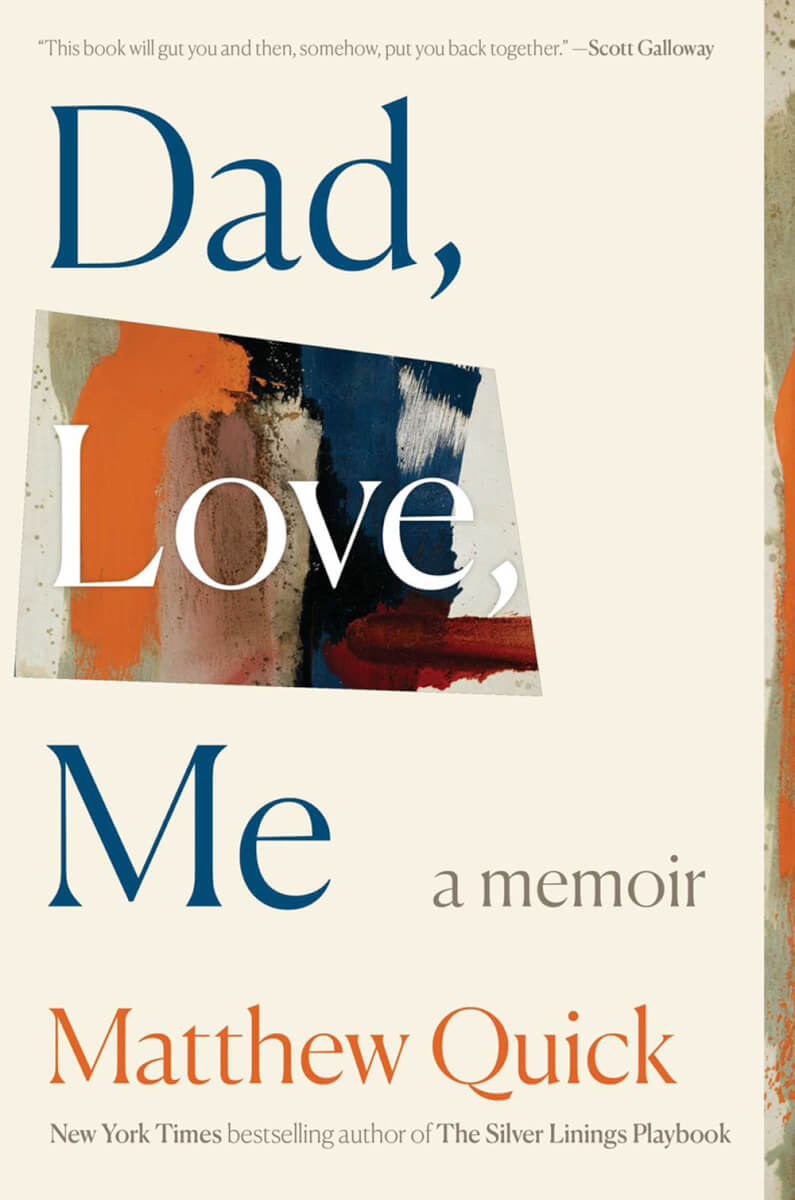
After admiring the late Pat Conroy’s novels and memoirs for decades—and relating to the “father issues so boldly on display”—Matthew Quick began telling himself, “Your life has become a Pat Conroy book.” Quick and his wife had moved to Lady’s Island, South Carolina, to help care for his aging parents. Now, the author of The Silver Linings Playbook and eight other novels puts his own life fiercely on display in Dad, Love, Me.
This “long overdue letter to my father” covers some of the same ground as Quick’s beloved debut novel and its 2012 film adaptation: most of all, an arduous, dramatic love of the Philadelphia Eagles and an ability to wrestle with toxic behaviors and relationships in a way that’s ultimately healing. Quick nimbly juggles past and present in a narrative that encapsulates the relationships among three generations of Quick men. Despite the “tornado-like fury that had been secretly—and not so secretly—swirling in my chest since I was very young,” Quick hopes to avoid writing a “dark, score-settling” account, realizing, “If I yielded to that temptation, would I be any better than my father had been to me at his worst?”
Quick acknowledges his own demons, including alcohol dependency, smoking and suicidal thoughts, while chronicling how his wife’s support and years of Jungian analysis (with a therapist he calls “Zeus”) have helped rescue him. As a result, he writes about his worst moments with his father with great insight and even tenderness for the damaged little boys deep inside both of their psyches. He also offers a poignant account of the impact of dementia, which is turning his “father’s brain into mashed cauliflower.” For instance, as the two of them pick up a pizza during a local Christmas festival, people around them “were laughing and singing, their hearts practically glowing with holiday cheer.” Speaking directly to his father—as he does throughout—he adds, “You looked like you were about to reenact your father’s storming of the Normandy beaches in World War II.”
Quick’s Christian faith has been part of his recovery, and he mentions it from time to time, at one point concluding—as he wrestles with how his father has treated him throughout his life: “I think the story of Christ is a metaphor for reaching masculine maturity. The needy-son mentality has to be crucified out of boys if they are to become men.” Regardless of their own spiritual beliefs, readers will likely find Quick’s references to prayers, forgiveness and his quest to “aim upward” with his writing insightful.
Quick admits he was “terrified of putting this book into the world,” but ultimately believes that sharing his personal story will have a larger impact: “I don’t write these words to condemn you. I write them to show other men what is possible when we allow love to lead us out of the darkness.” He achieves this goal with Dad, Love, Me.