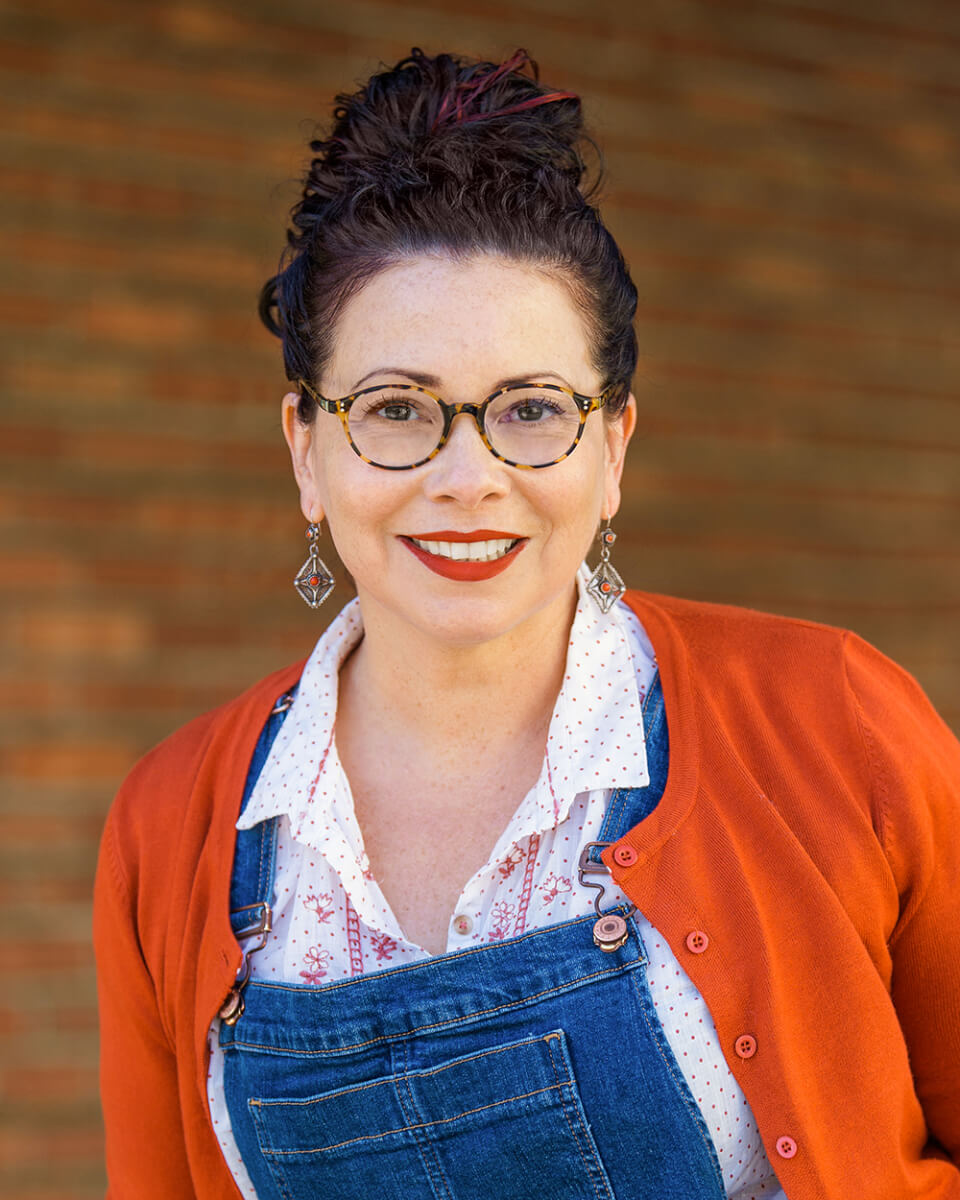
When Donna Barba Higuera and her husband, the children’s author Mark Maciejewski, moved from their city to their country home in Washington state, they added a turret to gain additional views of the adjacent fjord and Olympic National Forest across the water. They anticipated getting lots of writing done amid such beauty and peace.
“I don’t get anything done,” Higuera says with a laugh, from that turret over a video call. It turns out the view is hugely distracting. Today, eagles soar overhead, while yesterday she spotted a rare “mystery pod” of orcas that scientists believe may have traveled from the Gulf of Alaska or the Bering Sea. “I should have a live cam going at my house all the time,” she adds. “It’s just so magical.”
Once, when her father, who grew up in the Central California desert, visited, he hurriedly returned from the waterfront to announce that he had seen a seal with feet. “He’d never seen an otter before. They come up on our property and cause mass destruction.”
Higuera is a prolific, award-winning writer for whom thoughts of mass destruction have proved particularly inspirational, despite her claims of not getting anything done. In her Newbery Medal-winning middle grade novel, The Last Cuentista, Halley’s comet threatens Earth in 2061, prompting 12-year-old Petra Peña and her family to board one of three spaceships headed to a new life on planet Sagan. The sequel, Alebrijes, tells the story of 13-year-old Leandro Rivera and his younger sister, Gabi, as they try to survive in postapocalyptic California 400 years after the comet strike. Now, in the final installment in the trilogy, Firesnake, Petra’s granddaughter, Itzel, who has only known life on Sagan, returns to Earth for another action-packed, thought-provoking adventure.
Firesnake “was one of the hardest books I’ve ever had to write, for sure,” Higuera says, “because I had to combine these two very different worlds . . . and try to make it coherent.” She describes the result as the “Garden of Eden meets Mad Max,” referring to the contrast between the paradisiacal Sagan and the wild atmosphere back on Earth.
Higuera never intended to write a series; as a young reader, she didn’t like reading about the same characters over and over. However, readers barraged her with so many questions about what would happen next after The Last Cuentista that her imagination couldn’t help but shift into high gear. Perhaps the trilogy was inevitable, especially after she included an epilogue in Alebrijes about survivors on Earth sending a message to Sagan. However, since Higuera didn’t want to write about Petra again, she mused, “What if I wrote about a character that was born and raised on another planet, and then had to go back to Earth?”
“Sometimes, as a writer, you think you’re being really clever and you don’t know if it’s going to work or not,” she says. “My ideas are so bizarre and so weird.”
Whether she’s talking about orcas or children’s literature, Higuera’s creativity and enthusiasm are contagious. “I love writing for kids,” she says, “because their imaginations can do far more than mine can.” She believes that authors should avoid a didactic tone when writing for young audiences, and allow children to come up with their own ideas. “We might be creating future writers and storytellers. I think that’s one thing that I’m always thinking of when I’m writing: who I’m going to connect with.”
Higuera particularly likes writing for middle grade readers because those are the years when young people undergo the most development: “We find out what we believe and what we think. We’re still doing that when we’re young adults, but by then, we have more of an awareness of the world, and we are also trying to navigate how to make others happy.” In Higuera’s stories, the world is often “a disaster, but these kids are still finding hope within that. I love letting kids know that no matter how scary the world is, there’s always hope.”
That said, she appreciates that she has just as many adult readers as she does young ones. Her books are complex enough to appeal to all ages, and a number of libraries and schools have chosen The Last Cuentista for One Read events. “It’s extremely humbling,” Higuera says, to have so many people of different backgrounds reading her work. “The discussions can be so vast because you’ve got [someone with] a degree of innocence reading with somebody who has this degree of life experience.”
Higuera says that “some very wise editors” throughout her career have reminded her to start her novels with character instead of action. “You have to let people be invested in and love your character, so when you start taking them on this wild adventure, [the readers are] really afraid for them.” When she started writing The Last Cuentista, and Petra was leaving Earth for Sagan, her editor wanted to know what Petra was missing and what she loves. “So, I went back and wrote the first chapter, and it was absolutely autobiographical. It was me in the desert with my grandmother.” With age, Higuera’s novels have become more personal. Before, “I wasn’t ready to write about those things,” she admits.
Firesnake starts by introducing readers to Itzel’s life on Sagan and her passion for science, which she has inherited from her mother, who disappeared one day and is now presumed dead. Itzel also adores her grandmother Petra, by now “the oldest person on this planet by about four hundred and fifty years.” Petra informs Itzel, “You’re going to do extraordinary things.” Indeed, she does. The book brings the series full-circle, eventually concluding with a scene back on Earth’s desert that evokes the first chapter of The Last Cuentista.
Higuera continues to be inspired by memories of her Mexican American grandmother, who lost her father at age 9 and had to drop out of school and work in a hotel, where she made friends by telling stories. (“cuentista” means “storyteller.”) Higuera says that despite her grandmother’s lack of education, she was intuitive and brilliant. She recalls, “My grandmother would tell stories sometimes to make things better, and sometimes to scare me if I was misbehaving. And so, I started the book with Petra’s grandmother telling her a story about how Halley’s comet is really the firesnake coming home to its mother and how she should not be afraid. That’s how the series started and how it ended.” Higuera admits that when she reads that first chapter out loud to school groups—which she often does—she starts to cry as she thinks of her grandmother.
Similarly, Higuera tears up a bit as we discuss Harriet Hughes, her childhood librarian in the small town of Taft, California. She thanked Mrs. Hughes in her Newbery acceptance speech and eventually got back in touch with her. “She would write me these beautiful letters, at 100 years old.” Mrs. Hughes passed away in 2025, but Higuera remains forever grateful that she “gave hope to kids who maybe felt stifled or scared, growing up where we were,” surrounded by agricultural and oil fields. “I tell people all the time, please go thank your teachers and librarians, those who had an impact on you. Because they don’t often hear it.”
“I tell people all the time, please go thank your teachers and librarians.”
Higuera fell in love with science fiction as a child—especially A Wrinkle in Time and the Narnia books—but realizes that many people steer clear of the genre. When readers unfamiliar with sci-fi read The Last Cuentista, they’re surprised to discover that “it’s very much a story about humanity, relationships and family.” The books’ elements of Hispanic folklore and Aztec mythology remind readers of “who we are as humans, and the sci-fi element takes the backseat for sure.”
Kids have gravitated to the previous books because of their thrilling nature, and Firesnake has plenty of hair-raising, edge-of-your-seat scenes. “There is this human nature,” Higuera says, “to want to read the scary stuff, the apocalyptic stuff, in the safety of a book, because the world is scary enough. . . . I think kids want to explore things that are dangerous, but from a place of safety; they want to know that their parents or a teacher is nearby or in the next room.”
Higuera’s books are very visual—practically cinematic—to match their epic scope. Often when she writes, “it plays out like a movie in my mind. Sometimes, I’m closing my eyes, imagining a scene, and then certain things will happen in my mind and I get goosebumps, and I’m like, ‘That’s it.’ ”
“Often, I’ll lay down on the bed and close my eyes, and my husband will walk in and ask if I’m napping. I’m like, ‘No, I’m writing.’ Not everybody writes that way. I can plot and do a general synopsis, but it’s all going to go out the window once I start writing.”
Such a visual process could hardly be more appropriate, because Higuera had a whole separate career as an optometrist. Although she yearned to be a writer, her parents—both teachers—urged her to study science, for practical reasons. She majored in biochemistry, but says she often “probably didn’t do as well on a test as I could have done because I was caught up trying to finish a book that I loved. And so, my heart was always torn in two.”
Higuera sold her optometry practice several years ago when the competing demands of the two jobs became too much. She still misses seeing her patients and hearing their stories. (Wherever Higuera goes and whatever she does, she finds stories!) As a student optometrist, she also helped diagnose her mother with retinitis pigmentosa.
Her mother’s challenges eventually inspired her to make her character Petra visually impaired. When readers comment that they sometimes forget about Petra’s vision issues, Higuera responds, “Perfect! Exactly. That’s what I wanted. Because people didn’t know my mother had it. She had figured out how to navigate it.”
Higuera’s writing career started later in life: When her two daughters were young, she began writing short stories while waiting in the car for their various activities to finish. “I have a shelf of stinkers that should never see the light of day,” she says. Success came with the publication of Lupe Wong Won’t Dance, a humorous middle grade novel, and El Cucuy Is Scared, Too!, a picture book rooted in Mexican folklore. Higuera read the manuscript of Lupe Wong Won’t Dance aloud to her mother as she was dying in hospice. She believes her mother, a kindergarten teacher, would be particularly proud of her picture books and approve of the personal elements that Higuera adds to her writing. Meanwhile, her dad enjoys buying her books and proudly handing them out to strangers.
“I’m thankful every day that I did not publish my first book until I was over 50,” she says. “I couldn’t have written the kind of books that I write now when I was younger.”