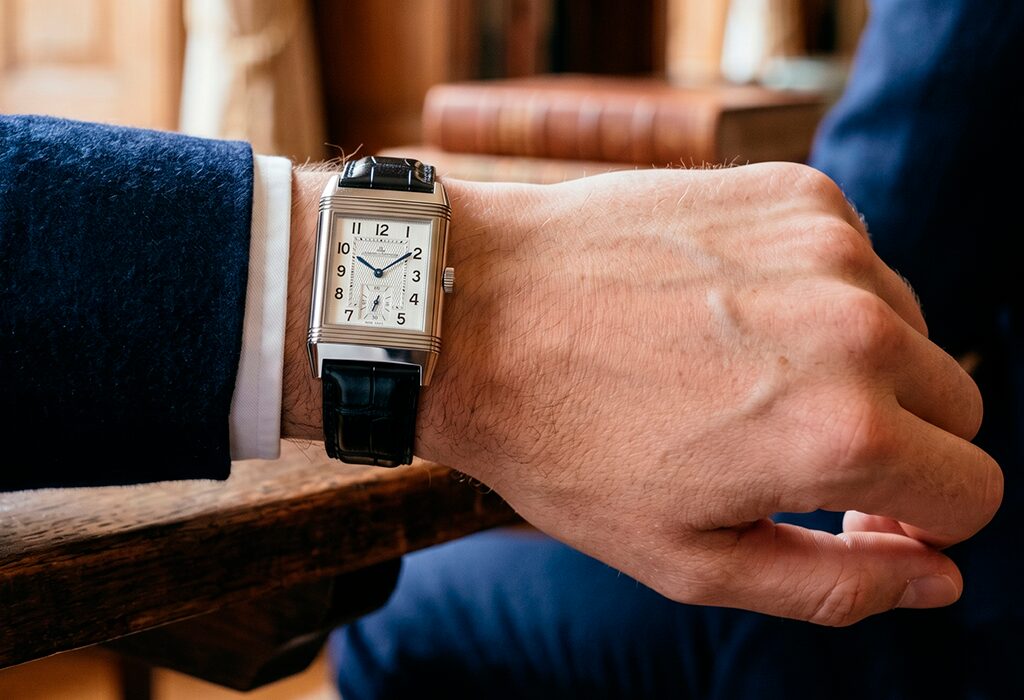
Walk into a room with a diamond-set gold watch the size of a hockey puck and people notice. Walk into the same room with a 36mm time-only piece on a calfskin strap and the only people who notice are the ones you probably want to impress anyway. That, in one sentence, is the old money watch philosophy.
I’ve been writing and coaching on men’s style for over fifteen years. I studied bespoke tailoring at the Savile Row Academy in London. I’ve fit clients ranging from CEOs to guys trying to dress better for their kid’s graduation, and I’ve watched the watch game shift hard in the last five years.
The Rolex-as-trophy era is cooling. “Quiet luxury” is having its moment — and underneath that trendy phrase is something much older. It’s the way men with generational money have dressed for a hundred years. Understated. Considered. Personal.
This piece is about what actually qualifies as an old money watch, why the category matters now, and — more practically — which watches to actually buy at which budgets. I’ll name names. I’ll give price bands. I’ll tell you where I’d put my own money if I were starting over today, at 25, at 40, or at 60.
If you want the full picture of what that looks like head to toe, the old money aesthetic guide covers the whole system — but right now, we’re zeroing in on the wrist.
What “Old Money Watch” Actually Means

Let’s strip the phrase down. An old money watch has four traits, and all four matter:
- It is discreet. The case is modest in diameter — usually 36 to 40mm, rarely larger. The dial doesn’t announce the brand across your wrist. The metals are steel, yellow gold, or occasionally white gold or platinum. No two-tone. No diamond-set bezels. No carbon fiber.
- It is classic. The design has been around long enough that nobody can accuse it of chasing a trend. A Cartier Tank was designed in 1917. A Jaeger-LeCoultre Reverso was built in 1931 so polo players could flip the case over and protect the crystal during matches. These aren’t fashion watches. They’re fixtures.
- It is quiet about value. Somebody who knows watches sees what it is. Somebody who doesn’t sees a nice-looking watch. That’s the whole point. Old money doesn’t need the stranger at the next table to be impressed. Old money needs the banker, the lawyer, the father-in-law, and the headwaiter to register quality at a glance and move on.
- And it is mechanical or quartz with a reason, not battery-powered trend-chasing. Most of the canonical old money watches run a mechanical movement — something the wearer chose to wind or wear for years rather than replace. The Cartier Tank Must on quartz is a legitimate exception, and I’ll get to why.
Also read: what makes a watch a “dress watch”.
Now — a quick note, because this matters. “Old money style” isn’t actually about money. I’ve known guys from multi-generational wealth who wore a $200 Seiko for thirty years because their grandfather gave it to them.
And I’ve known guys with no family money who picked up the same watch philosophy because they watched one too many Rolex Daytonas get flipped on Instagram and decided they wanted no part of it. The style is an attitude. The price is incidental.
Why This Style Is Having Its Moment Now

A decade ago, the aspirational watch was loud. Big case. Big logo. Ideally something with a waitlist. Rolex sports watches went stratospheric on the gray market. Hublot and Richard Mille became shorthand for “I made it.” The whole category moved toward more, louder, bigger.
Then a few things happened at once.
The gray market got ugly. The same Submariner that retailed for $9,000 was reselling for $15,000, then $20,000, then cratering back down. Regular guys watched their “investment grade” watches lose value in real time, which made the whole chase start to feel a little foolish.
The premiere of Succession Season 4 in spring 2023 drove searches for “quiet luxury” up 373 percent Robb Report, and suddenly a cultural conversation picked up that had been quietly moving among actual collectors for years.
Here’s the part most style writers miss: the shift wasn’t just aesthetic. It was generational. A guy in his 40s who already has a career, a family, and a seat at the table he wanted doesn’t need a watch to do announcement work anymore. He’s past the “prove it” phase of life.
What he wants now is something he actually enjoys wearing — something that fits under a shirt cuff without snagging, doesn’t scream across the conference room, and doesn’t make him look like he’s trying too hard at the PTA meeting.
That’s the real old money watch audience. It’s not 21-year-old trust fund kids. It’s men in their 30s, 40s, and beyond who’ve realized that the watch they wanted at 25 isn’t the watch they want at 45.
The Core Principles — What to Look For

Before I give you specific picks, let me hand you the rules I use when I’m evaluating a watch for old money energy.
Case size: 36 to 40mm. This is the single biggest mistake guys make. The mid-2000s trend of 44mm+ cases — sitting on your wrist like a manhole cover — was a blip. The actual old money watches have almost always lived between 34mm and 40mm because that’s the proportion that reads as tailored rather than obnoxious. If you have a small or medium wrist (under 7.25″), stick to 36–38mm. If you’re larger, 39–40mm. Above 40, you’re leaving the category.
Dial: clean, minimal, not busy. Three hands. Maybe a date window, though many old money classics skip it entirely. Roman numerals, Arabic numerals, or simple applied indices — all fine. What you don’t want is a dial cluttered with subdials, chronograph pushers, tachymeter bezels, or “open heart” skeleton cutaways.
Strap: leather, not bracelet. A black or dark brown alligator or calfskin strap is the canonical move. Bracelets aren’t disqualifying, but they’re louder. When in doubt, strap.
What’s the best strap for your watch?
Movement: mechanical, if you can swing it. A mechanical movement — whether automatic or hand-wound — is part of what you’re buying. It’s a reason. A quartz exception exists (Tank Must, certain Cartier dress pieces, the occasional Grand Seiko), but in general, old money watches tick with an escapement inside.
Quartz vs mechanical watch movements – what’s the difference?
The brand stays quiet. The dial says “Cartier” or “Jaeger-LeCoultre” or “Patek Philippe” in modest type. It doesn’t shout. Compare that to a logo-heavy fashion watch where the brand name takes up a third of the dial — that’s the opposite of what we’re after.
The Canonical Old Money Watches
If you asked ten serious watch guys to list the watches that embody this category, nine of them would name most of the same pieces. These are the anchors of the whole conversation, and they’ve held those spots for decades.
Cartier Tank (in any form)
The Tank is the prototype. Louis Cartier designed it in 1917, reportedly after seeing Renault FT-17 tanks on the Western Front — the “brancards” (the flat vertical rails on the sides of the case) mirror the tank treads. Over a century later, it’s still the dress watch most men in the category would name first.
Jackie Kennedy wore one. Andy Warhol collected them and famously said he didn’t wind his because he didn’t actually wear it to tell time. Fred Astaire, JFK, Princess Diana — the list of wearers reads like a who’s-who of the 20th century.
Modern access point: the Tank Must, starting around $3,300 retail for a stainless steel model. Step up to the Tank Louis Cartier in 18k gold and you’re looking at $10,000–$13,000 new. Above that, you’re into the Tank Américaine, Française, and the revived Tank à Guichets jump watch, which retails around $52,000 in gold.
My take: if you’re buying your first Cartier, the Tank Must in steel on a leather strap is the move. It’s the purest expression of the design at the most accessible price.
Jaeger-LeCoultre Reverso
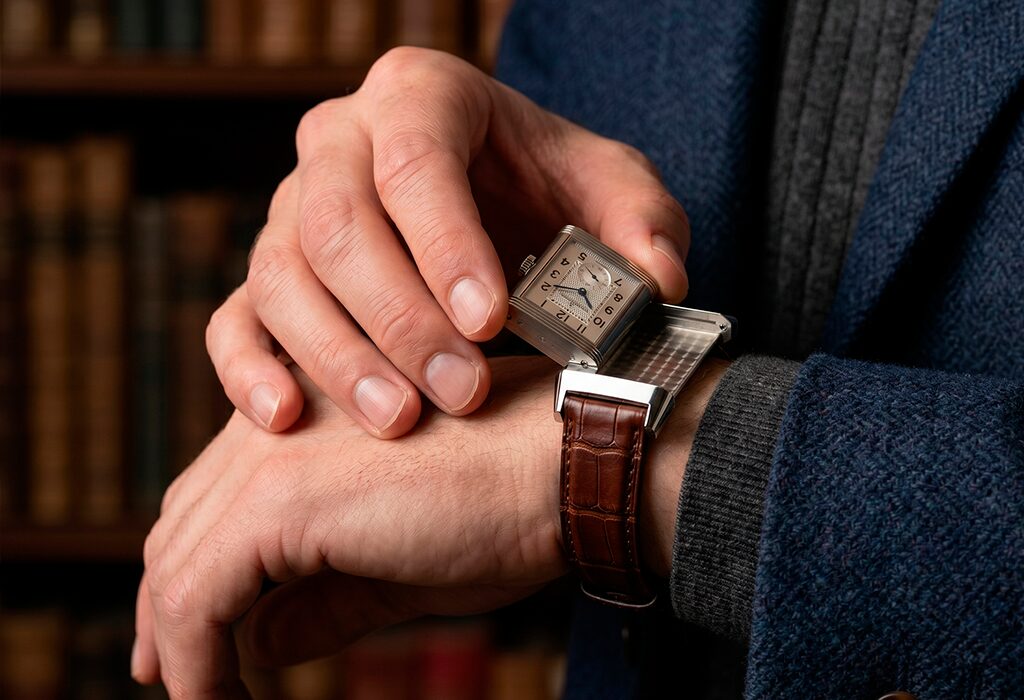
If the Tank is the dress watch that became an icon, the Reverso is the sport-dress hybrid with the best story. Built in 1931 so British cavalry officers playing polo in India could flip the case over and protect the crystal from mallet strikes.
The case literally slides and rotates. That reverse side was originally just a blank metal back — and for nearly a century, men have been engraving initials, family crests, and personal inscriptions on it, which is about as old money as a watch detail gets.
Price-wise, you’re starting around $9,000–$11,000 for a steel manual-wind Reverso Classic and climbing from there. It’s not an entry piece. But if you want a watch with a genuinely singular mechanical design — not a round three-hander pretending to be fancy — the Reverso is one of the few pieces that earns its price the minute you handle one.
Patek Philippe Calatrava

Patek Philippe occupies the top of this category, and the Calatrava is their most restrained and most copied design. Clean round case, simple dial, often thin as a dime, and the kind of finishing you have to look twice to appreciate. A new Calatrava in white gold or platinum starts in the mid-$20,000s and goes well up into six figures.
Realistically, most of you reading this aren’t buying a Calatrava this year. That’s fine. Know what it is, why it’s the reference point, and recognize that a lot of the watches I’m about to recommend are essentially translating Calatrava principles — clean, thin, round, quiet — into accessible price ranges.
A. Lange & Söhne Saxonia
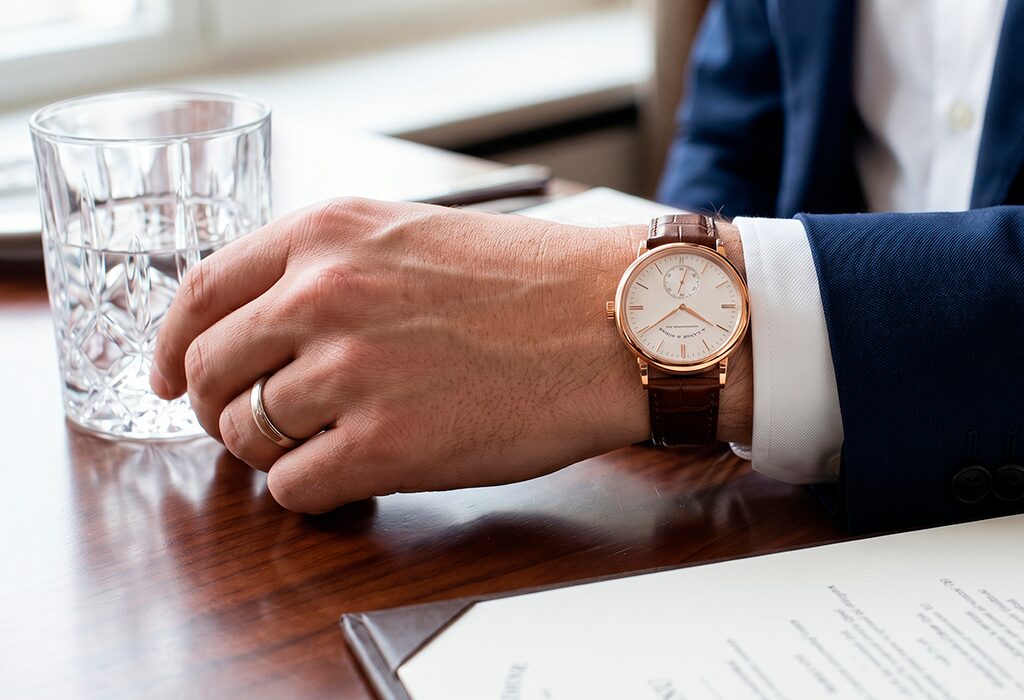
German restraint at its most extreme. A. Lange & Söhne was rebuilt after German reunification and has quietly — there’s that word again — become one of the two or three most respected watchmakers on earth.
The Saxonia is their dress watch: three hands, no date or with a discreet date, minimalist dial, absurdly good movement finishing on the back. Starts in the mid-$20,000s. Like the Patek, it’s the reference rather than the realistic buy for most men, but worth knowing.
Rolex — but which Rolex?

Here’s where I’m going to annoy some people. I’m not anti-Rolex. I wore some pieces for years and absolutely love them.
But the Submariner, the GMT-Master, the Daytona? These aren’t old money watches. They’re aspiration watches. They became that in the 1990s and 2000s, and at current retail and gray market prices, I can’t in good conscience tell a guy to buy one as a first serious watch. Look at Tudor. Same parent company, same manufacturing standards, half the price or less.
The one Rolex that does fit this category is the Oyster Perpetual — 36mm or 41mm, no date, no rotating bezel, clean dial, on a bracelet. Retail is around $6,100 for the 36mm, and unlike the sports models, you can usually walk into a boutique and buy one. That’s a real dress-casual old money piece.
The Picks — By Budget
Canonical history is useful. But you want to know what to actually buy. Here’s where I’d put real money, broken down by what you can spend.
Under $500: The Foundation Tier
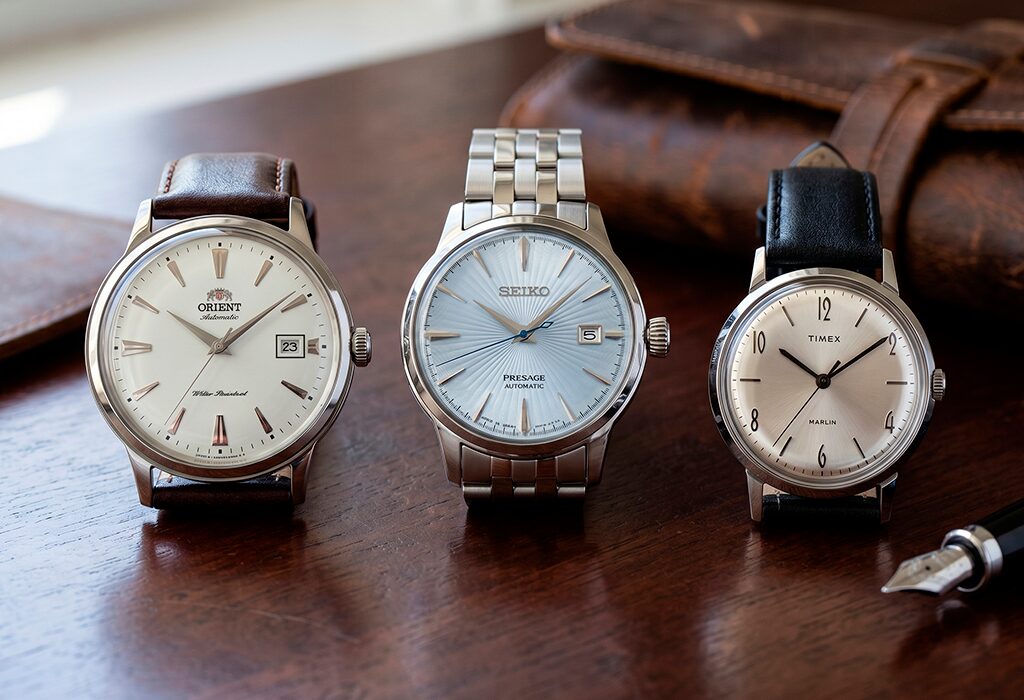
Yes, you can dress old money on under $500. The secret is that at this price the watch isn’t carrying the prestige — your clothes and bearing are. The watch just needs to stay out of the way and look right.
Timex Marlin Hand-Wound ($200–$250). A 34mm stainless dress watch with a hand-wound mechanical movement. Roman numerals, thin case, honestly charming. You wind it every morning. It’s a piece that would not look out of place on a college professor or a young lawyer who knows better than to wear a smartwatch to a wedding.
Seiko 5 Presage ($300–$450). Seiko’s workhorse dress line. The SRPG03 and its siblings come in at 40mm, automatic, with dial colors (cream, black, navy, champagne) that all work. Seiko’s in-house movements are reliable, finishing is better than the price suggests, and you’ll never worry about it.
Orient Bambino ($150–$250). The Bambino is a minor cult object in watch circles. Automatic, 40mm but wears smaller, dome crystal, applied numerals — a lot of the right old money visual cues for under $200 if you catch a sale.
My pick at this tier: Seiko 5 Presage on a leather strap. Swap out the bracelet the day it arrives, throw on a black alligator-grain strap from Barton Bands or Hirsch for another $30, and you’re wearing something that would not embarrass you at an interview.
For the rest of the budget wardrobe, the affordable old money brands guide covers the clothing side at the same price level.
$500 to $2,000: The Step-Up Tier

This is the range where a lot of men buy their “real” first watch. A lot of noise in this category. Some excellent signal.
Hamilton Jazzmaster Thinline ($650–$900). Swiss-made, 40mm, under 9mm thick, on a leather strap out of the box. Hamilton is owned by Swatch Group and uses reliable ETA-based movements. The Thinline is maybe the single best dress watch you can buy under $1,000 right now.
Tissot Le Locle Powermatic ($600–$800). Very similar pitch — Swiss automatic, clean dress dial, 39mm, solid movement with an 80-hour power reserve. Nothing showy, which is the whole point.
Longines Master Collection ($1,800–$2,500). Longines sits in a funny spot — not quite Omega, well above Tissot — and the Master Collection is where they’re strongest. 38.5mm or 40mm, automatic, dress-watch styling with just enough presence to carry through an evening event. If I had $2,000 and needed one watch for everything from a wedding to a boardroom, this is where I’d start.
Christopher Ward C5 Malvern or Bel Canto (varies, $800–$4,000+). British brand, direct-to-consumer, punches well above its weight. Some of their dress pieces look identifiably British and cost a fraction of the name-brand equivalents.
My pick at this tier: Hamilton Jazzmaster Thinline, black dial, 40mm. At around $850, it’s the cleanest expression of old money style in the sub-$1,000 bracket, full stop.
$2,000 to $6,000: The “Real Watch” Tier

Now we’re into the range where the canonical names start appearing.
Grand Seiko SBGW231 or equivalent ($3,000–$4,500). Hand-wound, 37mm, dress watch from Japan’s most under-appreciated luxury brand. The finishing on a Grand Seiko rivals Swiss watches at twice the price — the Zaratsu-polished hands and applied indices are genuinely spectacular in person. If you want to wear something that horology guys will notice and the general public won’t, this is the move.
Cartier Tank Must (steel, quartz or automatic) ($3,300–$4,250). I already made the case. At this price and with this history, there’s no better entry into the blue-chip end of the category.
Tudor Black Bay 36 or 1926 ($3,200–$3,900). Tudor is Rolex’s sister brand, uses very similar case construction, and sells at half to a third of the price. The Black Bay 36 is a sport-dress hybrid on a bracelet. The 1926 is a pure dress piece. Both age well.
Omega De Ville Prestige or Trésor ($3,500–$6,000). Omega’s sleeper dress line. Thinner than a Speedmaster, simpler than a Seamaster, and generally overlooked by guys chasing flashier Omegas — which is exactly why you should look at it. The De Ville Prestige channels the charm of mid-century Europe with modern Swiss precision, wearing particularly well with tailored clothing while staying understated enough for everyday wear.
My pick at this tier: Cartier Tank Must on a black strap. You’re buying the design. You’re buying the name you can say at a dinner and watch people nod. And you’re paying the absolute minimum for both.
$6,000 to $15,000: The Heirloom Tier
This is the territory where a watch starts to become a piece you might actually hand down. Buy carefully.
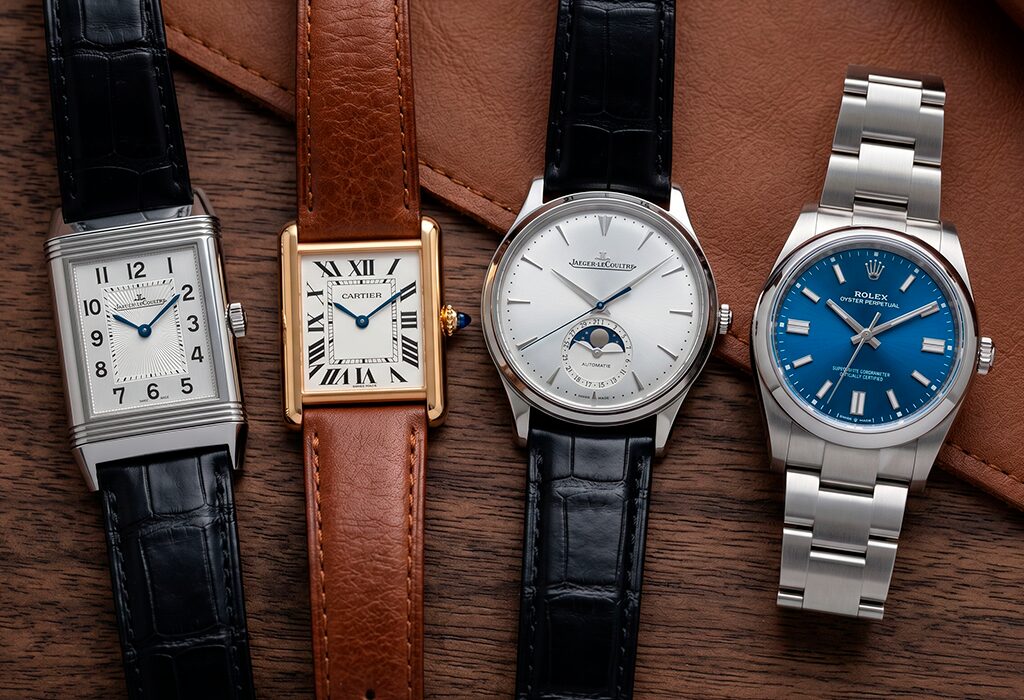
Rolex Oyster Perpetual 36 or 41 ($6,100–$6,400). Clean dial, no date, on a bracelet. Available at most Rolex dealers without the games and waiting lists associated with sports models. Will run for 50 years with two services. A serious option for a one-watch collection.
Jaeger-LeCoultre Master Ultra Thin ($8,000–$12,000). JLC’s other great dress line, in case the Reverso isn’t your shape. 39mm, mechanical, understated, and finished to a level that rivals watches twice the price.
Cartier Tank Louis Cartier in gold ($10,000–$13,000). If you’re going to spend five figures, the Louis Cartier is the original Tank in its truest form — 18k yellow or rose gold, hand-wound mechanical movement, deeply classical. Not a watch for everyone. A watch for a man who owns at least one good suit and actually wears it.
Jaeger-LeCoultre Reverso Classic Manual ($9,000–$11,000). Already discussed. One of the most distinctive watches you can own. The flip side is a blank canvas for engraving.
My pick at this tier: Jaeger-LeCoultre Reverso Classic Monoface. If you can afford it, there’s nothing else like it on the market, and the odds of you ever regretting the purchase are slim.
Above $15,000: The Final Form

If you’re shopping here, you probably don’t need my advice — but for completeness: Patek Philippe Calatrava, A. Lange & Söhne Saxonia, Vacheron Constantin Patrimony, and vintage Cartier (especially Tank Cintrée and Tank à Guichets) are the pieces that define the ceiling of the category. These are multi-generational purchases. Buy from reputable dealers. Get the papers. Service them with the manufacturer.
Five Mistakes That Kill the Old Money Look
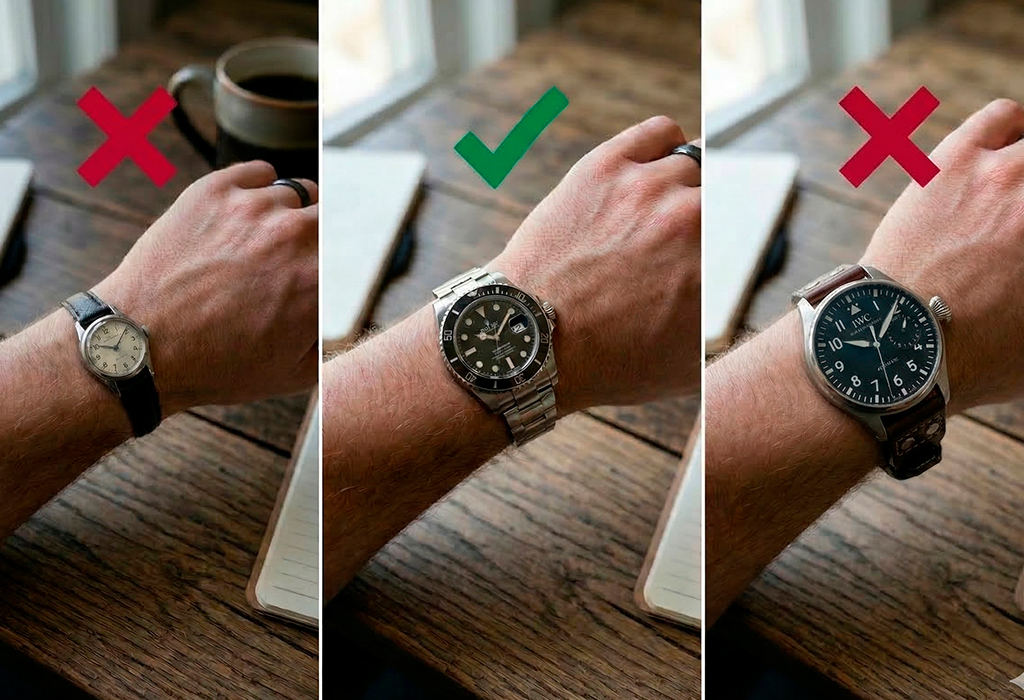
Having the right watch isn’t enough. How you wear it and what you pair it with decides whether it lands.
Oversizing. A 44mm diver on a lean wrist looks like a kid who borrowed his dad’s watch. Know your wrist size and stay in range. Men with wrists under 7″ should almost never wear anything above 40mm. Bigger is the mistake almost every guy under 35 makes once.
Pairing with the wrong strap. A gold watch on a rubber strap — no. A dress watch on a two-tone metal bracelet designed to “match” every color — no. A black alligator strap is the universal old money move. Brown for casual, black for formal. Keep the hardware color matched to your belt buckle.
Wearing it over your shirt cuff. I don’t know when this started and I don’t know why young guys keep doing it, but the watch goes under the cuff, with about a half inch of cuff showing beyond the case. It peeks. It doesn’t sit on top of the fabric.
Stacking. No bracelets. No beads. No rubber cause wristbands. The watch is the single statement on that wrist, and the other wrist — if it’s wearing anything at all — wears a wedding ring on the finger next to it and nothing else.
Treating it like a trophy. Here’s the thing. An old money watch is not a flex. It’s a fixture. The second you start bringing it up in conversation, turning your wrist for the table, or finding excuses to show it off, you’ve killed the effect. Wear it. Forget about it. Let other people notice, or not.
What I’d Actually Do If I Were Starting Today

Say you’re 35. Decent job. A couple of suits. A good pair of brown oxfords and a good pair of dark chukkas. Modest budget — maybe $1,000 to spend on a watch this year, with the idea of upgrading over time.
Here’s what I’d do.
I’d buy the Hamilton Jazzmaster Thinline, black dial, 40mm, on a black leather strap. Call it $850 landed. I’d wear it for three or four years. I’d learn which scenarios I actually reach for it in. I’d figure out whether I’m the guy who wants a round dress watch or whether I keep gravitating toward something with more personality, like a rectangular Reverso-style piece or a Tank.
Then, around year three or four, I’d sell the Hamilton (or hand it down, or keep it as a travel beater) and upgrade. Probably to a Cartier Tank Must if I’d figured out I was a rectangular guy. Or to a Grand Seiko SBGW if I wanted pure watchmaking for the money. Or, if the budget had grown, to a Reverso.
The principle: start in the right neighborhood, live with a watch long enough to know yourself, and upgrade when you know what you want — not when some YouTuber tells you a new release is “the one.”
If you want to go deeper on watch buying, I run the Watch Lover community over on Skool — we do watch reviews, buying advice, and straight talk about the market regularly, and it’s a good place to get your questions answered by guys who actually own the watches you’re curious about.
The One Thing to Remember

Old money style — in clothes, in watches, in anything else — is not really about money. It’s about not needing the world to know you have it. That attitude is harder to fake than any piece of gear, and it’s also the thing that makes the gear actually work.
A guy who carries himself like he has nothing to prove can wear a $300 Seiko and look like he’s worth ten million dollars. A guy who needs you to know he made it will wear a $40,000 watch and look exactly like what he is.
Pick the watch that fits the man you’re already becoming. Then stop thinking about it. Trust me — that’s the trick. That’s always been the trick.
Read next: The watch only lands if the shoes underneath it are right. Start with the old money shoes guide — it covers every foundational pair this aesthetic demands, from black cap-toe oxfords to suede loafers. Then work your way up to how a suit should actually fit. The watch works because the rest works. Don’t skip the foundation.