
Picture this: You’re invited to a fancy party, the first major event hosted by an up-and-comer on the social scene. You adjust your finery as you enter the massive dining room, which is absolutely heaped with flower arrangements. After sitting at a table bedecked with green place settings, you hear a little “Quack!” and realize the centerpiece is not a giant vase for even more flowers, but in fact a tub filled with water . . . and a raft of ducklings merrily paddling just inches away from your bread plate.
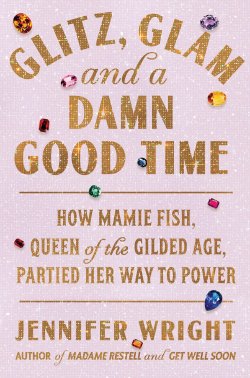
What on earth is this adorable, opulent social sorcery? Why, it’s a Mamie Fish party—just one of the society matron’s inventive and over-the-top events that historian (and excellent title-crafter) Jennifer Wright revisits with wit and gusto in her seventh book, Glitz, Glam, and a Damn Good Time: How Mamie Fish, Queen of the Gilded Age, Partied Her Way to Power.
Mamie was born Marion Graves Anthon in 1853 and in 1876 married her childhood friend Stuyvesant Fish, an executive with and eventual president of the Illinois Central Railroad. They were by all accounts a very loving couple. As Wright explains in her book: “He thought she was a hoot, and she loved that he was a constantly amused audience for her jokes and adventures.”
Mamie swept onto the scene in New York City (plus summers in Newport, Rhode Island) during a time of great change. Before her duckling-decorated debut, the social circuit was mainly presided over by the pretentious Britophile Ward McAllister and Manhattan socialite Caroline “Lina” Astor, a “refinement-obsessed team” who took themselves as seriously as their support for America’s lingering Puritan values. As one might imagine, their events were not particularly delightful experiences.
“I want history to be for people who want to gossip about what the Kardashians are doing.”
But late 1800s America, Wright says in a call with BookPage from the Los Angeles home she shares with her husband and daughter, was “a world that is learning to have fun for the first time, and it’s glorious.” She adds, “After victory in the Mexican-American War, there was an incredible push toward westward expansion that is only possible because suddenly we have railroads that allow you to go from New York to San Francisco. . . . And it’s miraculous to people that suddenly you can have a relative who lives in California and you live in New York, and instead of saying, ‘Well, goodbye. I hope to see you perhaps once again in this life,’ you can say ‘I’ll see you next month.’”
There were mass exoduses from farms into cities, where the sheer number of people meant that interactions could be chosen, versus limited to whoever your closest neighbor happened to be, says Wright. “Suddenly you could take a carriage and be at your neighbor’s place in 20 minutes and then go home.”
Such increased opportunities for connection were something to celebrate, and as Wright notes in Glitz, Glam, and a Damn Good Time, “It was clear that Mamie did not consider dining to be an event that required terrible solemnity. Instead, she wanted people to have fun at her dinners—and she wasn’t the only one.”
Read our starred review of ‘Glitz, Glam, and a Damn Good Time’ by Jennifer Wright.
While Mamie and Stuyvesant may not have been quite as wealthy as some vaunted New York families, her willingness to take risks was irresistible. And oh, did people want invites to Mamie’s carefully curated spectacles featuring everything from hay wagons to vaudeville performances to a “Satanic Flower Garden,” in which Fish filled her ballroom with flowers designed to resemble fire and guests received tiny pitchforks as party favors. Why, Wright says, guests might even be on the receiving end of teasing by the “very witty woman who would say things like, ‘Make yourself at home. Nobody wishes you were there more than I do.’ ”
Of course, Mamie also enjoyed the increased social clout and benefits to Stuyvesant’s business that resulted from her soirees. Wright says, “For all of the very legitimate criticisms, it was a time when wealthy women ironically seemed to have much more social power and much bigger public identities than they have now. With billionaires today, you never hear about their wives until they leave them and their wives start their own charitable organizations.”
Diving into Mamie Fish’s glittery world represented a move toward more lighthearted subject matter after Wright’s 2023 book, Madame Restell: The Life, Death, and Resurrection of Old New York’s Most Fabulous, Fearless, and Infamous Abortionist—not to mention 2017’s exceptional Get Well Soon: History’s Worst Plagues and the Heroes Who Fought Them. “I wanted to write a book about parties in America, how we went from being a very puritanical society to a very decadent society,” Wright says. “If there was one person who really changed things, who would that’ve been? And it was just Mamie Fish.”
While Wright enjoys parties, she doesn’t share Mamie’s stamina. “If I have one Christmas party a year at my house, I need the rest of the year to recover.” She adds, “I’m also fascinated by the sheer amount of partygoing that was happening during this period. I think so many of us still have this notion of this being an era where dusk would fall and everybody would go to bed at 9 o’clock. It was a revelation to me to find out nobody’s even starting until 10 or 11 at night, and they’re going until 4 in the morning.”
“It has never occurred to me that, when I throw my Christmas party, of course we have to send everyone home with an iPhone.”
Also surprising: “The number of party favors people were being given. They were incredible. People were going home with these beautiful gold picture frames to keep pictures of the evening in, and bundles of flowers, and brooches . . . . It has never occurred to me that, when I throw my Christmas party, of course we have to send everyone home with an iPhone.”

An avid fan of scholarly revelations of all stripes, Wright says her time at St. John’s College, a school where “you read all the great books of the Western canon, hopefully in their original language,” was instrumental in her pursuit of a history-based career. “Up until that point,” she reflects, “if you asked me if I was into history writing, I might’ve said, ‘No, I don’t want to write a biography of Winston Churchill.”
But as she broadened her readerly horizons, “It made me so much more fascinated by . . . how women were able to carve out a tiny little bit of power for themselves in incredibly patriarchal societies. And I think Mamie Fish is someone who embodies that.”
Postcollege, Wright worked in journalism, including as political editor-at-large for Harper’s Bazaar and a founding editor of the erstwhile 2010s website TheGloss, home of her popular Shelved Dolls series in which she wrote about interesting historical women. “That was not the first time that I was interested in writing about history,” she recalls, “but it was certainly the first time I realized there would be a real audience for this.”
She adds, “In school, it seems like you learn about Cleopatra and Amelia Earhart, and you learn that Amelia Earhart flew into the sun and we don’t know what happened to her, and that’s kind of it. There are so many other wonderful women that I wish we spent more time investigating!”
As for the inimitable Mamie Fish, while attending her parties is sadly no longer an option (she died in 1915), Glitz, Glam, and a Damn Good Time offers an extensively researched, highly entertaining window into her colorful life. Certainly, Wright says, “People in the past have the same foibles and eccentricities as people in the present,” and she offers clear-eyed assessments of Mamie’s less-savory moments. But overall, she writes, “Every 21st-century influencer owes Mamie a debt. Because she taught American women that even in an era when they might never wield the same power as their male counterparts, they could have as much fun as the men in their lives, and it would not be held against them.”
“I want people to understand that, at least to a certain degree, history is gossip.”
Wright is always thinking about how information is delivered and received. “If you grew up thinking of Jon Stewart as kind of the newsman of our generation, then you have grown up in an age where you think smart people are funny and should know how to communicate their points in a way that is lively and able to grab people’s attention.”
She adds, “I think that is very different from a lot of the biographies about Winston Churchill I grew up reading that almost feel like they are being deliberately obtuse . . . and scholarly in a way that is intended to alienate anyone who is not trying to at least imagine they are reading this in front of a roaring fire in their library filled with many leatherbound volumes. I don’t want history to just be for people who want to imagine themselves in that library. I want history to be for people who want to gossip about what the Kardashians are doing right now.”
Ultimately, she explains, “I want people to understand that, at least to a certain degree, history is gossip. This is just an interesting conversation about some very, very big personalities. I’m always so delighted when I find anyone who can gossip about historical figures as though they are our friends.”
Photos of Jennifer Wright by Zachary Lee (reclining) and Marie Buck (seated with flowers).