Products You May Like
A beige plastic telephone sits on a wooden table. The handset, attached by a coiled cord, rests in its cradle. The base has a clear dial with ten finger holes. The telephone is the most ordinary of household objects but, sitting silently on the table, it seems to portend something. It’s bound to ring.
Article continues after advertisement
Suddenly it does: a metallic brrrrring, distinctive and familiar. Nearby on the carpet, a smiling girl with pigtails and a ruffled-sleeve dress leaps to her feet, races over, and picks up the handset. She holds a stuffed toy duck to the receiver. Quack! Quack! Quack!
“That’s no way to answer the phone, Susie!” says an older boy, appearing in the frame. He has neatly brushed brown hair and wears a white shirt buttoned to the neck. He grabs the handset from Susie and demonstrates proper etiquette: “Hello. Matthews residence. This is Jimmy.” He listens and speaks again. “Just a minute, please.”
A grown-up arrives, smiling, also wearing his hair neatly parted, with a button-down shirt and khaki trousers. “Uncle Bill,” Jimmy tells him earnestly, “Captain Adams wants to talk to you.”
“Thanks, Jimmy,” says Bill. He takes the handset and holds it to his ear, stretching its coiled cord. “Hi, Captain, this is Bill,” he says. “No, we don’t usually have ducks answer the phone. That one belongs to Susie.” No time for jokes, though. Captain Adams needs Uncle Bill to come at once. These are the whitest white people you’ve ever seen, performing a fantasy of middle-class American life familiar from TV sitcoms that featured Wally and Beaver, Mike and Robbie and Chip.
Eighty-nine years into the telephone era, this wholesome scene opened a movie called We Learn About the Telephone, made in Technicolor on behalf of American Telephone and Telegraph (AT&T) by a well-known Hollywood producer, Jerry Fairbanks. The film was distributed as a public service to schools around the country and played for a captive audience of children in classrooms. In 1965, the United States had one telephone for every four people; the number had tripled in the two decades since World War II. It already seemed the universal appliance. Yet the phone company—there was basically just one—still thought its customers needed instruction.
Back to the show. Little Jimmy asks: “What did people do before the telephone was invented? How’d they get messages to each other in a hurry?”
The paradox of the telephone was its plainness, its tendency to hide in the background while changing everything around it.
Thus prompted, Uncle Bill draws a cartoon character called Mister Man, who begins to speak. (If his voice sounds familiar, it’s because AT&T hired the best: Mel Blanc, the onetime vaudevillian who voiced Bugs Bunny, Daffy Duck, and many other characters.) Mister Man guides us through a potted history of human communication, beginning with the “cave men” and the Egyptians. “The only way Mr. Caveman knew how to get a message from one place to another was to send a runner,” Bill explains. Greeks used runners, too, and Romans, until they discovered horses. Then came knights and cowboys. “That’s a Pony Express rider!” says Jimmy. “That’s right,” Bill replies. “But man wanted to send messages faster than a runner or a horse could travel.” A cartoon Indian sends smoke signals. Sailors communicate from ship to ship with flashing mirrors and blinking lights. Then the telegraph appears. “Man has always been able to solve his problems by inventing new things…The telegraph was, and still is, wonderful,” Uncle Bill explains. But the telegraph was not enough. “Mister Man wanted to send his voice over a distance, to carry on a real conversation,” Uncle Bill continues. “Then in 1876 a man named Alexander Graham Bell found a way. He invented the telephone.”
This was the story in a nutshell. It was not entirely true, but it served as the essential origin story of its sponsor, the greatest commercial enterprise the world had ever known. AT&T, known as the Bell System, held more capital and generated more income than most nation-states. Its scientific research arm, the Bell Telephone Laboratories, was unique in the world, eventually the source of eleven Nobel Prizes in physics and chemistry. Mister Man was right to place the telephone at the head of a line of increasingly powerful information technologies. Humanity had learned to send its voice—its many voices—disembodied, far and wide, eliminating walls, bridging towns and countryside, inviting conversation with strangers unseen.
No single genius accomplished that, and it didn’t happen all at once. No one had felt the absence of telephones before they existed, and at first hardly anyone understood what they might be good for. Much that seems obvious in retrospect had to be learned by people feeling their way toward the future.
*
AT&T had no trouble inserting its potted history into the curriculum of millions of primary-school children, and after the history lesson came some instruction in how to use the device. It was hardly necessary. Most people had a telephone at home that looked exactly like the one in the movie. The Western Electric model 500 was ubiquitous across the United States. It first appeared in 1949 and hardly changed as the years passed: a thermoplastic shell screwed to a metal base, a clear plastic finger wheel, and a handset with a mouthpiece and an ear-piece attached by a cord twisted in a stiff spiral. The phone was heavy, about four pounds, but a person could pick it up with two fingers under the cradle while nestling the handset between shoulder and neck. That was actually comfortable, when people got used to it. If they opened the base by turning it over and removing some screws, they could see a pair of brass bells, with a small clapper between them, and a few colored wires. Ordinary as it was, it spoke of modernity, with its sculpted plastic. No other household gadget had anything like that dial.
When the telephone rang, it did not chirp or chime or play a tune; it just rang. The sound was the same throughout the United States and much of the world: an electromechanical bell ringing for two seconds at a time, with a four-second pause in between. (Older people will never forget that sound, and it can still be heard in old movies and television shows. Nostalgists have been known to install “Old Telephone” as the ringtone for their smartphone.)
At first the telephones were all black; then AT&T customers could choose among ivory, gray, beige, and a few more colors. The phones remained simple, undramatic, and unadorned. Yet they ripped invisible tunnels through space—like wormholes, only real.
More than eight in ten homes in the United States had a Bell System telephone—owned by the company, merely on loan to the customer. No other company was allowed to manufacture telephones, and everyone’s telephones were the same. People thought that was a normal state of affairs: it had always been like that and it always would be.
The phone was a simple object with not so much as an on-off switch, but the Bell System never stopped educating the public in its proper use. Uncle Bill and Mister Man offered children some dos and don’ts. Don’t shout into the telephone. Do use your normal speaking voice. Speak directly into the mouthpiece. It’s important to speak clearly. Don’t let the phone ring too long before answering—“but if you’re the person making the call, you should let the phone ring eight to ten times.”
There is even a lesson in dialing, using the finger wheel to choose the desired telephone number: “When you dial, you should make sure you bring your finger all the way around to the finger stop. Then for each number let the dial go all the way back by itself. Each number. All the way. Then let go. See?”
Everyone knew how to dial the phone. It was no harder than, for example, learning to tie one’s shoelaces. But the Bell System left little to chance. It was relentless. Far more than outsiders knew, it had made itself the author of its own story. The company subsidized books by supposedly independent authors; it sponsored articles, speeches, and pamphlets; and it arranged lectures for business schools and law schools on such matters as public-utility regulation. The slick Jerry Fairbanks movie was one of many instructional films and cartoons. Schoolteachers received a twenty-four-page booklet, also titled We Learn About the Telephone, full of helpful material. A section called “The Telephone Brings Everybody Together” listed, with illustrations, some of the people you can call: the repairman, storekeepers, the fireman, the policeman, and the doctor.
Half a century earlier, the Bell System advertised itself as “The Sign Board of Civilization.” Its full name was the American Telephone and Telegraph Company and Associated Companies. Its logo was a great bell, deliberately resembling the Liberty Bell, bearing the words “Local and Long Distance Telephone.” Advertisements in magazines and newspapers said:
Wherever you see this sign, it stands for civilization. It is the sign of one of the most powerful influences for broadening human intelligence…
Bell telephone service has brought the entire country up to the same instant of progress.
It has unified the Nation…
You can see this march of progress right in your own neighborhood. Every little while some neighbor has a Bell telephone put in. If you have one, every new subscriber enlarges the scope of your personal contact.
The copywriters could not resist adding a threat: “If you have not, every new telephone makes you the more isolated.” This was the essence of the company’s business model: every new subscriber adds value for every other.
*
Children in 1965 were growing up in a world transformed, normal though it seemed to them. Everyone had from birth at least a vague awareness of an invisible web of voices, bringing the unreachable within reach. It was already hard to remember the earlier world, where the loudest shout would barely carry to the next room. The paradox of the telephone was its plainness, its tendency to hide in the background while changing everything around it. When the telephone was still new, Marcel Proust in France saw it already growing old and familiar, “a supernatural instrument before whose miracles we used to stand amazed, and which we now employ without giving it a thought, to summon our tailor or order an ice cream.”
By 1965, teaching children how to dial the telephone was unnecessary. But in the next century the knowledge would be lost again, and YouTube would feature videos of youngsters baffled by ancient rotary telephones. “This is like phones that my mom used as a kid?” “How does this even work?” “It looks like a phone, it has a telephone and it has numbers.”
The telephone had other inventors besides Alexander Graham Bell, an amateur who did not know much about electricity. Neither the idea nor the device came to any one person in a visionary flash. Even with the new invention in hand, the most expert entrepreneurs and government officials had trouble seeing what it was for. The president of the Western Union Telegraph Company dismissed it. “What use could this company make of an electrical toy?” he said, thus condemning his business to stagnation and decline. We might say the telephone was invented by the people who used it. They made it what it is, creating new habits and a new language as they went. Or we might say the telephone invented itself: it was an inevitability; it had to come, and when it came it could not be stopped, an invasive species dragging its wires through cracks in the familiar world.
We have learned by now that gadgets can have a life of their own and an influence we cannot evade. Using a technology changes a person. Using a technology changes a culture.
First the telephone was a curiosity, then a luxury item, and then an ordinary necessity. In 1965, people made something like 100 billion telephone calls a year, long and short, local and long-distance; that number has increased a thousand-fold, but even then the telephone had helped humanity coalesce into a wired collective—trading news and rumors, mingling public intelligence with private gossip. The telephone company could help its customers learn about the telephone, but it could hardly explain the changes that four-pound box of plastic and metal had already worked in the fabric of modern life and in the psyches of the people who put their ears and mouths to it.
The telephone enabled the expansion of cities and the creation of suburbs by freeing workspaces and living spaces from the requirement of proximity. It encouraged nationhood by softening the differences between regions. “The service of the telephone in the consolidation of our Union was an epoch-making service,” wrote Michael Pupin at Columbia University in 1930. “No other country availed itself of the consolidating power of the telephone as much as this country did. No other country needed it so much.”
The telephone brought a generation of women into the workforce for the first time. The job of telephone operator—a profession like none that had ever existed—required intelligence, physical dexterity, mental focus, and genial patience, and it was decided by universal consent that the job belonged to women.
The telephone marked the beginning of a rebalancing of the senses in human culture: it re-centered sound and hearing, which had been deprecated during the long rise of text as the mode of communication most reliable, most stable, most respected. “As there was an Enlightenment, so too was there an ‘Ensoniment,’” argues Jonathan Sterne, a scholar of media and culture. That rebalancing continues.
Was it a connector, a unifier? Or a disrupter of precious solitude? Sociologists argued about what the telephone had done to shape the evolution of modern culture, to alter social habits and relationships. They even argued about whether it could have done anything—whether any technology in itself could dictate human affairs. Some doubted that. People made the telephone, some said; people decided how to use it, so let’s not fall into the trap of granting it agency. The violin doesn’t play the violinist. “No single invention—and no group of them taken together in isolation from nontechnological elements—ever changed the direction in which a society was going,” George Daniels wrote in 1970. “Habits seem to grow out of other habits far more directly than they do out of gadgets.”
But we have learned by now that gadgets can have a life of their own and an influence we cannot evade. Using a technology changes a person. Using a technology changes a culture.
After the telegraph laid the groundwork, establishing the possibility of nearly instantaneous long-distance communication across networks of wires, the telephone became the first piece of what later coalesced into the phenomenon called mass media—the incessant, ubiquitous exchange of information conducted point-to-point via telephones and telefaxes, broadcast via radio and television, and stored and shared as phonographs, photographs, and cinema. Media, distinct from mechanism, required theorists, such as Marshall McLuhan, who asserted its primacy with his clever slogan “The medium is the message.”
The telephone became a cultural artifact and a generator of other artifacts. The ability to speak across space transformed business organizations, military tactics, the rules of etiquette, the rituals of romance. Each profession evolved in its own way, from news gathering to sex work. (“The prostitute was a specialist, and the call-girl is not,” McLuhan declared coolly in 1965.) Other powerful technologies arose alongside the telephone and followed after, but the telephone was special. It conferred upon every individual a power to communicate that was essential in the development of modern life.
It left a trail of appurtenances: the party line, the busy signal, the dial tone, the collect call, the wiretap, the answering machine, the telephone book, the telephone booth. Telephone booths, boxes, kiosks, and cabins, varying from country to country, appeared on public sidewalks; these structures had no other purpose but to house telephones and shelter their users. Anyone old enough to remember telephone booths retains a mental image of a characteristic design—in Britain, a cast-iron box, usually painted red, with a rounded roof, a single door, two mullioned windows, and a classical pediment bearing the royal crest. Some urban children imagined that pay phones whisked their coins through underground pipes to a central repository. Besides allowing people to make calls in semi-privacy, telephone booths spun off oddities of their own. In the mid-twentieth century, pranksters competed to see how many people could squeeze into a telephone booth at once. The comic-book hero Superman used telephone booths to shed his civilian garb; this became so familiar a trope that it inspired a sight gag in the 1978 movie Superman in which Clark Kent dashed for a phone booth and was dismayed to find its modern replacement, a pay phone mounted on a post. Special heroes required special phones: Dick Tracy a wrist radio, Batman his Bat Phone, and Maxwell Smart his shoe phone. Star Trek’s spacefarers had flip phones (“communicators”) twenty years before such things appeared in real life. Meanwhile, the science-fiction paladin Doctor Who traveled through space and time in a vehicle that took the form of the British telephone box. It was bigger on the inside than it appeared from the outside. All phone booths were.
And then, in an eye blink, the phone booths were left to rust, the phone books stopped arriving at the door, and the busy signal and the party line and all the rest became memories. The telephone turned into something else entirely.
______________________________
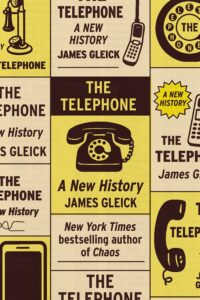
From The Telephone: A New History by James Gleick. Copyright © 2026. Published by Farrar, Straus and Giroux, a division of Macmillan.