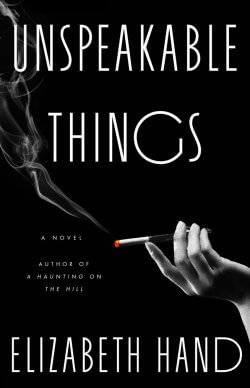
Coming of age in 1920s Britain, Olivia yearns for freedom. Her father, a closeted actor, and his longtime lover have established a life of quiet respectability in the country, their security dependent on conformity and discretion. When Olivia meets wild, working-class Tamsin, she can no longer contain her desire for a more liberated life—but in grand, gothic tradition, their love tilts into obsession, and the possibility for violence lurks within both women.
Unlike many gothic tales, Unspeakable Things isn’t set in the 19th century, but amid the “Bright Young Things” and social change of the 1920s. Could you share why you were attracted to this period?
I fell in love with that whole scene and its flamboyant cast of characters when I was in high school. The 1970s were heavily influenced by 1920s fashion and culture—movies like Cabaret, The Great Gatsby, The Boy Friend; the Broadway revival of No, No Nanette; Stephen Sondheim’s Follies; Barbara Hulanicki’s London fashion powerhouse Biba. I was a theater kid, enamored with Noel Coward—“Destiny’s Tot,” as he was nicknamed, a triple threat as playwright, actor and composer. I read Coward’s plays and memoirs and every biography I could get my hands on, and from there cast a wide net to read everything by and about his social and creative circle, which extended from Gertrude Lawrence to Laurence Olivier to Marlene Dietrich and far beyond.
At the same time, I discovered Evelyn Waugh, starting with Brideshead Revisited and Vile Bodies, and also Christopher Isherwood’s Christopher and His Kind (because Cabaret), which recounts his sexual explorations with W.H. Auden in Weimar Berlin starting around 1929. Martin Green’s Children of the Sun: A Narrative of “Decadence” in England after 1918 (1976) was a great introduction to the Brideshead generation. The 1970s, like the 1920s, was an era of great sexual freedom for people who were LGBTQ+. As someone who identified as bisexual, this was incredibly liberating. So all these people and settings have been cooking in my brain for 50 years.
“I’m playing the long game. If people years from now still read my work, great. If not, I won’t be around to be bothered by it.”
Olivia is living in a promising and dangerous time to be queer, a time in which a culture of queerness was both increasingly visible and targeted. Did you have to do much historical research about this aspect of the ’20s?
Well, as noted, I was already aware of a lot of this history and material, and had (have) a substantial library relating to it. But I did a deeper dive into primary sources, which is always the most exciting part of writing for me. I reread Serious Pleasures, Philip Hoare’s wonderful biography of the aesthete and influencer Stephen Tennant, who was the great World War I poet Siegfried Sassoon’s lover. Tennant inspired Tippy in my novel. I also tracked down Marie Jacqueline Lancaster’s hard-to-find bio of poet and writer Brian Howard, the inspiration for Anthony Blanche in Brideshead Revisited.
But my big discovery was the extraordinary Lord Berners, an English aristocrat who lived openly in his stately home with his younger lover, known as The Mad Boy. An accomplished composer, painter and writer, Lord Berners hobnobbed with Stravinsky, Dali, Diaghilev and the Mitfords—Nancy Mitford memorably cast him as Lord Merlin in The Pursuit of Love and Love in a Cold Climate. Lord Berners gave me a model for the relationship between Olivia’s father and his partner, Martin, though Lord Berners was a far more lovable person. I highly recommend Sofka Zinovieff’s The Mad Boy, Lord Berners, My Grandmother and Me, which reads like a novel—you could not make this story up.
Can you share some of the literary and or cultural influences that you tapped into for this story?
There’s a vast amount of history centered on 1920s England. We envision it in black-and-white images, but it was such a marvelously colorful, over-the-top era. So many writers and artists whose influence continues to this day—Virginia Woolf, Vita Sackville-West, F. Scott Fitzgerald (American, but still), Waugh, T.S. Eliot, Agatha Christie, Dorothy Sayers, the Sitwells, etc. etc. etc. WWI devastated the U.K., resulting in what Gertrude Stein called the Lost Generation.
But the war also created an opening for women to join the workforce, and the loss of an entire generation of young men contributed to a huge shift in gender and sexual dynamics. The generation that came up immediately afterward was ready to party, in our own parlance. They’d seen their older brothers, fathers, lovers and husbands killed, disabled, wracked by shell shock—what we call PTSD. Women had gotten a taste of freedoms they hadn’t experienced before. Among the upper and upper-middle classes, a small hard-partying cohort emerged, dubbed the Bright Young Things or Bright Young People by the press. Their antics were eagerly reported on (this is all hilariously captured in Waugh’s Vile Bodies), photos and gossip and hand-wringing by their parents and politicians.
Today, the BYT would be influencers, with a similar shelf life.
And do you think about current literary trends in your writing?
I don’t think about current literary trends, ever. If I’m fortunate enough to have a novel that taps into a fad, good. But that hardly ever happens. I’m playing the long game. If people years from now still read my work, great. If not, I won’t be around to be bothered by it.
The neogothic is having a moment, with books like Mexican Gothic (2020), The Hacienda (2022) and The Water House (2026). What do you think is happening in our contemporary culture and politics that is driving this resurgent interest?
I honestly don’t think the gothic ever goes out of style. We can trace its origins back to our earliest literature—Gilgamesh, Beowulf, The Bacchae, Medea. People love dark stories, that frisson of thinking about what lies beyond the circle of firelight, the intoxicating pleasures and dangers of forbidden sexual desire. Wondering what goes on inside that cave/fortress/castle/vast country house where there’s always a light burning in the middle of the night. We may not dare to look for ourselves, so writers and artists do it for us.
The short opening chapter closes with an evocative passage that foreshadows danger. “I’d been in London on Armistice Day with my father and Martin, seen the crowds in the street, people shrieking as though they were animals set free from the zoo. . . . I’d been too young to understand the kissing and groping that surrounded us. But now, I’d recently turned eighteen. I wanted to be a wild animal too. I wanted to kiss someone, anyone. I wanted to bite someone, to draw blood. To run and never stop.” Could you talk about why you opened with these particular images and comparisons?
Well, I was deliberately riffing on that wild sense of freedom and desire and fear that I imagined people felt after the armistice. People really did behave like that on Armistice Day. What would it have been like to be a child who witnessed, not understanding what was going on, but perhaps feeling the first frisson of sexual desire? And I also wanted to give a sense of Olivia’s own inherent wildness, something she can’t name or express until she meets the far more violently inclined Tamsin.
“People love dark stories, that frisson of thinking about what lies beyond the circle of firelight.”
You do such an excellent job painting the barely concealed danger and contradictions in Olivia’s life. Though her father, Peter Madden, is a gay actor who lives with his longtime lover and dresser, he explicitly forbids her from dressing and acting the way she wants. Why did this specific dynamic in gay life feel important for you to explore?
I’m a parent, and I think that parents often want to protect their children from what they perceive, rightly or not, as threats to them, especially once they reach adolescence and the parents recall their own risk-taking. In Peter’s case, though, it’s more a matter of neglect. He’s a narcissist (not uncommon for an actor), and also he’s paid a price for his own relationship with the far more loving and kindhearted Martin.
And Peter’s essentially a coward. He’s brave enough to live openly with Martin, albeit in a semiexile in remote Cornwall. But he’s too enmeshed with and dependent upon the status quo to risk anything more. Martin wants to move to Paris. Peter’s afraid to.
Many gay men and women lived in relative freedom in Europe—France; Weimar Berlin, as recorded by Isherwood; Capri. But this was still a time when gay men and women could be imprisoned. The writer Radclyffe Hall (born Marguerite Antonia Radclyffe-Hall) was prosecuted for obscenity for her lesbian novel The Well of Loneliness. The term “homosexual” was known but not in common usage. Gay men and women were considered inverts, with numerous slang terms for men but very few for gay women. So it was risky for Peter and Martin to live together at Kerrith—I’ll give Peter points for that.
Your last novel was A Haunting on the Hill, the first authorized continuation of Shirley Jackson’s iconic The Haunting of Hill House. Are there other authors that are meaningful to you or influential when it comes to your work?
So many! Probably too many to mention. Angela Carter, James Salter, John Crowley, to name a few. Daphne du Maurier, who had such a fascinating life—cross-dressing as her alter ego, Eric Avon, until she hit puberty; love affairs with women while married to a man (as a girl, she also had a relationship with a female schoolteacher). She reminds me in some ways of Alice Sheldon, the brilliant, tormented writer whose nom-de-plume was James M. Tiptree, Jr. Who might these women have been if they’d lived at a time when it was easier to identify as gay or trans or bisexual or whatever they chose? Whatever challenges they faced came out in their work, sometimes coded.
I’m very drawn to landscape, which is usually where I start with a novel or story. I first visited West Penwith 30-odd years ago, unaware that it was not too far from where du Maurier lived and worked and set some of her most famous novels. I became obsessed with that part of Cornwall—it reminds me a lot of where I live in Maine—and have returned to it many times over the years, in real life and in fiction.
Can you talk about the relationship between reading and writing for you?
The two are inextricable, as I think they are for most professional writers. I read, I write fiction, I teach creative writing. For almost 40 years I wrote book reviews—probably a thousand over the decades—for a score of magazines and newspapers and online venues, but nearly all of the book reviews have disappeared. I was heartbroken and enraged when Bezos killed The Washington Post’s Book World section early this year. I’m never not thinking about reading and writing.
Your award-winning body of work has very successfully straddled multiple genres, from fantasy and science fiction to noir. Is there one genre that comes more easily to you to write?
They’re all hard! I never think about genre, just about how best to frame and tell the story I want to tell. I skew dark when I write, so most everything I do tends to be dark, in varying shades depending on the story.
What types of books do you turn to most often for pure pleasure? Has that changed over time?
I read less fiction than I used to; this has been going on for decades. Once I started reviewing fiction (and teaching how to write it), I was always thinking critically about books—how to make them better, tighter, how to bring the author’s story to the fore so that a reader would want to continue turning the pages. At some point, reading fiction became work. Obviously I do still read novels and short fiction, but for pleasure I often turn to biographies or nonfiction. I love studies of obscure folklore; books about Elizabethan England, especially theater; rock ’n’ roll bios or memoirs, the trashier the better. I do try to keep up with new novels. I just finished Daniel Mason’s Country People, very funny and set in Vermont, which I know well, and am also reading Alison Bechdel’s Spent, ditto on both counts (Vermont and very funny).
What would be on your recommended reading list for those who want to further explore early 20th-century queer history?
All the books and writers I mentioned earlier, and also Mark Amory’s Lord Berners: The Last Eccentric, D.J. Taylor’s Bright Young People: The Lost Generation of London’s Jazz Age, Margaret Forster’s Daphne du Maurier: The Secret Life of the Renowned Storyteller and Jane Dunn’s Daphne du Maurier and Her Sisters (both of du Maurier’s sisters also had lesbian relationships). Compton Mackenzie wrote two amusing novels about the lesbian colony on Capri in the 1920s, Extraordinary Women and Vestal Fire.
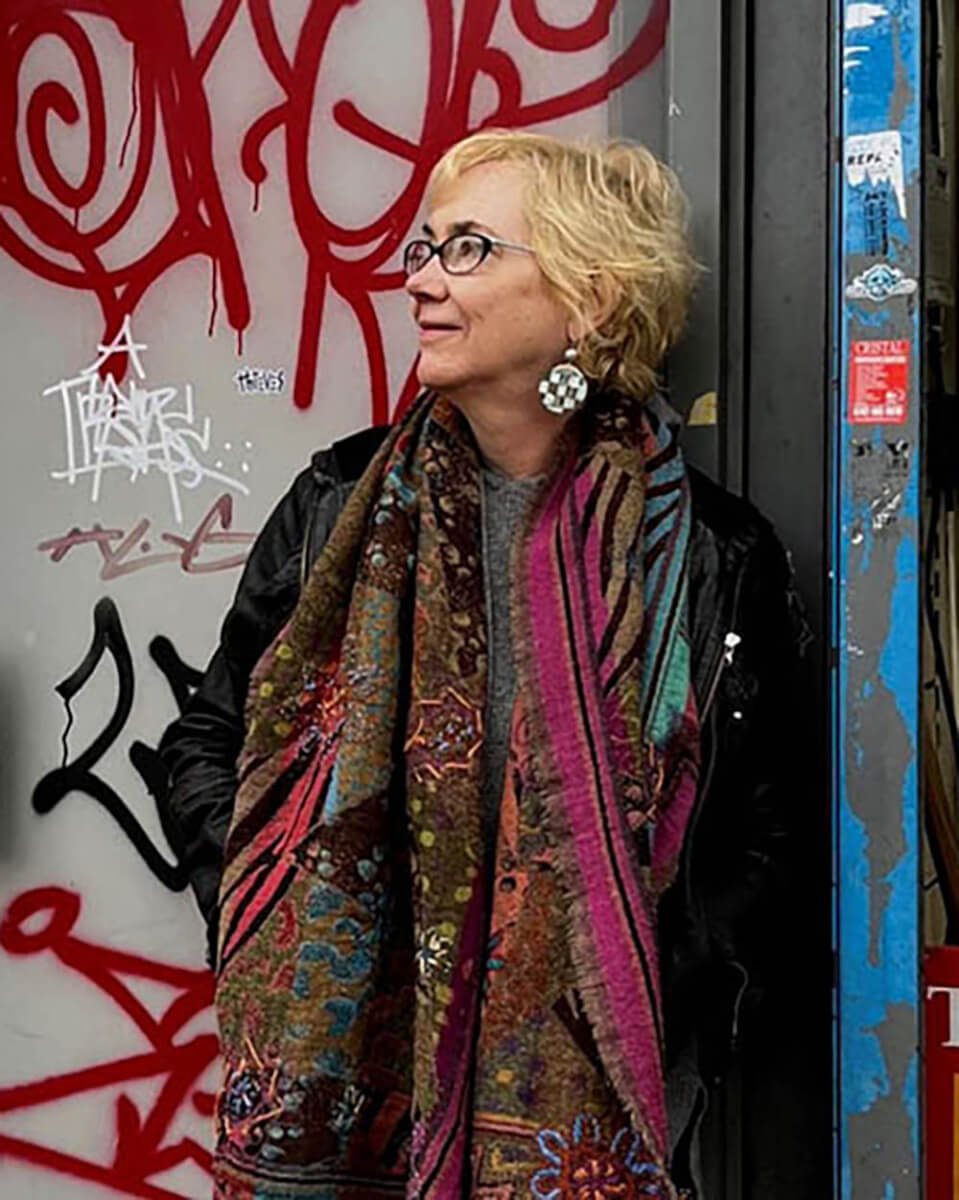
Photo of Elizabeth Hand by Judith Clute.