What jacket do you actually need?
Most men answer that question in the store, staring at a rack of 40 coats that all look about the same. That’s how you end up with three black puffers and nothing to wear over a suit.

There are dozens of types of jackets for men, but you only need to answer 2 questions to pick the right one:
1. How cold is it?
2. What are you wearing it over, and where are you going?
Need something to throw over a suit in a Chicago January? Think formal and warm: an overcoat. Live in LA and want something for the beach at sunset? Lightweight and casual: a denim jacket.
The chart below covers 20 of the most common and classic jackets and coats a man will run into. It’s organized so the lightest, most casual jackets sit in the top left. Move down and to the right and they get warmer and more formal. Below the chart I break down every one of the 20, then give you a comparison table, the jackets I’d buy first, and how each one should fit.

A larger, poster size version is available to any man (or lady) who has purchased any of my premium courses or products.
Just email me and I’ll get it to you!
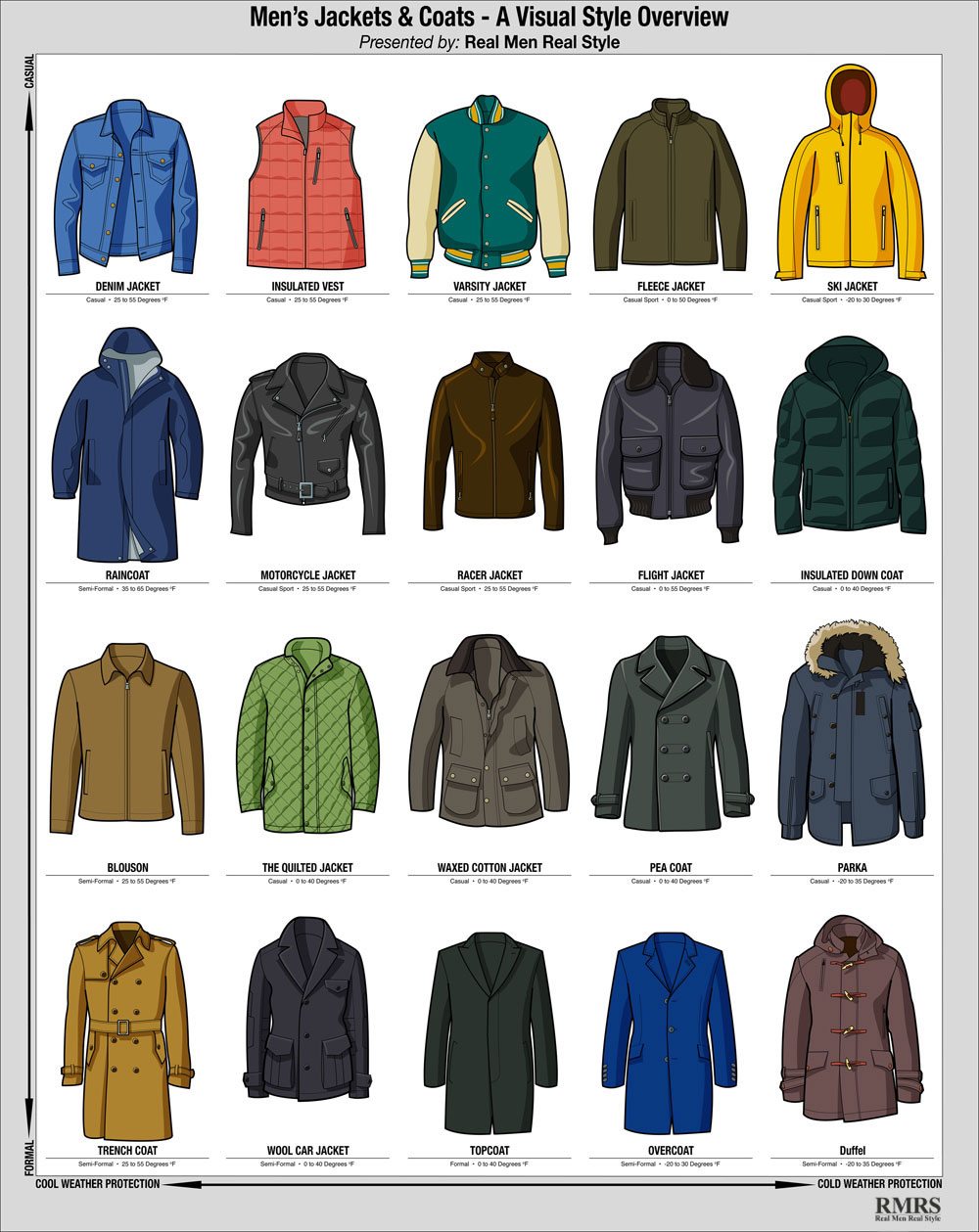
The 20 Types of Jackets and Coats Every Man Should Know
Here’s every jacket on the chart, row by row. For each one: what it is, when to wear it, and the one thing to get right when you buy it.
Row 1 — Lightweight Casual Jackets
1. Denim Jacket. The trucker-style jean jacket is the most casual jacket on the chart and one of the most useful. Wear it over a tee, an Oxford shirt, or a hoodie in spring and fall. Get it short (it should end at your belt) and fitted through the body. Avoid wearing it with jeans of the exact same wash. Contrast the shades instead. If you’re torn between this and leather, read my leather jacket vs. jean jacket breakdown.

2. Insulated Vest. A quilted or down vest keeps your core warm and leaves your arms free. That’s why you see them on guys loading a truck or walking a dog on a cold morning. Layer it over a flannel or a quarter-zip sweater. Keep it trim, because a boxy vest makes your torso look wider than it is.

3. Varsity Jacket. Wool body, leather sleeves, striped rib-knit collar and cuffs. It’s pure Americana and it’s casual — tees, sweatshirts, jeans, sneakers. Skip the oversized logos and chenille patches if you’re past college. A plain varsity in navy or forest green looks grown-up.

4. Fleece Jacket. Light, warm, dries fast. Fleece is a hiking and weekend piece first, and it also works as a mid-layer under a shell or parka. It’s not a city coat on its own. Wear it to the trailhead, not to dinner.

5. Ski Jacket. A waterproof, insulated shell built for the slopes, with a hood, a powder skirt and lots of pockets. It’s the warmest jacket in the top row because it’s built for snow, wind and hours outside. Off the mountain it reads as sportswear, so keep a separate coat for town.

Row 2 — Rain, Leather and Sport Jackets
6. Raincoat. A longer, waterproof coat that covers your sport coat or suit jacket and keeps it dry. Pick a clean, unbranded one in navy, olive or black and it works over business clothes. Make sure it’s long enough to cover whatever jacket you wear under it.

7. Motorcycle Jacket. The asymmetrical-zip, belted leather jacket. It’s the most rebellious jacket on the chart. Wear it with a white tee, dark denim and boots and let the jacket do the talking. Fit is everything here: it should be snug through the shoulders and chest and end at the belt. My guide to leather jackets covers hides and fit in detail.

8. Racer Jacket. The café racer is the cleaner cousin of the motorcycle jacket. It has a center zip, a small band collar and no lapels or belt. Because it’s so minimal it dresses up easily. Wear it over a button-down or a knit polo with chinos.

9. Flight Jacket. Born in the cockpit: leather or nylon, with a ribbed waistband and cuffs, and often a fur or shearling collar. As a Marine who once trained to fly, I’m biased, but there’s a reason this design has stuck around for 80+ years. Wear it with jeans and boots. For the nylon version, see my bomber jacket guide.

10. Insulated Down Coat. The puffer. Nothing on the chart gives you more warmth for less weight. A hip-length puffer in a dark, matte color is the most practical winter coat for most guys. The mistake is wearing it over a suit, because it crushes the jacket and looks like you gave up. Keep it for casual days.

Row 3 — Rugged, Heritage and Cold-Weather Coats
11. Blouson. A short jacket gathered at the waist so the body “blouses” slightly over the band. The Harrington is the best-known version. It’s light and smart casual. Wear it over a polo or an Oxford with chinos. It’s also a great jacket for shorter men because it ends right at the waist and keeps your legs looking long.

12. Quilted Jacket. Diamond-stitched, lightly padded and usually finished with corduroy collar trim. It’s the English countryside jacket. Thin enough to wear under an overcoat or over a sport coat, and it looks right with flannel, chinos and boots.

13. Waxed Cotton Jacket. Cotton treated with wax so rain beads off. It gets better with age, and the creases and scuffs are the point. It’s built for wet, cool days. Expect to re-wax it every year or two, and it’ll last decades.

14. Pea Coat. A short, double-breasted navy wool coat with a wide collar you can turn up against the wind. It comes from the Navy and it’s still one of the best-looking coats a man can own. It works with jeans and a sweater, and it works over a sport coat as long as the coat is longer than the sport coat. See how it stacks up in overcoat vs. peacoat vs. parka.

15. Parka. A long, hooded, insulated coat, often with fur or faux-fur trim. If you live where winter means -10°F and wind, this is your coat. Pick one that covers your seat and has a two-way zipper so you can sit and drive without it bunching.

Row 4 — Tailored Coats (Worn Over Suits and Sport Coats)
16. Trench Coat. Double-breasted, belted, storm flap, epaulettes. It was designed for the trenches of World War I and is now the classic rain coat for a man in a suit. Khaki is the default. Go a shade darker if you’re pale or short. Everything you need is in my trench coat guide.

17. Car Coat. A wool coat cut to mid-thigh so a man could sit behind the wheel without it bunching. It’s the bridge between casual and business: it covers a sport coat but looks right with jeans too. If you drive to work, this may be the most useful coat on the chart.

18. Topcoat. A lighter-weight tailored coat, usually single-breasted and around knee length. It’s what you wear over a suit in fall and spring, when an overcoat is too heavy. Here’s how to wear a topcoat.

19. Overcoat. The heavy wool (or wool-cashmere) coat built for real winter over business clothes. If you wear a suit even once a month, own one. Buy it in charcoal or navy, sized to fit over a suit jacket, ending at or just above the knee. My overcoat buying checklist walks you through it.

20. Duffel Coat. Heavy boiled wool, a big hood and wooden or horn toggles instead of buttons. It’s warm and it has personality: a little academic, a little British. Wear it over chunky knits and cords. I’ve rounded up a few in the best duffle coats.

Men’s Jacket Comparison Chart
Here’s the whole chart as a table. The temperature ranges are a rule of thumb for the jacket over normal clothes. Add a sweater and a scarf and you can push most of them 10 degrees colder.
#rmrs-cmp-jackets *{box-sizing:border-box;margin:0;padding:0;}
#rmrs-cmp-jackets{–navy:#14213d;–navy2:#1f335c;–cream:#faf6ec;–cream2:#f1e9d6;–gold:#c9a24b;–ink:#2a2a2a;–line:#e2d7bd;font-family:-apple-system,BlinkMacSystemFont,”Segoe UI”,Roboto,Helvetica,Arial,sans-serif;color:var(–ink);max-width:860px;margin:32px auto;padding:0 4px;line-height:1.45;-webkit-font-smoothing:antialiased;}
#rmrs-cmp-jackets .cmp-title{text-align:center;color:var(–navy);font-size:22px;font-weight:800;margin-bottom:4px;}
#rmrs-cmp-jackets .cmp-sub{text-align:center;color:#6b6250;font-size:13px;margin-bottom:18px;font-style:italic;}
#rmrs-cmp-jackets .cmp-scroll{overflow-x:auto;-webkit-overflow-scrolling:touch;border-radius:12px;box-shadow:0 6px 22px rgba(20,33,61,.12);}
#rmrs-cmp-jackets table{width:100%;border-collapse:collapse;background:var(–cream);min-width:680px;font-size:14.5px;}
#rmrs-cmp-jackets thead th{background:var(–navy);color:#fff;padding:14px 12px;text-align:left;font-size:13px;font-weight:700;text-transform:uppercase;letter-spacing:.5px;border:none;}
#rmrs-cmp-jackets thead th:first-child{color:var(–gold);background:var(–navy2);}
#rmrs-cmp-jackets tbody th{background:var(–cream2);color:var(–navy);font-weight:700;text-align:left;padding:10px 12px;border-top:1px solid var(–line);white-space:nowrap;}
#rmrs-cmp-jackets tbody td{padding:10px 12px;border-top:1px solid var(–line);vertical-align:top;color:var(–ink);}
#rmrs-cmp-jackets tbody tr:nth-child(even) td{background:rgba(201,162,75,.07);}
#rmrs-cmp-jackets tr.cmp-row-break th,#rmrs-cmp-jackets tr.cmp-row-break td{border-top:2px solid var(–gold);}
#rmrs-cmp-jackets .cmp-note{font-size:12px;color:#8a8071;text-align:center;margin-top:12px;}
@media(max-width:520px){#rmrs-cmp-jackets .cmp-title{font-size:19px;}#rmrs-cmp-jackets table{font-size:13px;}}
| Jacket | Formality | Temp (°F) | Wear it over | Best for |
|---|---|---|---|---|
| Denim Jacket | Casual | 50–70° | Tee, Oxford, hoodie | Spring & fall weekends |
| Insulated Vest | Casual | 40–60° | Flannel, quarter-zip | Chores, dog walks, layering |
| Varsity Jacket | Casual | 45–65° | Tee, sweatshirt | Game days, casual Americana |
| Fleece Jacket | Casual sport | 40–60° | Base layer, tee | Hiking; mid-layer under a shell |
| Ski Jacket | Sport | 0–35° | Fleece, thermal layers | Slopes and snow |
| Raincoat | Smart casual | 45–70° (wet) | Shirt, sport coat | Rainy commutes |
| Motorcycle Jacket | Casual | 45–65° | White tee, henley | Nights out, jeans & boots |
| Racer Jacket | Smart casual | 45–65° | Button-down, knit polo | Dinner, dates, casual Fridays |
| Flight Jacket | Casual | 35–55° | Sweater, flannel | Cool, dry fall days |
| Insulated Down Coat | Casual | -10–35° | Sweater, fleece | Casual cold-weather days |
| Blouson | Smart casual | 50–65° | Polo, Oxford | Spring evenings; shorter men |
| Quilted Jacket | Smart casual | 40–60° | Flannel, sport coat | Countryside, weekend errands |
| Waxed Cotton Jacket | Smart casual | 35–60° (wet) | Sweater, flannel | Wet, cool days outdoors |
| Pea Coat | Smart casual | 25–45° | Sweater, sport coat | The do-everything winter coat |
| Parka | Casual | -20–35° | Sweater, fleece | Brutal winters |
| Trench Coat | Business | 40–60° | Suit, sport coat | Rainy days in a suit |
| Car Coat | Smart casual / business | 30–50° | Sport coat, sweater | Drivers; casual-to-office |
| Topcoat | Formal / business | 40–55° | Suit | Over a suit in fall & spring |
| Overcoat | Formal / business | 15–40° | Suit, sport coat | Over a suit in real winter |
| Duffel Coat | Smart casual | 15–40° | Chunky knit, flannel | Cold days with personality |
Temperature ranges are a rule of thumb for the jacket over normal clothes. Layer a sweater and scarf to push most of them about 10° colder.
Jacket vs. Coat: What’s the Difference?
People use the words interchangeably, but here’s the working rule. A jacket ends around the hips or the waist and is usually lighter. A coat is longer, going past the hips to mid-thigh or the knee, and is built to go over other layers, including a suit jacket. A pea coat is the exception that proves the rule: it’s short like a jacket but heavy and cut to layer like a coat.
Why it matters: if you wear a suit or sport coat, your outer layer has to be longer than the jacket underneath. A hip-length jacket over a suit leaves the suit’s hem hanging out the bottom, and it looks wrong every time.
Which Jackets Should You Buy First?
You don’t need 20 jackets. You need 3 that cover how you actually live. Here’s what I’d buy first, depending on your life:
- You wear a suit or sport coat to work: a charcoal or navy overcoat, a khaki trench, and one casual jacket for weekends (leather or a waxed cotton jacket).
- You dress business casual or casual: a denim or racer jacket for mild days, a navy pea coat or car coat for cold days, and a rain shell.
- You live where winter is brutal: a parka or long down coat for the worst days, a wool overcoat for anything dressy, and a quilted jacket or vest to layer under both.
Buy the coat you’ll wear the most first, not the one that looks coolest on the rack. Then buy quality: a good wool overcoat or leather jacket will outlast three cheap ones.

4 Fit Rules For Any Jacket or Coat
- Shoulders first. The seam should sit at the edge of your shoulder bone. A tailor can fix sleeves and the waist, but shoulders are close to impossible to fix. If they’re wrong, don’t buy it.
- Sleeves to the base of the thumb. Long enough to cover your shirt cuff (and your suit jacket’s cuff on a coat) when your arms hang at your sides.
- Room for what goes under it. Try a coat on over what you’ll actually wear: a sweater, or a suit jacket. You should be able to button it and cross your arms without the buttons pulling.
- Length covers the layer underneath. A coat worn over a sport coat has to be longer than the sport coat. Casual jackets should end at the belt or just below it.
Body type note: if you’re a shorter man, favor jackets that end at the waist (racer, blouson, denim) and coats that stop above the knee. A long coat cuts your legs off. If you’re a bigger guy, go single-breasted and dark, and skip anything puffy or boxy. Clean vertical lines slim you down. More on this in long vs. short coats.
Jackets Not On The Chart
When I first published this chart I asked what jacket I left off. You told me. Here are the ones that come up most:
- Bomber jacket: the nylon MA-1 cousin of the flight jacket. How to buy and style one.

- Field jacket: four pockets, cotton, military roots — 5 field jacket outfits that work.

- Barn coat: canvas, corduroy collar, built for work. See why it’s fall’s secret weapon.

- Sherpa and shearling jackets: fleece- or sheepskin-lined and very warm. Sherpa jackets for real winter.

- Chore coat and shirt jacket: unlined workwear layers that sit between a shirt and a jacket. How to wear an overshirt.

Men’s Jacket FAQ
What is the most versatile jacket for men?
For most guys, a navy pea coat or a dark car coat. Both work with jeans and a sweater on Saturday and over a sport coat on Monday. If you need something lighter, a leather racer jacket covers more ground than any other casual jacket.
What coat should I wear over a suit?
An overcoat in winter, a topcoat or trench in spring and fall. It needs to be long enough to cover the suit jacket and cut with enough room through the chest and arms to go over it. Never a puffer or a ski jacket. They crush the suit and clash with it.
How many jackets does a man need?
Three covers most men: one casual jacket for mild weather, one warm coat for cold weather, and one rain layer. Add a dressy overcoat if you wear suits. Past five, you’re collecting, which is fine, but know that’s what you’re doing.
What color jacket should I buy first?
Navy, charcoal, olive or brown. They go with everything in a normal wardrobe and hide wear. Black is fine for leather, but a black wool overcoat looks severe in daylight. Save loud colors for your second or third jacket.
Which jacket would you add to the chart? Let me know in the comments.
The post 20 Types of Jackets for Men: A Visual Guide (With Chart) appeared first on Real Men Real Style.