The composer and pianist launches After the Masters – School of Velocity, pushing the influence of Liszt and Rachmaninoff into bold new territory
There’s a big difference between being influenced by the masters and trying to imitate them.
With his new composition “Valenor,” Avohee Avoher is doing something far more interesting: taking centuries of classical piano tradition and asking where it can go next.
Released August 31, “Valenor” is the opening work from Avoher’s ambitious new project, After the Masters – School of Velocity, a series of original compositions inspired by the musical and technical achievements of legendary piano virtuosos while refusing to simply recreate the past.
And from its opening moments, “Valenor” makes it clear that this isn’t going to be a quiet history lesson.
WHEN THE PIANO BECOMES CINEMATIC
“Valenor” moves with urgency.
A dark minor-key motif gives way to rapid passages sweeping across the keyboard, while shifting rhythms and syncopation create an almost cinematic feeling of pursuit. The music races forward, pulls back into moments of unexpected vulnerability, then accelerates again.
That contrast is what makes the composition work.
Avoher certainly has the technical firepower to make virtuosity the attraction, but “Valenor” isn’t simply about how quickly or dramatically someone can play a piano. The technique is being used to create tension, movement and emotion.
One listener might hear determination. Another might hear fear, escape, obsession or ambition. During the quieter passages, that same music can suddenly feel fragile or searching.
Avoher deliberately leaves that interpretation to the listener.
AFTER LISZT AND RACHMANINOFF, WHAT COMES NEXT?
The title After the Masters is provocative for a reason.
Franz Liszt radically expanded expectations of what a pianist could physically accomplish. Sergei Rachmaninoffbrought enormous technical demands together with sweeping emotional expression.
Their influence remains deeply embedded in modern piano performance.
Avoher isn’t trying to escape that inheritance. He’s using it as a starting point.
“Valenor” takes inspiration from the technical and musical language associated with that tradition, but filters it through a contemporary sensibility. The result feels less like a tribute to classical history and more like a conversation with it.
There’s also a particularly personal connection: Avoher’s own pianistic lineage traces back to Liszt, giving the concept of musical inheritance behind After the Masters another layer of meaning.
THE SCHOOL OF VELOCITY
The second half of the project’s title may be even more revealing.
School of Velocity sounds like it should simply mean speed.
It doesn’t.
For Avoher, velocity can also describe how quickly a musical thought develops, how rhythms collide, how tension builds or how one idea chases another across the keyboard.
And “Valenor” is only the beginning.
After the Masters – School of Velocity is planned as a continuing series that will eventually expand from solo piano into original compositions written for two pianos. That opens up an entirely different musical vocabulary: overlapping rhythms, competing melodies, complex counterpoint and passages that would be physically impossible for a single pianist to perform.
Suddenly, velocity isn’t merely speed.
It becomes conversation.
It can even become confrontation.
FROM “12V” TO SOMETHING NEW
“Valenor” also represents a natural evolution from Avoher’s previous project, 12V, a twelve-track collection of cinematic piano works released earlier this year. Apple Music lists 12V as a 12-song release from June 30, 2026.
While 12V explored emotional states through a series of distinct musical “voltages,” After the Masters keeps that emotional freedom while dramatically increasing the emphasis on technique, movement and the physical possibilities of the piano.
The connection between the projects is important.
Avoher still isn’t telling listeners exactly what they’re supposed to feel.
He gives them the music.
They finish the story.
FROM THE CONCERT HALL TO ABBEY ROAD
There is another intriguing bridge between musical history and the present behind “Valenor.”
The composition was written and performed by Avohee Avoher, with the recording receiving its final sonic treatment at Abbey Road Studios, mastered by Stefan Brown.
That feels appropriate for a project built around respecting musical history without becoming trapped inside it.
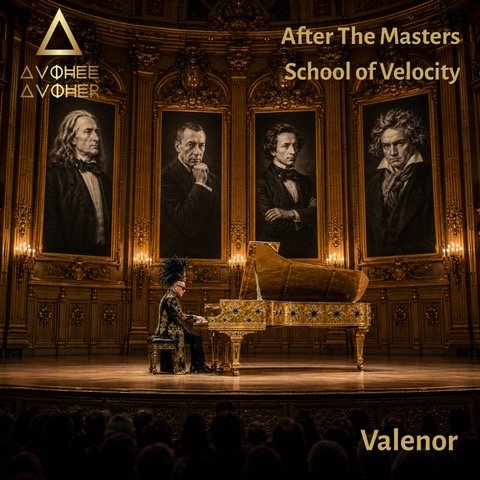
Even the striking artwork captures the concept beautifully: Avoher sits at an ornate golden piano beneath portraits of the great masters. He isn’t simply standing there admiring them.
He’s playing.
And perhaps that’s the entire philosophy of After the Masters – School of Velocity captured in one image.
The masters already changed music.
The interesting question is what the next generation chooses to do with everything they left behind.
With “Valenor,” Avohee Avoher has started answering that question — at full speed.
“Valenor” by Avohee Avoher is available now on major streaming platforms.
Avohee Avoher Official Website
Listen to “Valenor” on Spotify