
A $400 shoe and a $150 shoe can look identical in a product photo. That’s the whole problem.
Price tells you almost nothing about a dress shoe. What tells you something is how it’s built, what the leather actually is, and whether anyone can fix it when the sole wears through. Get those three right and a shoe lasts fifteen years. Get them wrong and you’ve bought a disposable object with a leather-look coating that will crack across the vamp by month eight.
Here’s the deal, gents. I’ve been fitting men for two decades and I’ve watched guys make the same two mistakes on repeat. They either spend $180 on something that gets thrown away in a year — which is the expensive choice, not the cheap one — or they spend $1,200 believing the price bought them something a $600 shoe wouldn’t have given them.
Below are the best dress shoes for men in 2026, sorted by what you’re actually spending. Every price was checked this month. I’ll tell you where the quality curve climbs steeply, where it flattens out, and the exact point where you’re paying for craft appreciation rather than function — because that point exists, and almost nobody selling shoes will show it to you.
In this article we’ll cover:
- The three things that decide whether any dress shoe is worth its price
- The best dress shoes at every tier, from $220 to $1,750
- A side-by-side comparison table with current prices and construction
- How to spot corrected grain leather in about thirty seconds
- The real cost-per-wear math on resoling — with actual 2026 repair prices
- Which well-known brands to walk past entirely
Three Things That Decide Whether A Dress Shoe Is Worth It

Before a single brand name matters, three specs decide everything. Learn them and you can evaluate any shoe in any store in about a minute.
1. Construction — can it be fixed?
Goodyear welted is the one you want. A strip of leather — the welt — gets sewn to the upper and the insole. Then the outsole gets stitched to that welt. Nothing that holds the shoe together runs through the outsole itself, so when the sole wears out, a cobbler cuts the stitches, pulls the old sole, and sews on a new one. The shoe you paid for stays intact. Any competent repair shop in America can do it.

Blake stitched runs a single line of stitching from inside the shoe straight through to the outsole. You get a slimmer, more flexible shoe with less bulk around the edge — Italians love it for a reason, and it looks elegant. Two costs, though. Those stitch holes go clean through the sole, so water has a direct path in. And resoling requires a Blake machine, which a lot of neighborhood cobblers simply don’t own.
Blake rapid splits the difference — upper stitched to a midsole, midsole stitched to the outsole. That extra layer buys back most of the water resistance and it resoles more easily than straight Blake.
Cemented means glued. No stitching, no repair, no second life. Glued shoes have their place — they’re light and cheap — but they’re not what this article is about.
One honest caveat, because you’ll hear otherwise: Blake construction isn’t bad. A well-made Blake shoe from a good maker beats a badly-made Goodyear shoe every day of the week. Construction is the first filter, not the only one.
2. Leather — is the grain real?
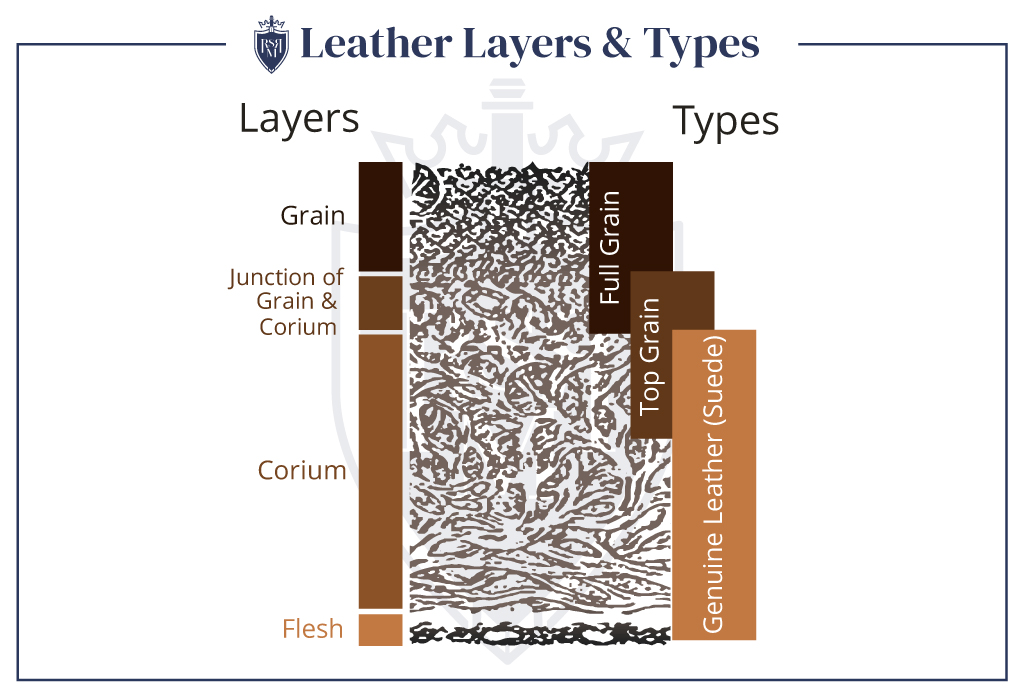
This is where most of your money quietly goes, and where most brands quietly cheat.
Full-grain calf keeps the hide’s outermost layer intact — the densest, strongest fibers on the animal. It creases in soft rolling folds, develops a patina, and takes polish because polish has somewhere to go.
Corrected grain starts as a lower-grade hide with scars and bug bites. The tannery sands the natural surface off entirely, then stamps a fake grain pattern back on with a heated plate and seals it under a coating. It photographs beautifully. Then it creases in hard sharp lines, and eventually the coating cracks — and a coating can’t be conditioned back to life, because it isn’t leather anymore.
And “genuine leather”? That’s the lowest grade in the whole hierarchy despite sounding like a certification. When you see it stamped on a sole, walk away.
3. The last — does it fit YOUR foot?

The last is the foot-shaped form the shoe is built around, and it matters more than the brand on the box. Crockett & Jones’ 348 is squared off. Alden’s Barrie is round and roomy in the forefoot. Allen Edmonds’ 65 is generous through the toe. Carmina’s Rain is sleeker and narrower.
A $900 shoe on the wrong last will hurt more than a $250 shoe on the right one. Which is why the single most useful thing in this entire article is this: buy from makers with free returns until you know your last. Then buy that last for the next twenty years.
Tier 1: $200–$350 — The Entry That’s Actually Worth Owning
This is the tier where the biggest jump in quality happens. Below about $200 you’re buying corrected grain and glue almost without exception. Right around $220 the door opens.
Meermin Linea Clásica — $220–$230

The cheapest genuinely Goodyear-welted calf oxford I can recommend without qualifying it into oblivion. Spanish design house, welted in their own workshop, real calf uppers, leather soles, and a range of lasts wide enough that most feet find something.
Why it wins its lane. Nothing else at this price is resoleable, full stop. That single fact changes the math — a $220 shoe you keep for a decade costs less per year than a $180 shoe you replace three times.
The honest drawback: the standard line needs real break-in — expect a few uncomfortable weeks. The finishing is a step behind the tier above it: edges are less refined, and the leather, while real, isn’t the supple stuff you get at $400. Their upgraded Linea Maestro line fixes most of that and runs $310–$420.
Best for: Your first proper pair, or a black oxford you’ll wear a dozen times a year to weddings and funerals.
Beckett Simonon Dean Oxford — $239

Full-grain Italian calfskin from a Gold Rated tannery in Arzignano, made in Bogotá, at a price that undercuts everything comparable. They pull it off by making to order — no inventory, no markup on unsold stock.
The honest drawback — and it’s a real one. That made-to-order model means you wait. Ten to twelve weeks is standard; orders placed now ship around October. If you need shoes for an event, this is the wrong pick. Reviewers who’ve worn them for years also report stiffer-than-expected leather and some color inconsistency between pairs. The leather spec is genuinely good; the execution is less consistent than the makers a tier up.
Best for: Patient buyers who want real full-grain leather at the lowest price it exists.
Carlos Santos — $295–$380

Portuguese, Goodyear welted, European calf, and — this is the part that matters — finishing that embarrasses American brands charging more. If you want one shoe from this tier that could pass for a $600 shoe across a conference table, it’s this.
The honest drawback: distribution in the US is thin, so trying a pair on before buying usually isn’t an option. Sizing runs a touch narrow through the waist.
Tier 2: $350–$550 — The Sweet Spot
If I could only recommend one price band to a man building a wardrobe, it’s this one. The construction is the same as the $900 tier. The leather is 90% as good. What you give up is finishing refinement and prestige — and neither of those makes the shoe last longer.
TLB Mallorca — $354–$451

Spanish, Goodyear welted, and the closest thing to a steal in the entire roundup. The attention to detail — bevelled waists, tight sole stitching, sharp edge finishing — reads like shoes at twice the money. Comfortable out of the box, which is rare at any price.
Best for: The man who’s done buying entry-level and wants his last pair of “reasonable” shoes.
The honest drawback: ordering from Spain means shipping time and a return process that’s more friction than a domestic order.
Grant Stone Cap Toe Oxford — $395

Goodyear welted, excellent leathers including Horween Chromexcel, and a brand that has done something I respect: they’re openly, unapologetically made in Xiamen, China, and they’ve published exactly why. In a category built on flag-waving, a maker refusing to hide its factory is worth noticing — and the shoes back it up.
The honest drawback: the toe box runs tight. Consistently. If you have a wide forefoot, size accordingly or look elsewhere.
Best for: Guys who want durability over delicacy — these are built like they expect to be worn hard.
Allen Edmonds Park Avenue — $450 (routinely $250 on sale)

The default American answer for forty years, built in Port Washington, Wisconsin, on the 65 last, with 360-degree welting and a factory recrafting program that will rebuild them for $150.
I have to be straight with you about this one. Since the ownership changes of the last decade, the reports of declining consistency have gotten hard to wave away — uneven welt stitching, rough sole edge finishing, and warping at the welt joint show up in enough teardowns that it isn’t just forum grumbling. Some pairs are still excellent. That’s the issue: it’s now a lottery where it used to be a guarantee.
So here’s my actual advice: never pay $450 for these. The sale has become the standard price, and at $250 the Park Avenue is a solid buy with a recrafting pipeline nobody else in America matches. At full retail, TLB Mallorca and Carlos Santos beat it on materials and finishing without a close argument.
Best for: The man who wants a shoe he can hand to the maker for a factory rebuild every five years, bought on sale.
Tier 3: $550–$1,000 — Buy Once, Wear For Twenty Years
Carmina — $650 (box calf, Rain last)

Made in Mallorca, Goodyear welted, on lasts with genuine elegance — the Rain in particular has a sleek profile that flatters a suit in a way blockier American lasts don’t. The box calf is excellent. Shell cordovan versions run $1,125 if you want a shoe that outlives you.
The honest drawback: customer service has a genuinely poor reputation. Sizing exchanges and order issues can turn into a slog. Buy through a good retailer rather than direct and you sidestep most of it.
Crockett & Jones Hallam — $930

Northampton, England. Goodyear welted, single leather sole, the 348 last with its squared toe. This is the shoe I’d point at if a man asked me what “the good stuff” looks like without going silly.
What the money buys over the $400 tier is real but subtle: tighter-grained calf that holds a shine longer, a more elegantly bevelled waist, cleaner sole stitching, and a shoe that emerges from a resole looking new rather than repaired. Owners routinely report fifteen and twenty year service lives.
The honest drawback: the 348’s square toe is a look. On a smaller foot it can read chunky. Try the more rounded lasts if that’s you.
Alden 990 Shell Cordovan — $989

Made in New England, Goodyear welted, tempered steel shank, double oak leather outsole, on the round and roomy Barrie last. Shell cordovan isn’t leather in the usual sense — it’s a dense membrane from a horse’s hindquarter that doesn’t crease so much as ripple, and it shrugs off scuffs that would gouge calf.
The honest drawback: the 990 is a plain-toe blucher, which makes it a fantastic shoe with flannels or denim and the WRONG shoe with a formal suit. It’s also heavy, and shell takes weeks of wear to soften. Buying shell for a boardroom oxford is a category error — buy calf for that.
Tier 4: $1,000+ — Where It Stops Being About Function

Edward Green Chelsea — $1,750
English-made on the 202 last, French and Italian calfskins chosen for tight grain, and oak bark tanned soles that spend nine months in tanning pits before anyone stitches them to anything. It is, objectively, a more beautiful object than the Crockett & Jones.
Now the part nobody selling these will tell you. The quality curve is steep from $200 to $600. From $600 to $1,000 it’s still climbing but more gently. Past roughly $1,000 it flattens hard. A $1,750 Edward Green will not last meaningfully longer than a $930 Crockett & Jones. It will not be more comfortable. It will not survive rain better.
What it will be is finished to a standard you notice when you look closely and hold it in your hands — a waist so bevelled it’s nearly stitched under the arch, a finish on the calf that looks lit from inside. That’s real. It’s also aesthetic appreciation, not function, and there’s no shame in either buying it or skipping it. Just know which one you’re doing.
Best for: The man who already owns good shoes and wants a great one. Not a first pair. Never a first pair.
The Best Dress Shoes For Men 2026, Side By Side
| Shoe | Price | Construction | Made in | Best for |
|---|---|---|---|---|
| Meermin Linea Clásica | $220–230 | Goodyear welted | Spain / China | Cheapest resoleable pair |
| Beckett Simonon Dean | $239 | Made to order | Colombia | Full-grain on a budget, if you can wait |
| Carlos Santos | $295–380 | Goodyear welted | Portugal | Punching above its price |
| TLB Mallorca | $354–451 | Goodyear welted | Spain | Best overall value |
| Grant Stone Cap Toe | $395 | Goodyear welted | China (openly) | Durability, narrow feet |
| Allen Edmonds Park Avenue | $450 (buy at ~$250) | Goodyear welted | USA | Factory recrafting access |
| Carmina (Rain last) | $650 | Goodyear welted | Spain | Sleek profile under a suit |
| Crockett & Jones Hallam | $930 | Goodyear welted | England | The “buy once” oxford |
| Alden 990 | $989 | Goodyear welted | USA | Shell cordovan, casual tailoring |
| Edward Green Chelsea | $1,750 | Goodyear welted | England | Craft appreciation, not function |
Prices verified August 2026. Sale prices move constantly — the Park Avenue in particular is almost never worth its sticker.
How To Spot Corrected Grain In Thirty Seconds

You can do this in a store without asking anyone a question they’ll lie about.
Look at the grain pattern. Real hide is irregular — the texture varies across the shoe, and you’ll spot the occasional tiny mark. A pattern that repeats evenly in a mechanical rhythm was stamped on by a plate.
Flex the vamp. Bend the toe up and watch where it creases. Full grain folds in soft rolling waves. Corrected grain often throws faint white or pale stress lines — that’s the coating fighting the bend, and it’s the tell that matters most.
Touch it. Full grain feels slightly warm and slightly irregular under your fingers. Corrected grain feels cool, uniformly smooth, faintly plastic.
If you own them already, try a drop of water. Full grain darkens and absorbs it slowly over half a minute, then dries back. Corrected grain beads it and sits there, because the surface is sealed.
How A Dress Shoe Should Actually Fit

More expensive shoes get returned for fit than for any defect. Most men have never been told what correct actually feels like, so they judge by the two things that mislead them worst — length and immediate comfort.
The ball of your foot must sit at the widest point of the shoe. This is the whole ballgame. That’s where the shoe is built to flex, and if your foot flexes somewhere the shoe doesn’t, you’ll get creasing across the vamp, pain across the joint, and a shoe that wears out early. Length is secondary to this. A half size longer with the ball in the right place beats a “perfect” length with your foot sitting forward.
A little heel slip is normal and correct. Roughly an eighth of an inch of lift when you walk, in a new leather-soled shoe, is exactly right. The sole is stiff and hasn’t flexed yet. That slip disappears within a couple of weeks as the leather breaks in. Men size down to eliminate it and end up in a shoe that’s too short — one of the most common mistakes I see.
Snug across the width, never tight. Good leather gives across the width and does not give in length. So a shoe that’s a touch snug across the ball will relax into shape; a shoe that’s short will be short forever. Width also comes in more options than most men know — if you’ve spent your life assuming shoes just hurt, there’s a decent chance you’ve been wearing a D when you need an E or EE.
Try shoes on in the afternoon. Feet swell over the course of a day, and a shoe fitted at 9am can be a vise by 4pm. Wear the socks you’d actually wear with them, too — a dress sock and an athletic sock are close to a half size apart.
One more thing, gents, because it saves a lot of grief: get measured on a Brannock device once, standing, both feet. Most men have one foot noticeably larger than the other and fit to the smaller one out of habit. Fit the larger foot and shim the other with an insole if you need to.
The Cost-Per-Wear Math Nobody Runs

Here’s the arithmetic that should decide your budget, and it’s simpler than people make it.
A resole in 2026 runs about $150 to $175 at a good independent cobbler. Allen Edmonds will rebuild their own for $150 standard or $175 for the full package, four to six weeks turnaround. Alden’s factory restoration is around $200.
Twenty years on a $930 Crockett & Jones, resoled four times at $165: $930 plus $660 equals $1,590. Call it $80 a year.
Twenty years on a $180 cemented shoe replaced every three years: roughly seven pairs, $1,260. Call it $63 a year.
Notice something? The cheap route is not dramatically cheaper. It’s slightly cheaper — and for that you get seven pairs of mediocre shoes instead of one excellent pair that fit better every year and never once embarrassed you in a meeting.
Now run it at the entry tier. A $230 Meermin resoled three times at $165: $725 over twenty years. Thirty-six dollars a year, and every one of those years you’re in a real leather, real welted shoe.
That’s the actual answer to “how much should I spend.” The floor is $220, not $600. Above that you’re buying refinement, and refinement is a legitimate thing to buy — just not a necessary one.
Two Care Rules That Beat Everything Else

Never wear the same pair two days running. Your feet put out real moisture over a day, and leather needs roughly 24 hours to give it back to the air. Wear the same shoes daily and you’re walking in damp leather every morning, which breaks fibers down from the inside. Two pairs alternated will outlast three pairs worn into the ground in sequence. This is the single highest-leverage thing you can do, and it costs nothing but the discipline.
Cedar shoe trees, in, the moment you take them off. Not the next morning — while the leather is still warm and pliable. They hold the shape, pull moisture out, and stop the toe curling up like a genie slipper. Twenty-five dollars a pair and they’ll add years.
Polish matters far less than either of those. Condition a couple of times a year, polish when you want the shine, and don’t let anyone sell you a twelve-step routine.
Buy Them In This Order

You don’t need ten pairs. You need four, bought in this sequence, and you can spread it over three years without ever being caught out.
First: the black cap-toe oxford. The most formal shoe a normal man ever needs and the one you cannot improvise. Interviews, weddings, funerals, anything with a dark suit. Buy it before you need it, because the day you need it you won’t have time to shop.
Second: a dark brown derby or oxford. This is the one you’ll actually wear most. Brown works with navy, grey, and charcoal, dresses down to chinos, and looks better with age than black does — black hides patina, brown shows it off.
Third: a loafer, in brown or burgundy. Now you’ve got a warm-weather and a no-socks option, and something for the meetings that stopped requiring laces sometime around 2019.
Fourth: a suede derby or chukka. The most underrated shoe most men don’t own. Suede reads relaxed without reading sloppy, and it rescues an outfit that would look stiff in polished calf.

Notice what’s not on that list: anything with a square toe, anything with a rubber lug sole, anything that came free with a suit. Four pairs, rotated, resoled when they need it. That’s a lifetime of dressing well from the ankles down.
Brands To Walk Past
I don’t enjoy naming names, but you’re spending real money and vague advice doesn’t help you.
Cole Haan. Fine sneakers. Their dress shoes are not dress shoes in the sense this article means.
Hugo Boss. You’re paying $400 for cheap leather and cheap construction with a logo on it.
Johnston & Murphy. A historic American name that no longer makes what its reputation implies. Judge the current product, not the heritage.
Magnanni. Handsome shoes with heavy patinas that do a lot of work hiding leather that doesn’t merit the retail price. The fact that they’re perpetually discounted tells you what the real price is.
Frequently Asked Questions
How much should I spend on my first pair of dress shoes?
Around $220 to $250 gets you into real full-grain leather with Goodyear welted construction, which is the threshold that matters. Below that you’re buying something disposable. You don’t need to spend $600 on a first pair, and you shouldn’t — spend it on the second pair once you know your last.
Are expensive dress shoes actually worth it?
Up to about $600, yes — you’re buying better leather, better construction, and a shoe that can be rebuilt repeatedly. Between $600 and $1,000 you’re buying refinement that’s real but subtler. Past $1,000 you’re buying craft and beauty, not durability. All three are valid; just know which one you’re paying for.
How many times can a Goodyear welted shoe be resoled?
Realistically four to six times before the upper itself gives out, assuming decent care and rotation. What eventually kills the shoe isn’t the sole — it’s the leather upper cracking or the lining wearing through, which is precisely why leather quality matters as much as construction.
What’s the one dress shoe every man should own?
A black cap-toe oxford. It handles interviews, weddings, funerals, and any suit you own. Buy that first, in the best quality you can afford, and get a dark brown one second — brown is more versatile day to day, but black is the one you’ll need on the day you can’t go shopping.
Is Goodyear welted always better than Blake stitched?
Not always. Goodyear is more water resistant and any cobbler can resole it, which makes it the safer default. But Blake gives you a slimmer, more flexible shoe with almost no break-in, and a good Blake shoe from a serious Italian maker beats a poorly built Goodyear shoe every time. Construction is the first filter, not the last word.
The Bottom Line
Buy Goodyear welted. Buy full grain. Buy the last that fits your foot, then stop shopping and start wearing.
If you’ve got $250, buy Meermin or a Park Avenue on sale and put cedar trees in them every night. If you’ve got $400, TLB Mallorca is the best value in this entire article and I’d hand a man that pair before anything else here. If you’ve got $900 and you want to be done thinking about it, the Crockett & Jones Hallam is the answer.
And if you’re looking at the $1,750 Edward Green — enjoy it, gents. Just don’t tell yourself it’s an investment. It’s a beautiful thing, and that’s reason enough.
Also read:
- Men’s Oxford shoes — the ultimate buying guide
- Best men’s dress shoes under $100: how to spot quality construction
- Are Allen Edmonds shoes worth the money?
- Double monk strap shoes: how to buy, fit & wear them
- Wedding shoes for men: a bespoke tailor’s guide
The post Best Dress Shoes for Men 2026: From $200 to $1,000+ — What’s Actually Worth It appeared first on Real Men Real Style.