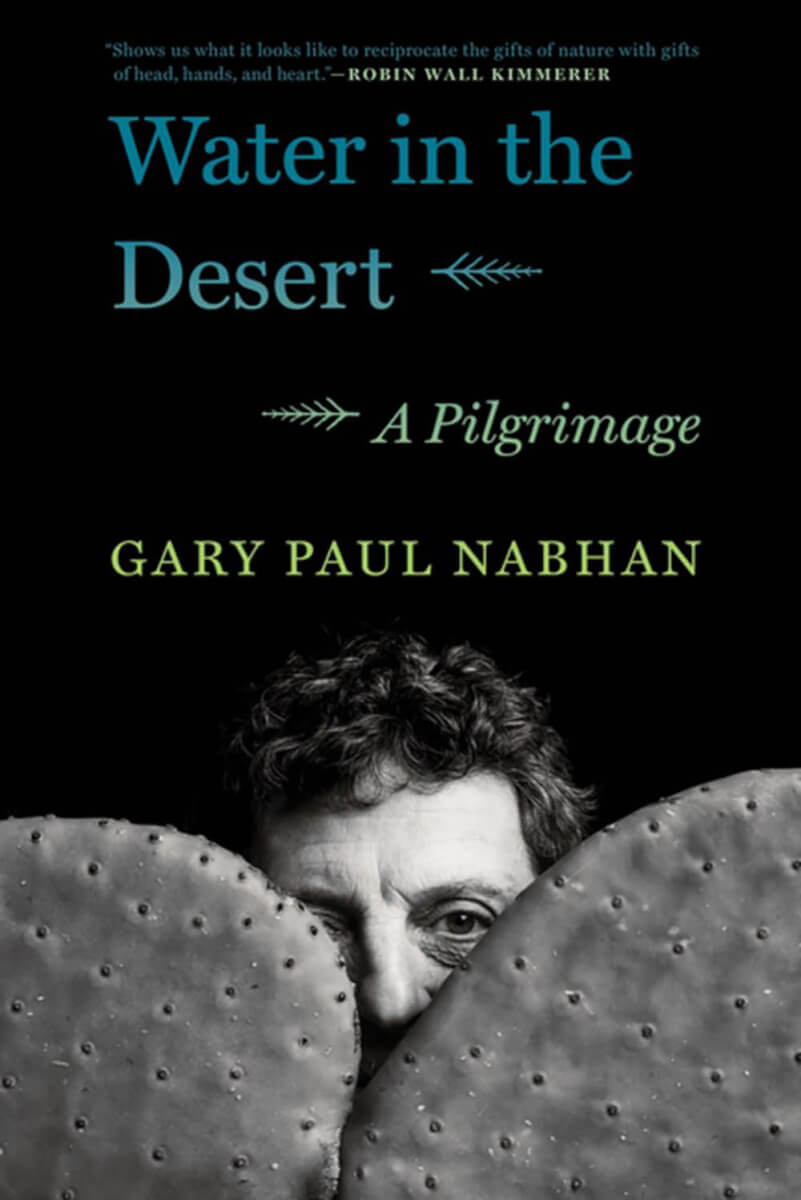
From an early age, Gary Paul Nabhan would fall into what ecologist E.O. Wilson called “the naturalist’s trance.” Intensely absorbed by the sand dunes and wildlife of the shores of Lake Michigan, young Nabhan was called the “Dune Detective” by his loving Lebanese American family. He was much less comfortable in school, where his preference for solitude and frustration with authority figures led to diagnoses of disabilities, among them “asocial with introvert tendencies.” This was in the 1950s and 60s, when neurodivergence was rarely tolerated, let alone accommodated. Nabhan escaped into nature: “I cherished playing hooky in wetlands, disappearing into dense patches of tule, river cane, and reed.” (He was later “tagged as a highly sensitive person,” a label that made more sense to him.)
Now in his 70s, Nabhan has led an extraordinary life as an ethnobotanist, field biologist and fierce advocate for environmental justice. In Water in the Desert: A Pilgrimage, he charts his journey from his Midwestern childhood to a life in the Southwest as a scientist and activist dedicated to the health of entwined ecosystems among the region’s peoples, creatures, rivers and deserts. Nabhan traces his love for the “edges and boundaries” of the Sonoran desert to his ancestral roots in the Bekaa Valley on the border between present-day Lebanon and Syria. Nabhan calls these border places the “ecotone:” “a place rife with ecological edge effects . . . exactly the kind of place where I felt most at home.”
When ecotones are at risk of ecological collapse, whether from pollution, climate crisis or, as at the time of this writing, war, Nabhan calls on the powers of the paraecologos: emergency medical technicians for the environment. Nabhan’s work organizing restorative ventures among desert communities equates the health of the land and water with the health of the people dwelling there. Much of this work has focused on the springs and rivers that emerge in otherwise arid landscapes, sacred meeting places between water and desert, where 20% of the endangered species in the U.S. reside.
In this memoir, Nabhan spins an immersive yarn about a child who loved sand dunes and lake water, who grew up to witness both environmental triumphs, such as the establishment of Earth Day in 1970, and ecological tragedy. Water in the Desert is an inspiring call to action and a contemplative read.