
The first time I really understood umbrellas, I was standing on a corner in Chicago in a navy overcoat, watching a $14 drugstore special turn itself inside out like a dying jellyfish. Wind grabbed it, flipped it, snapped two ribs, and walked away laughing. I tossed it in the trash and walked four blocks in the rain with water running down the back of my collar and into a wool suit I’d spent three fittings getting right.
That suit took two weeks at the dry cleaner to come back to itself. The umbrella cost me $14 and about $80 in collateral damage.
Here’s the thing most guys don’t get about a men’s umbrella: it’s not a disposable. It’s a tool you use a hundred times a year, and it lives next to your wallet, your watch, and your shoes on the list of small objects that either signal “this guy’s got his act together” or “this guy bought whatever was at the register.”
One well-built umbrella will outlast a decade of throwaways, keep you genuinely drier, and look right when you’re walking out of a meeting in a charcoal suit. That’s what this guide is about.
Key Takeaways
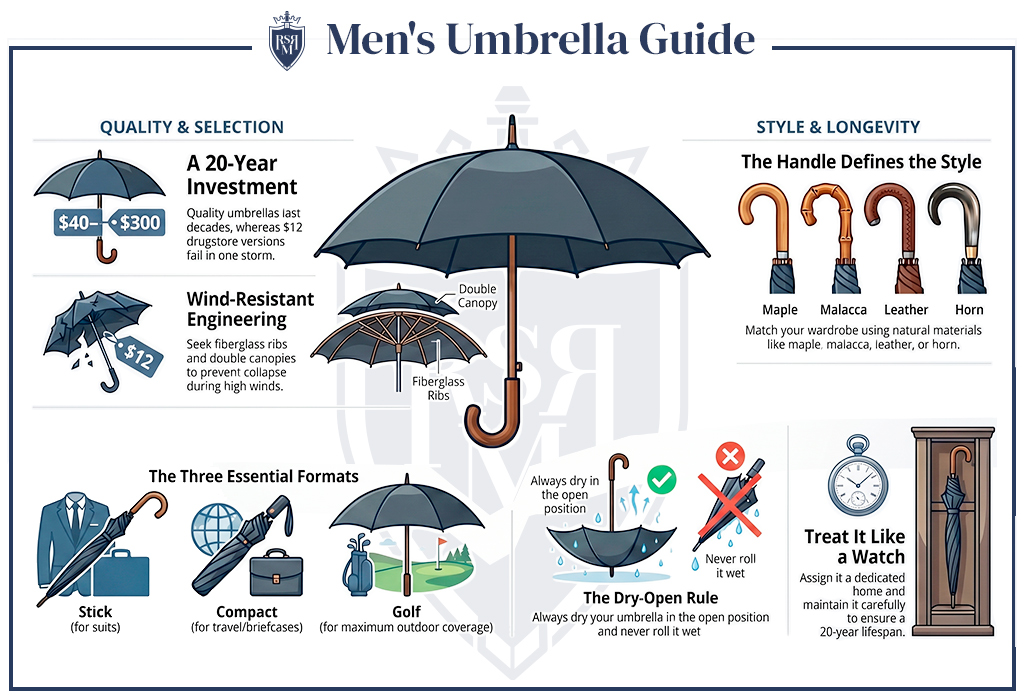
- A real men’s umbrella costs $40–$300 and lasts 5–20 years. Drugstore umbrellas cost $12 and die in one storm. The math is not close.
- Three formats cover every situation: classic stick (for suits and overcoats), compact (for travel and the briefcase), golf (for actual coverage outdoors).
- Fiberglass ribs and a double canopy are the two features that determine whether your umbrella survives wind. Steel ribs and single canopies are why cheap umbrellas die.
- The handle is where the personality lives. Maple, malacca, leather, horn — pick one that feels right in the hand and matches what you already wear.
- Treat it like a watch. Give it a home. Dry it open. Don’t roll it wet. It’ll last.
Why Most Men Are Wet, Cold, And One Umbrella Away From Fixing It

When I was running a bespoke suit company, I’d watch clients walk into fittings with dark splotches across the shoulders of jackets they’d spent two thousand dollars on. Wool absorbs water. Wool, when wet, distorts the canvas inside the chest of the coat. Repeated soakings break down the structure of a tailored garment faster than almost anything else you can do to it.
And these were guys who owned six suits, three pairs of Allen Edmonds, a Tag Heuer — and a $9 collapsible umbrella from CVS that lived crumpled in a desk drawer. The math made no sense to me then and it makes no sense to me now.
Here’s the Marine in me talking: in the Corps, we used to say Gore-Tex is a privilege. You learn quickly that staying dry isn’t luck. It’s a discipline. Wet is cold, cold is miserable, miserable is mistakes. You take your wet-weather gear seriously because the alternative is being the guy who didn’t.
You’re not in a fighting hole. But you are walking from a parking garage to a client meeting in February, and showing up with rain dripping off your nose communicates something. Buying one good umbrella is the single cheapest upgrade in menswear. It’s $80–$150 for an object you use constantly. Compare that to what you spent on your last pair of dress shoes.
The Three Umbrella Formats Every Man Should Know
There isn’t a single best umbrella for men. There are three formats, and a put-together guy probably owns two of them — one for the office, one for travel.
The Classic Stick Umbrella

This is the dress umbrella. Full-length, usually 32–36 inches long when closed, single solid shaft, traditional curved or straight handle in wood, leather, or horn. It walks with a suit and overcoat the way a good pair of cap-toe oxfords walks with a charcoal trouser. It can double as a walking stick if you’re an older gentleman or just appreciate the gesture.
The gold standard is Fox Umbrellas of London, founded in 1868, still making them by hand. Brigg (now owned by Swaine) is the other British house worth knowing — they’ve supplied royalty for two centuries. Both will run you $300–$600 and outlive most marriages.
If you don’t want to spend Fox money, Royal Walk and Balios both make handsome wood-handle stick umbrellas in the $50–$90 range that get you 80% of the way there. The shafts won’t be solid-cut from a single piece of chestnut, and the canopies won’t be hand-stitched, but the geometry is right and they look correct with a suit.
When to carry one: business attire, overcoat weather, anywhere you’re already dressed with intention. Not the gym. Not the airport.
The Compact / Folding Umbrella
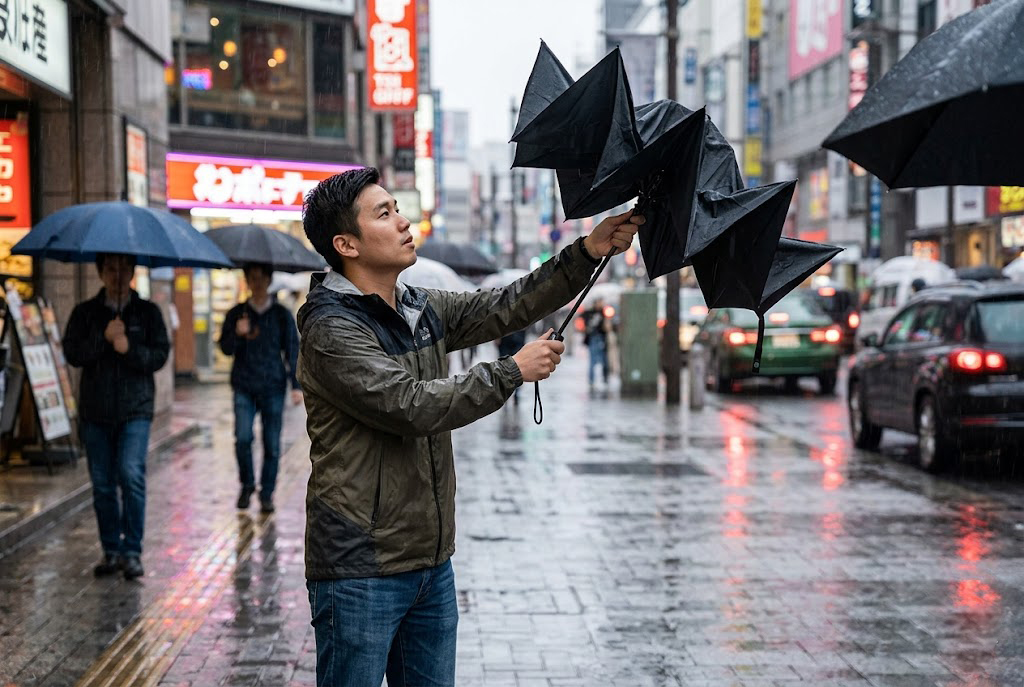
This is the one that lives in your briefcase, your car door, your travel bag. The whole point is that it’s there when you need it, because the umbrella you don’t have with you is worse than the cheap one you do.
What you want in a compact:
- Auto open/close — one button, both directions. The cheap ones only auto-open.
- Double canopy (vented) — two layers of fabric with a gap that lets wind pass through. This is the single biggest reason expensive compacts survive gusts that destroy drugstore ones.
- Fiberglass ribs, not steel. Fiberglass flexes and returns. Steel bends once and stays bent.
- A handle that fits your hand — rubberized or contoured, not the slick plastic stub on the $12 ones.
Top picks here are the Blunt Metro, the Davek Solo, the Senz Original (more on Senz in a minute — it’s a special case), and on the budget end, the Repel Travel Umbrella. I’ve personally owned three of these across the last decade.
The Golf Umbrella
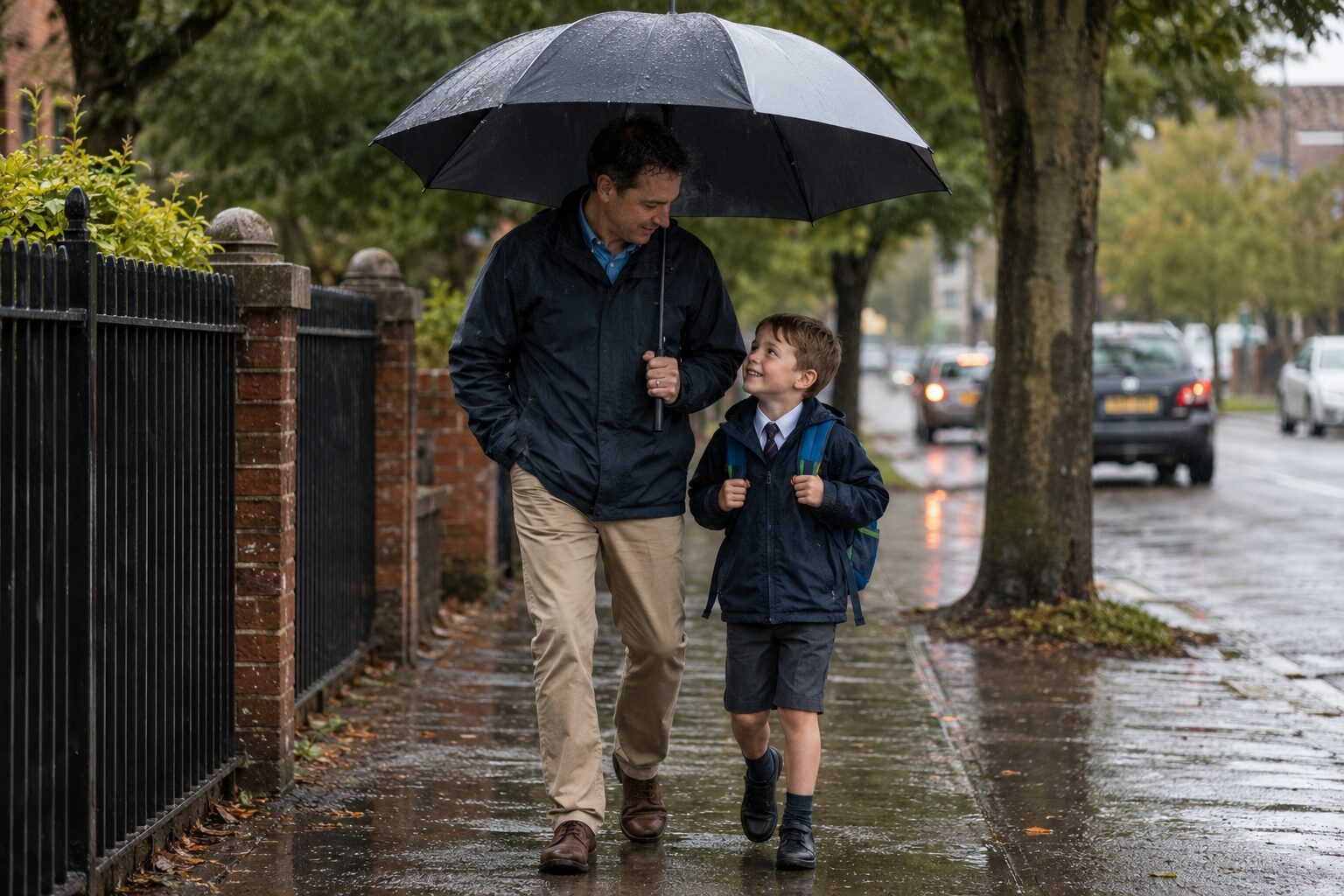
The big one. 60–68 inches of canopy. Genuinely useful when you actually need coverage — walking the kids to school in a downpour, standing on a sideline, walking with your wife so neither of you gets wet.
But here’s where guys get it wrong. A golf umbrella in a crowded downtown sidewalk makes you look like you’re trying to colonize the pavement. It pokes people in the eye. It’s the SUV of umbrellas — fine in the right context, absurd in the wrong one.
Keep one in the trunk. Don’t carry it to the office.
Anatomy Of A Good Men’s Umbrella
You need to understand the mechanism, because the mechanism is what keeps you dry. Looks are downstream of engineering.
Ribs: Fiberglass Beats Steel For Wind
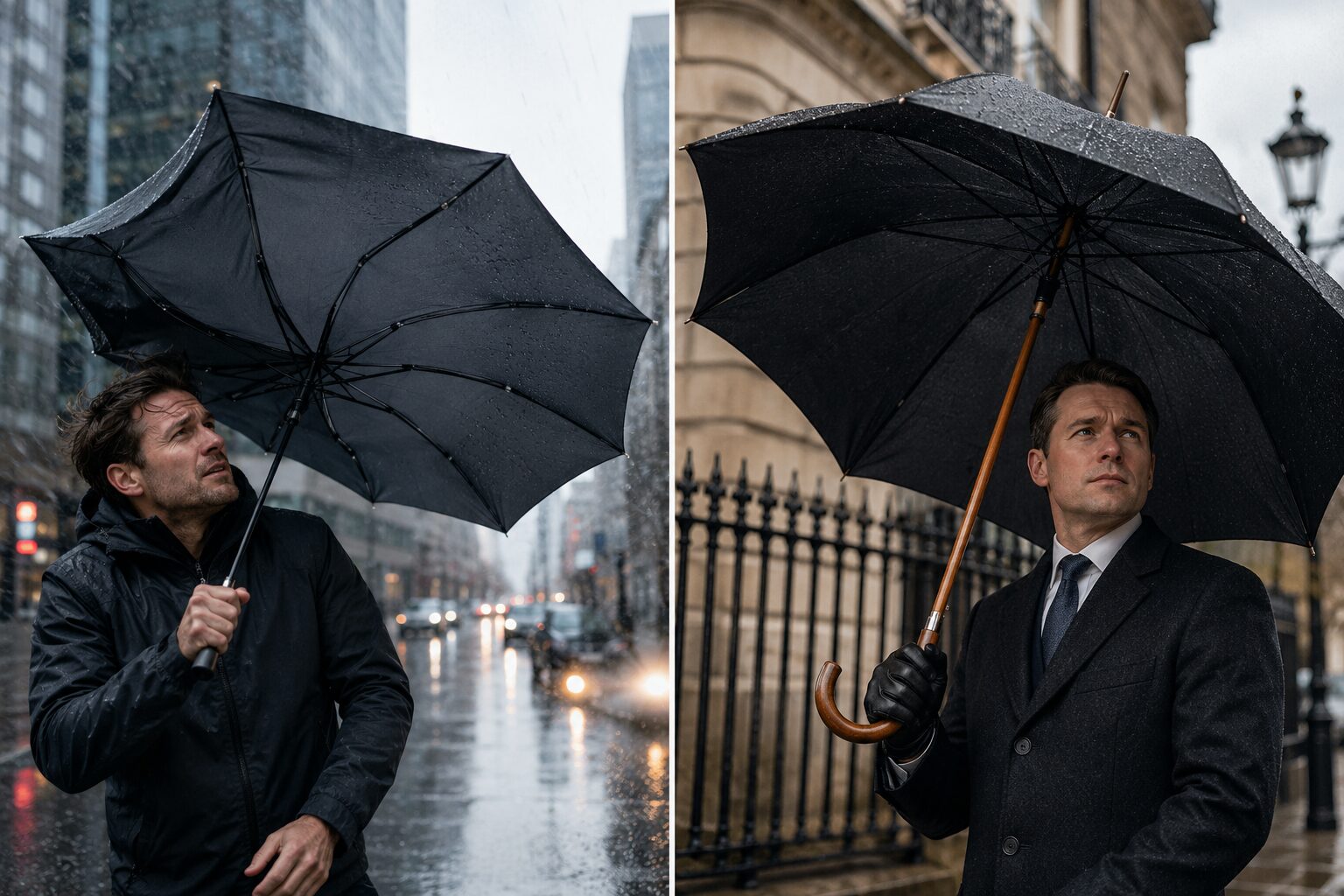
Steel ribs are stiff until they’re not. Hit them with a 30 mph gust and they kink. Once kinked, your umbrella has a sad little dent in its silhouette forever, and the canopy doesn’t tension correctly anymore.
Fiberglass ribs flex. They bow under load, release, and snap back. The good compacts — Davek, Blunt, Senz — all use fiberglass or fiberglass-resin composites. This is the single feature most responsible for “this umbrella survived a storm that killed three other umbrellas.”
Classic stick umbrellas often still use steel ribs because they’re paired with a deeper canopy and a sturdier shaft, so the geometry compensates. Fox uses solid steel ribs on a heavy hardwood shaft and the whole thing is overbuilt enough that wind isn’t the failure mode — losing it in a taxi is.
The Double Canopy
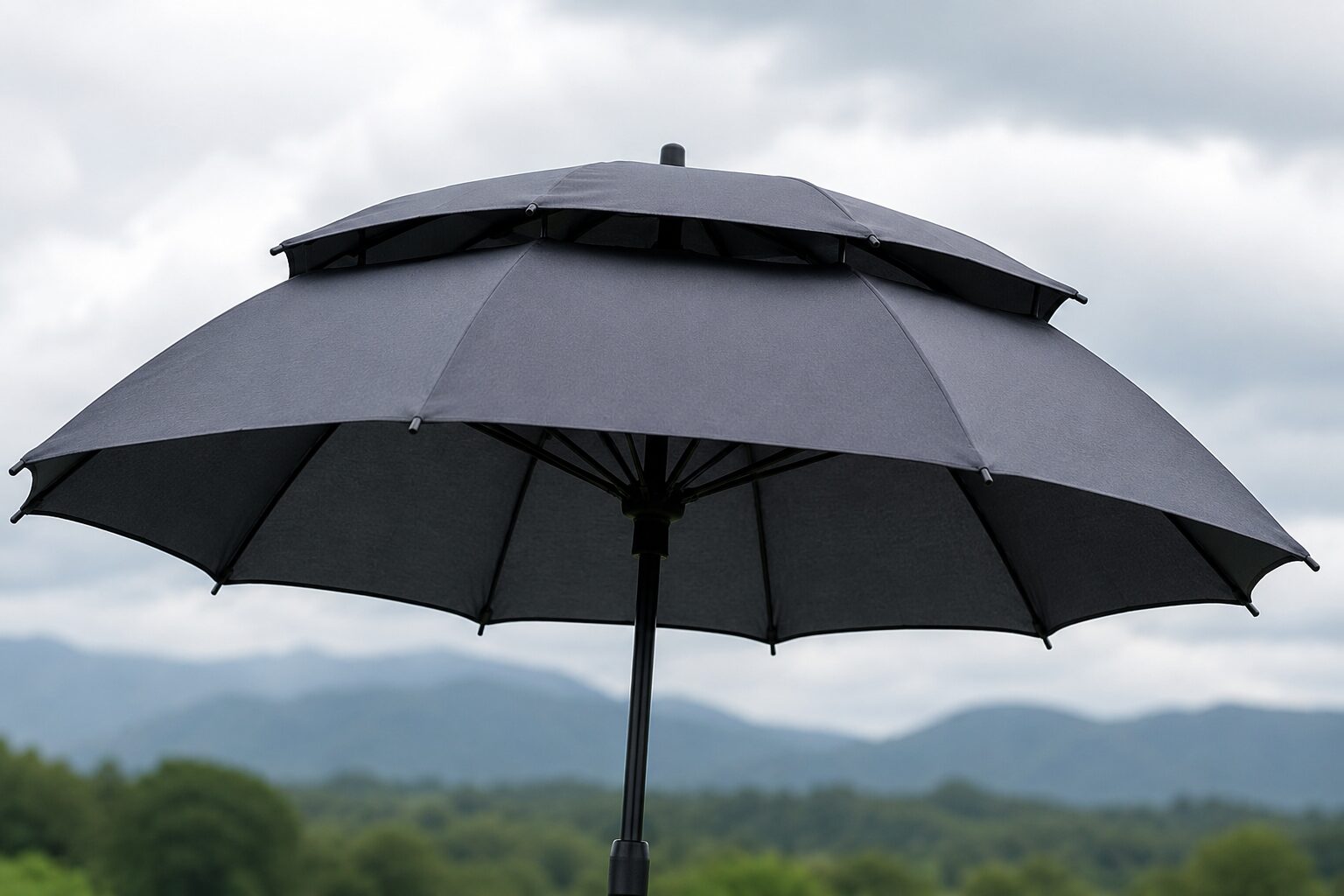
A double canopy (or “vented” canopy) has a top layer of fabric and a second layer underneath, with an overlap that lets air pass through but keeps water out. When a gust hits, the air escapes through the vent instead of pressurizing the underside of the canopy and inverting it.
This is why cheap umbrellas flip inside out. Single canopy + steel ribs = guaranteed casualty.
The Handle
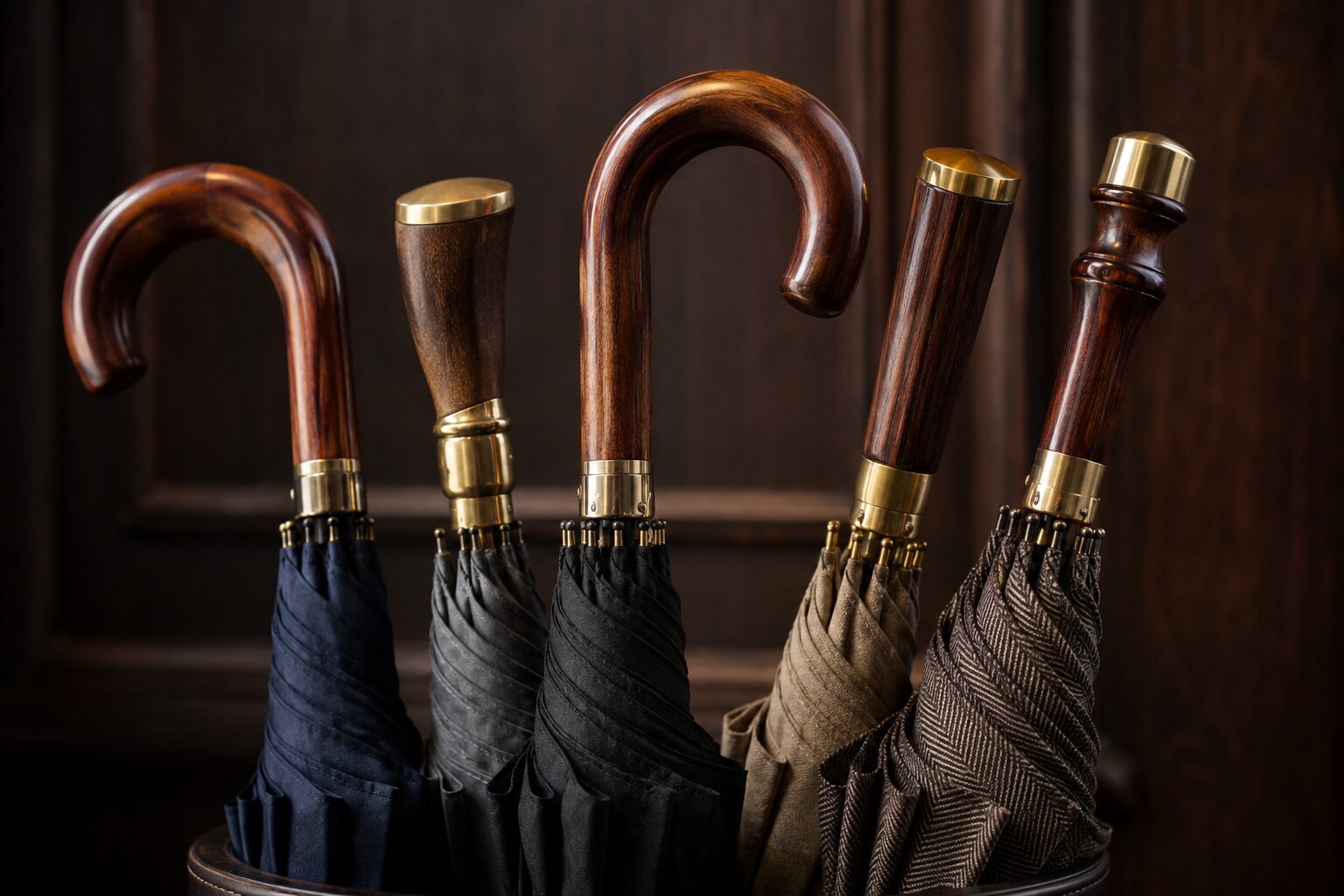
This is the watch-strap of the umbrella. It’s where personality lives, and it’s also where function lives, because if your hand can’t grip the thing properly when you’re cold and wet, none of the rest matters.
Crook (curved) handles in maple, chestnut, or malacca are the classic dress choice. They hook over your forearm when you’re not using them, which is half the point. Straight handles read sportier. Leather-wrapped handles look great and grip well. Horn and antler are the flex moves and they cost accordingly.
On a stick umbrella, a solid wood handle paired with a solid wood shaft — same piece of wood from tip to handle, when you can find it — is the umbrella equivalent of a Goodyear-welted shoe. It’s craft you can feel.
How To Match An Umbrella To Your Wardrobe
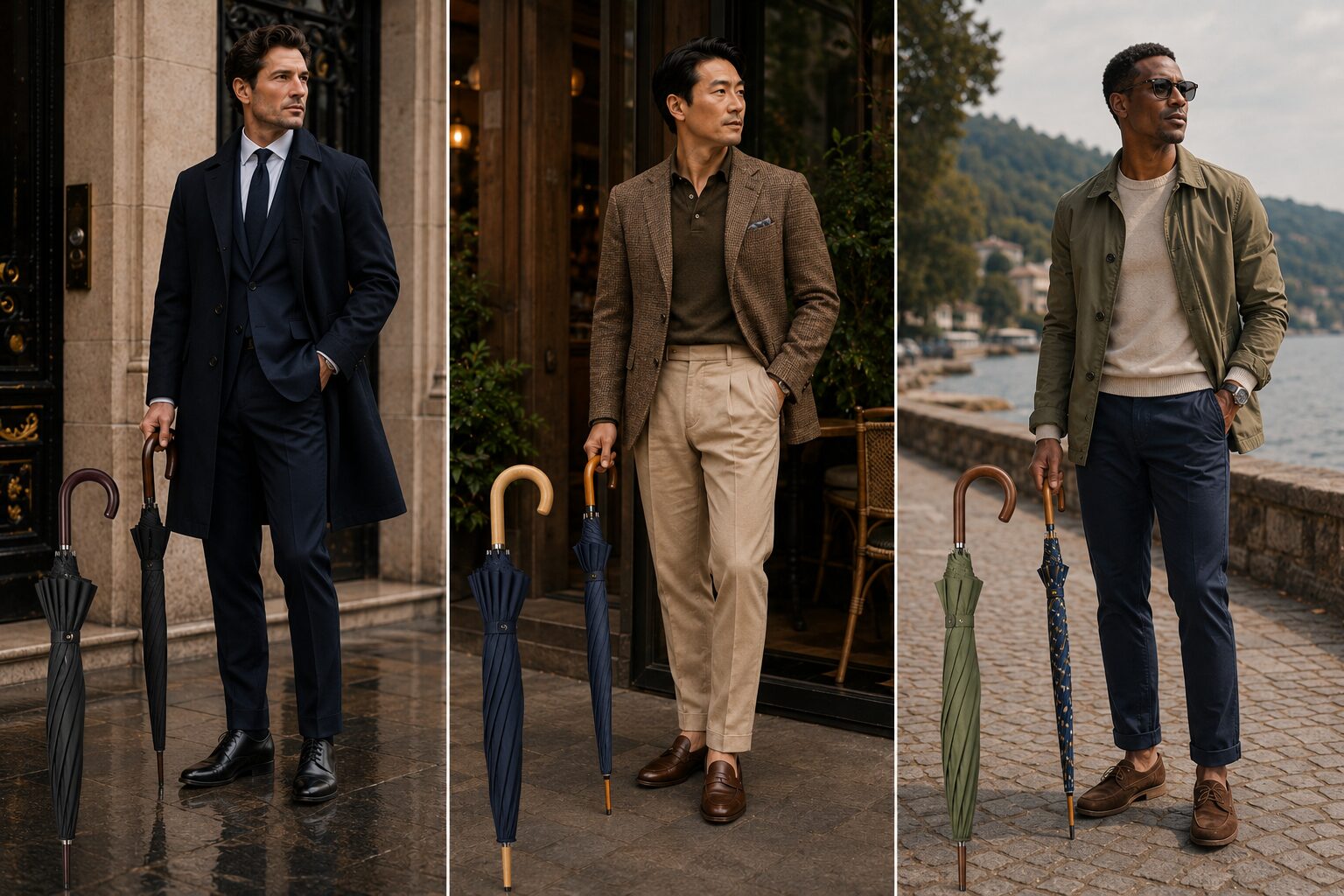
Most men don’t think about this and it shows. Your umbrella is a four-foot accessory you hold in front of your body. It’s visible. It should belong with the rest of what you’re wearing.
The simple rules:
- Navy or charcoal suit, dark overcoat ? black canopy, dark wood or leather handle. This is your default. Buy this first.
- Brown, tan, or olive tailoring ? navy canopy, lighter wood handle (maple, oak, malacca).
- Casual wardrobe, weekend ? anything goes. Bright canopies, patterned shafts, whatever.
Patterned canopies — tartan, pinstripe, glen check — can look fantastic if your wardrobe already lives in that British country-gentleman register. If you wear tweed sport coats, you can pull off a Prince of Wales canopy. If you wear slim-cut suits and sneakers on weekends, a tartan umbrella looks like a costume.
The handle is where you express yourself. Two guys can carry the same black-canopy stick umbrella and look completely different if one has a polished maple crook and the other has a brown leather-wrapped grip. Pick the one that feels right in your hand and matches the leather you already own — your shoes, your watch strap, your briefcase.
Quick aside: if you wear a lot of brown shoes, get a brown-handled umbrella. If you wear a lot of black shoes, get a black or dark-wood handle. Coordinate the leather goods. Same principle as belt-to-shoes.
Umbrella Etiquette (Brief, Not Preachy)
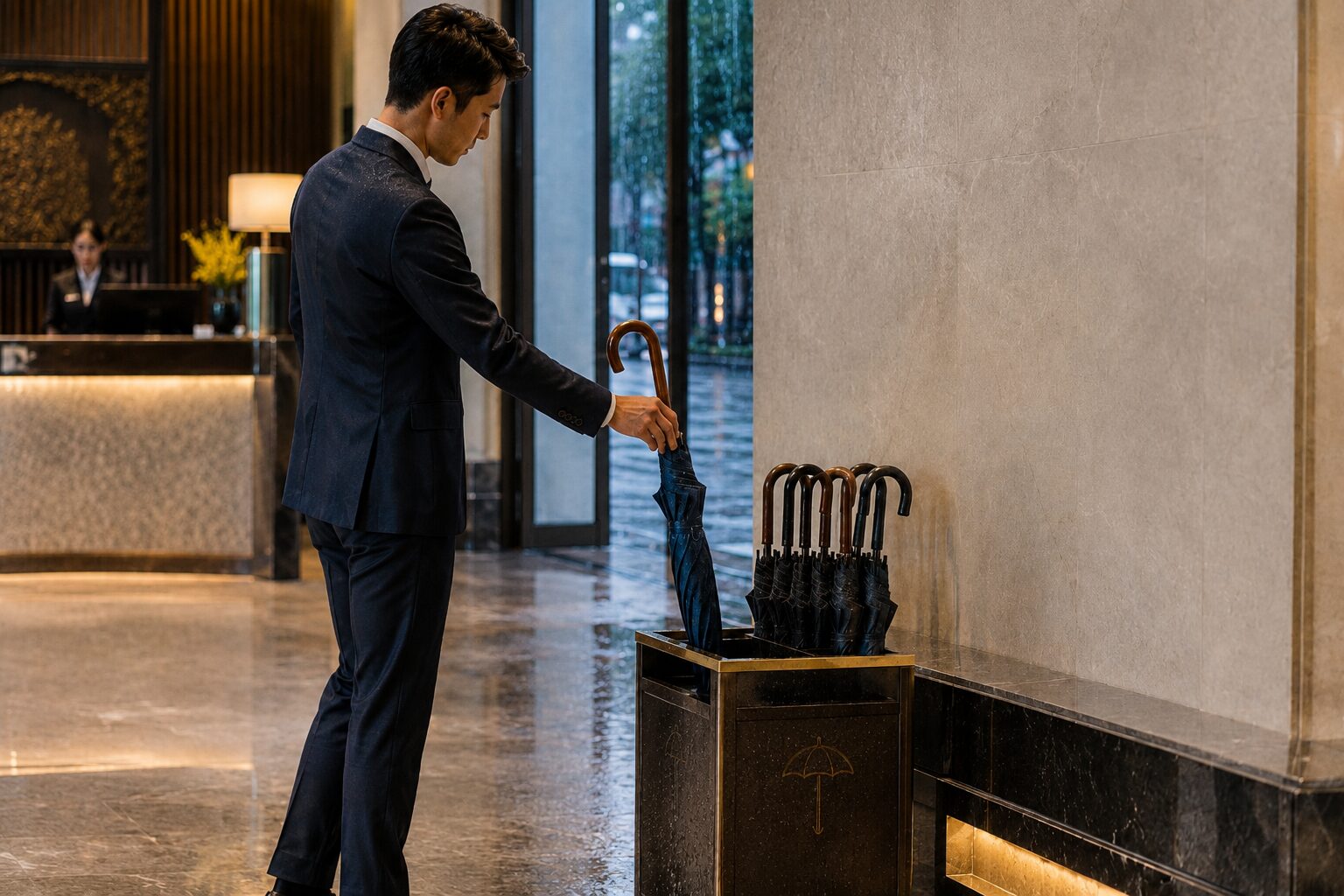
Most umbrella crimes are committed by guys who never thought about it. Five things:
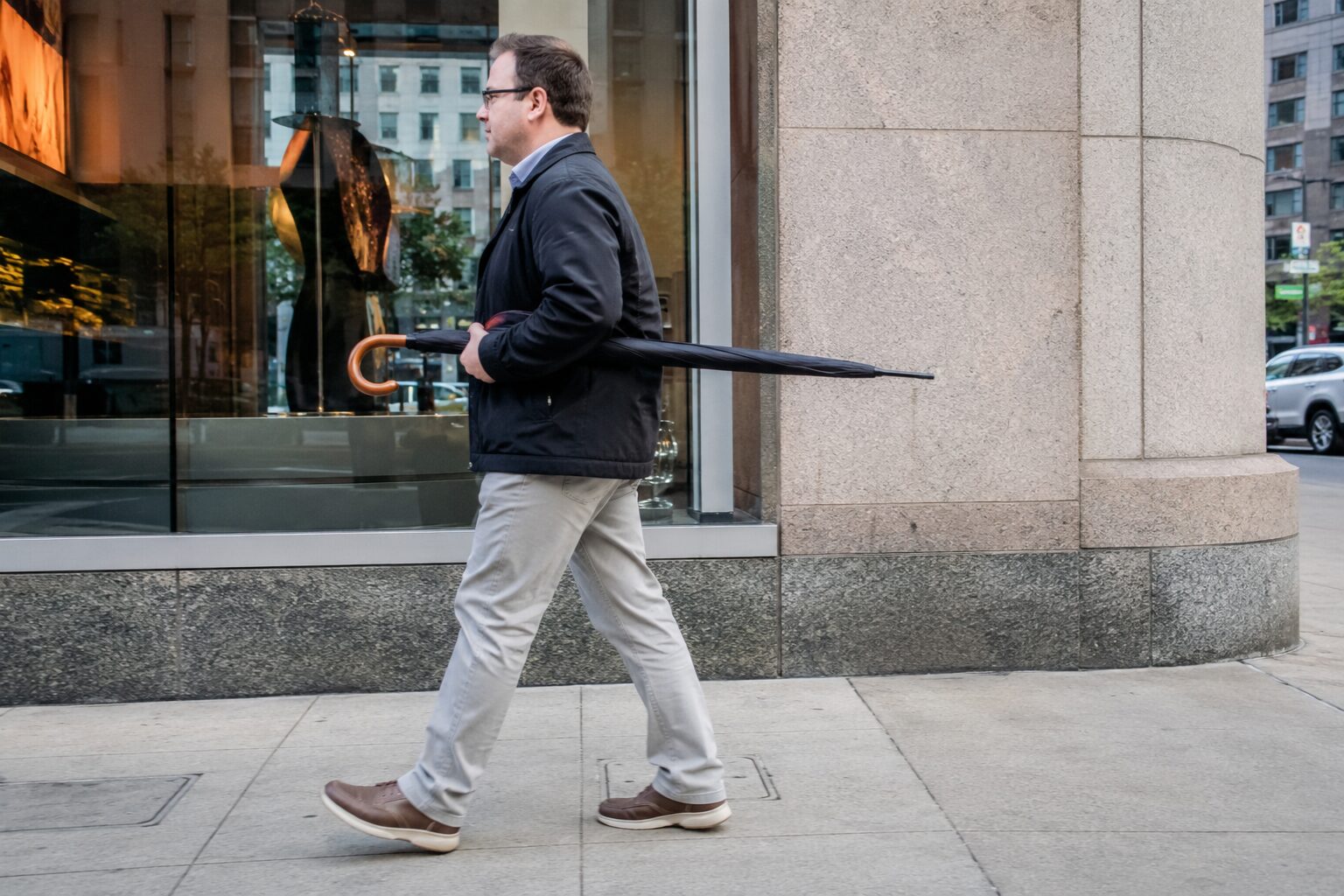
Carry it point-down when closed. Not horizontal under your arm like a sword. You’ll take someone’s eye out and you’ll look like a tourist. Point down, hand on the handle, walking-stick style.
Shake it out before you walk inside. Step under the awning, give it two firm shakes away from people, then enter. Don’t drip on the lobby floor.
Find the umbrella stand. Most decent buildings have one. If there isn’t one, lean it in a corner, point down, on tile or stone if possible. Never set a wet umbrella on someone’s desk, conference table, or upholstered chair. I shouldn’t have to say this. I’m saying it.
Hold it for the person you’re with. Walking with a date, your wife, an older colleague — you hold the umbrella, you hold it slightly toward them, and you accept that one of your shoulders is going to get a little wet. That’s the deal.
Don’t open it indoors. Old superstition, sure, but mostly it’s about water everywhere and poking ceiling fans. Step outside first.
For more on the small accessories that quietly signal you’ve got it together, check out our briefcase guide and watch guide.
Care And Longevity — How To Get 10+ Years Out Of One Umbrella

A good umbrella, treated halfway right, will outlast three cars. Here’s how.
Dry it open. When you get home, open the canopy fully and stand it in a corner or tub. Letting it dry rolled up is the single fastest way to rot the fabric and rust the springs. Once it’s bone dry, then you roll it.
Re-wax cotton canopies. Traditional Fox and Brigg canopies are tightly woven cotton, sometimes treated with a wax. Every couple of years, a fresh coat of fabric proofer (Nikwax, Otter Wax, Grangers — same stuff you use on a waxed Filson jacket) brings the water-repellency back to new.
Tighten the cap screw. On a stick umbrella, there’s often a small screw at the top where the canopy meets the ferrule. It loosens over years of use. Five seconds with a small screwdriver, you’re done.
Know when to retire it. A bent rib can sometimes be re-bent or replaced (Fox and Davek both offer repair). A torn canopy at a small seam can be re-stitched. A shattered shaft is usually the end. But honestly — most “broken” umbrellas just need to be opened all the way and dried out.
The Picks: Best Men’s Umbrellas Across Every Tier
I’ve personally owned or handled all of these. No fluff. Who it’s for, what makes it work, where it falls short.
Heirloom Tier: $200–$500+
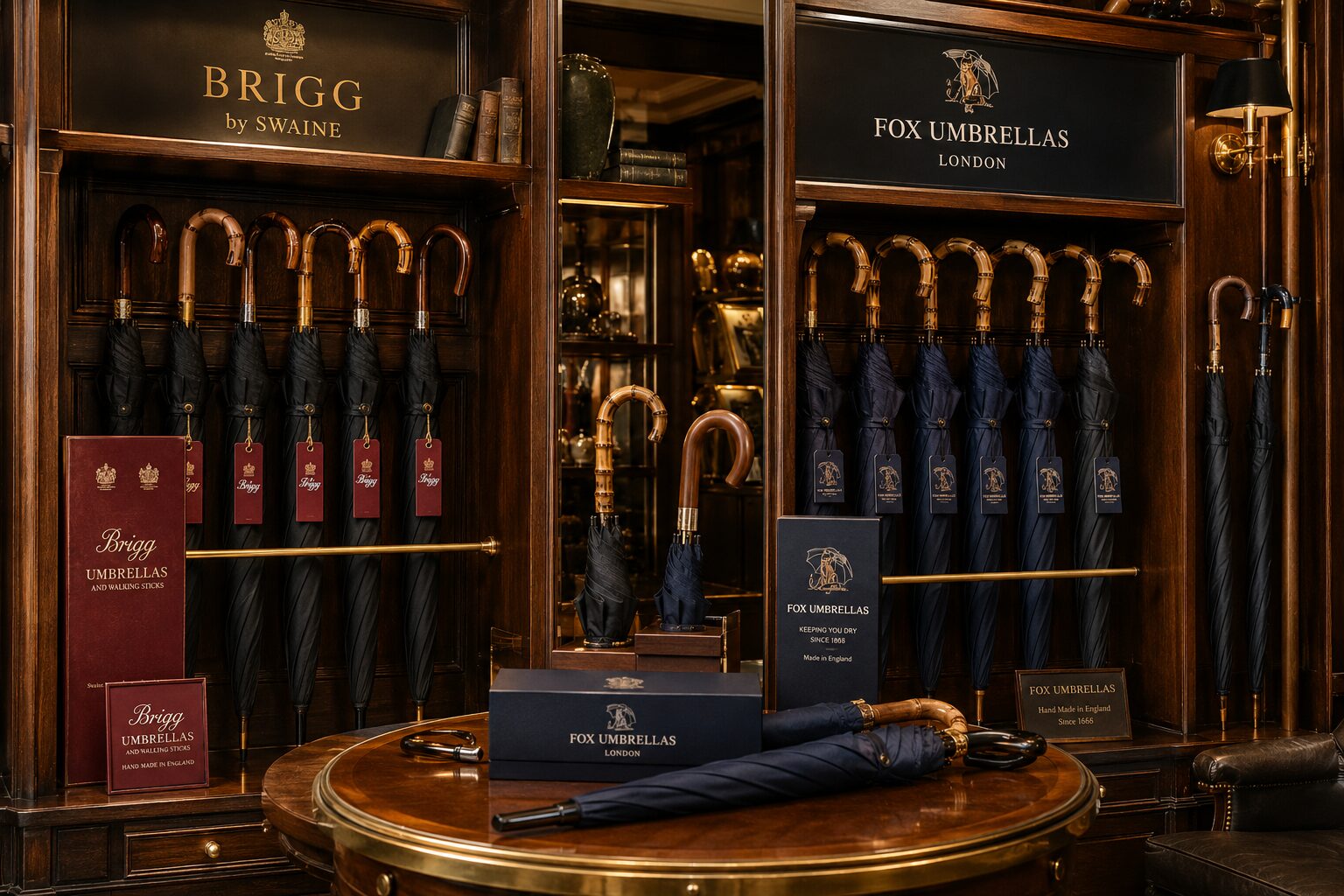
Fox Umbrellas (London) — $300–$600 depending on the handle.
The benchmark. Solid-stick construction available — that means the shaft and handle are cut from a single piece of wood (chestnut, maple, ash, hickory). Hand-assembled in England since 1868. Genuine craft object. The canopy is tight-woven cotton-blend that beads water beautifully and re-waxes well.
Who it’s for: a man in his 40s or 50s who already owns Edward Green shoes and a Patek, and wants the umbrella equivalent. Not a starter umbrella.
Tradeoff: it’s heavy. It’s a commitment. You will not forget it in a cab, because you’ll feel its absence the way you’d feel a missing wallet.
Brigg (Swaine) — $400–$800.
Britain’s other heritage house. By appointment to the Royal Family for over a century. Generally a bit dressier than Fox — more leather-wrapped handles, more formal silhouettes. If Fox is country squire, Brigg is gentleman’s club.
Who it’s for: the formalist. Pair with a chesterfield overcoat.
Buy-It-For-Life Tier: $100–$200
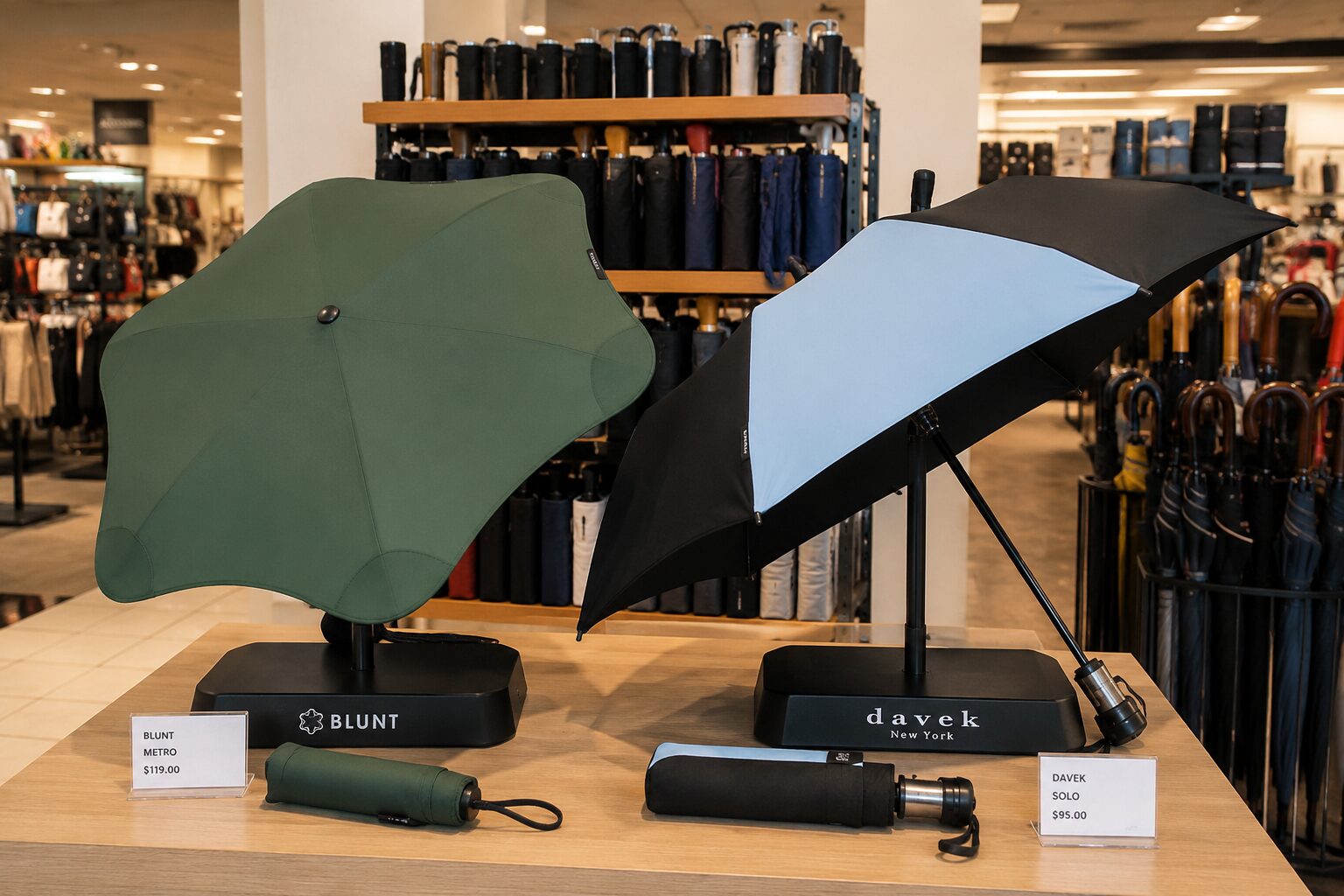
Davek Solo — about $99.
Probably the best compact umbrella made in America. Auto open/close, double canopy, fiberglass ribs, and the company offers an unconditional lifetime guarantee plus a loss replacement program (lose it, they sell you a replacement at half off, no questions asked — which acknowledges reality). Mine has been to four countries.
Who it’s for: the traveler. The commuter. The guy who wants one excellent compact and never thinks about it again.
Tradeoff: it’s heavier than a cheap travel umbrella. About 1 lb. You feel it in a briefcase.
Blunt Metro — $69–$89.
New Zealand engineering. The corners of the canopy have rounded “blunt” tips instead of sharp points — looks weird at first, then you realize it makes the whole canopy more aerodynamic and you stop snagging people’s coats on a crowded sidewalk. Rated for serious wind. Tested in Wellington, which is one of the windiest cities on earth.
Who it’s for: the city commuter who walks a lot and deals with real weather.
Tradeoff: aesthetic is modern, not traditional. Doesn’t pair perfectly with a chesterfield coat. Pair it with a topcoat and a briefcase and it looks right.
Sweet Spot: $40–$80
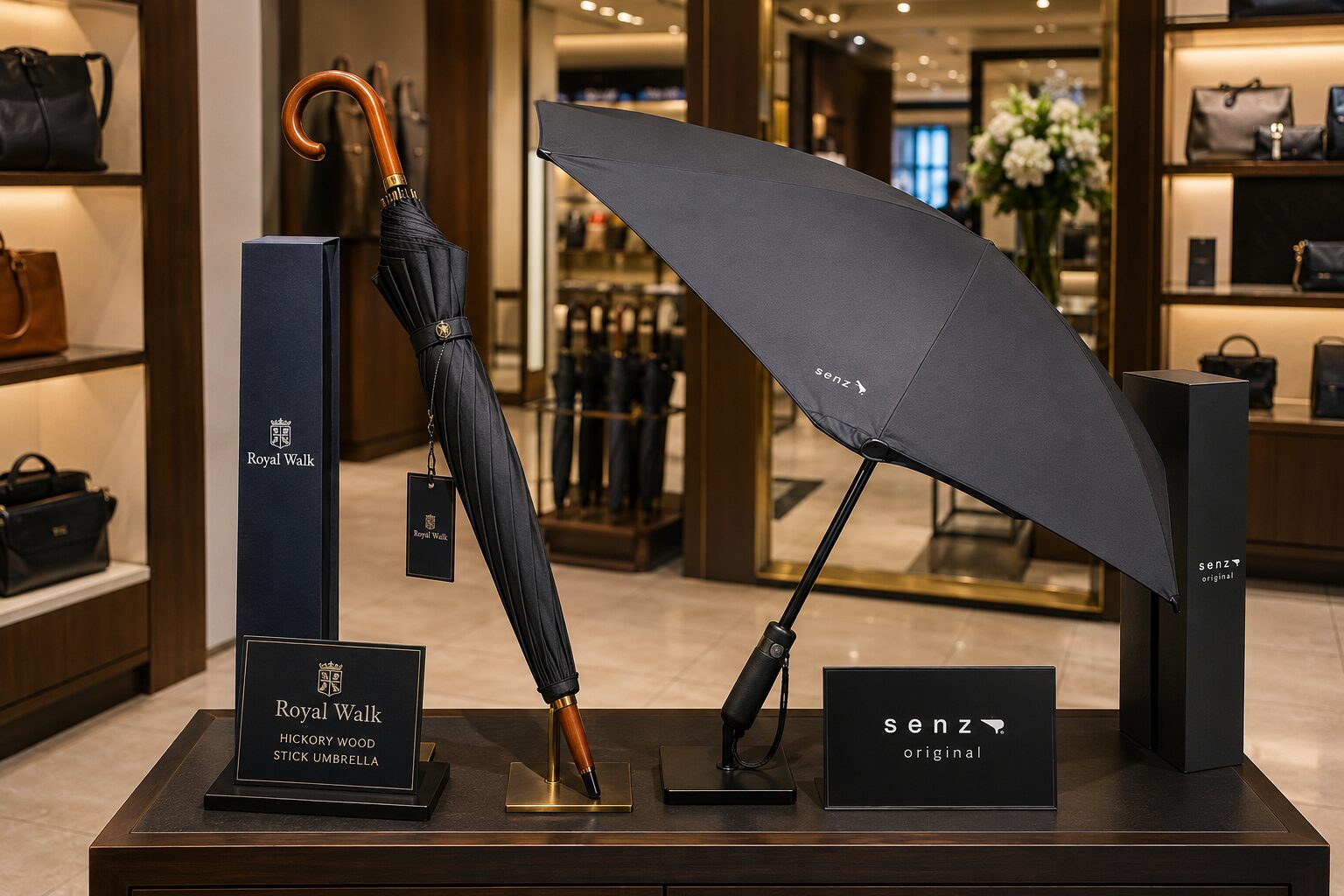
Senz Original — $65–$80.
This is the wind specialist, and it deserves its own beat. The canopy is asymmetrical — longer in front, shorter in back, like an aerodynamic teardrop. The whole thing is designed to pivot into the wind so gusts pass over instead of under. It’s rated to 70 mph (Beaufort 10), which is straight-up gale force. I’ve used one in Wisconsin in February when my neighbors’ umbrellas were rolling down the street like tumbleweeds.
Who it’s for: anyone who lives in a windy city. Chicago, Boston, San Francisco, anywhere on the Great Lakes or the coast.
Tradeoff: it looks like an engineering thesis. Not a dress umbrella. Carry it for function.
Royal Walk Hickory Wood Stick Umbrella — $45–$70.
The honest sweet spot for a traditional stick umbrella. Real wood handle, full-length canopy, fiberglass ribs (a smart concession to durability), looks correct with a suit. Not Fox. But also not Fox money.
Who it’s for: a guy in his 30s who wants his first proper dress umbrella and isn’t ready to drop $400.
Tradeoff: the shaft isn’t solid-cut. The canopy is polyester, not waxed cotton. You can tell the difference up close. From across the street, you cannot.
Budget Pick That Doesn’t Suck: $25–$40
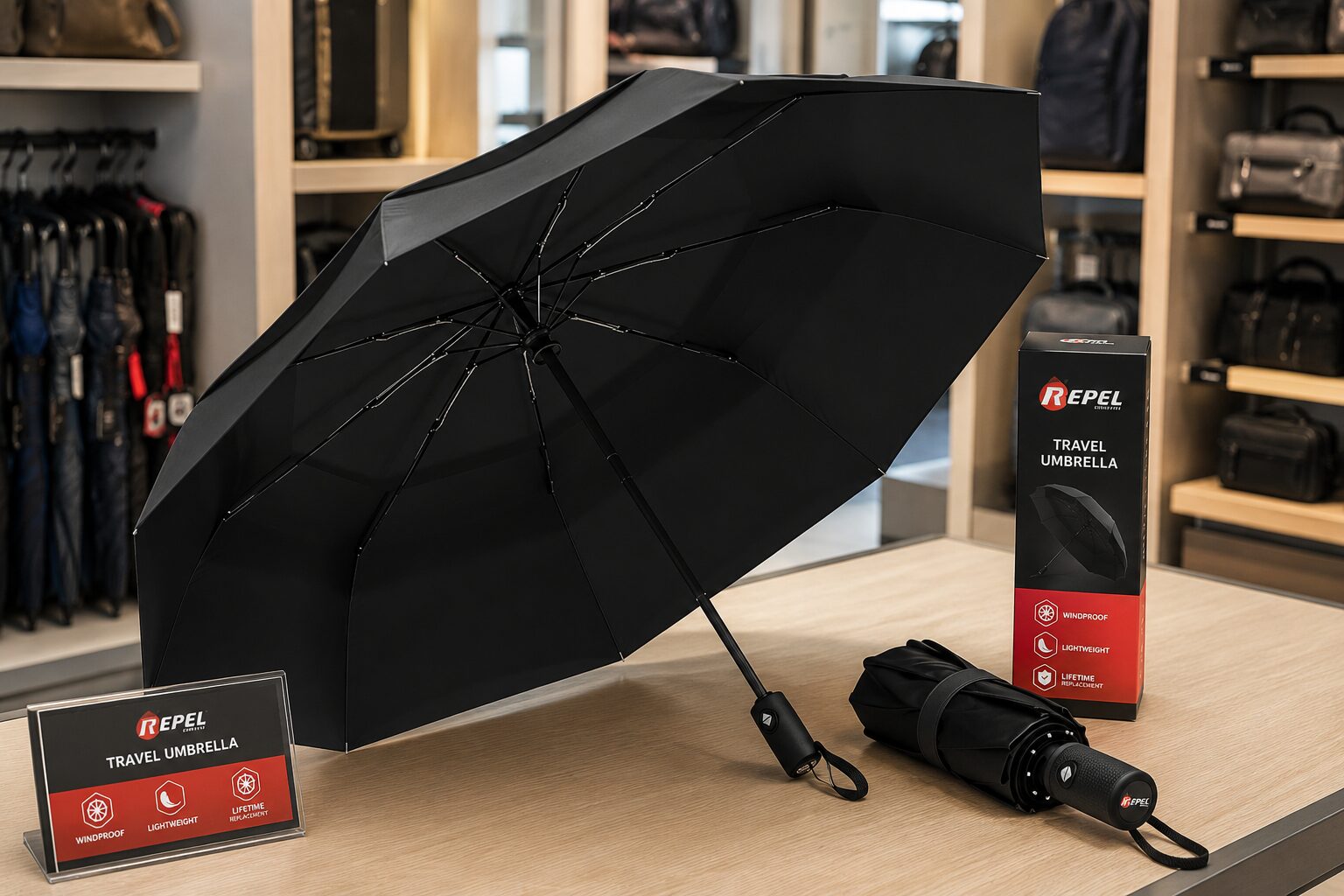
Repel Travel Umbrella — $25–$30.
The honest budget hero. Double canopy, fiberglass ribs, auto open/close, nine ribs instead of the cheap eight. You can buy four of these for the price of a Davek, and they actually work. They’ll last 2–3 years of regular use instead of 10, but the math still beats drugstore umbrellas by a wide margin.
Who it’s for: the guy who loses umbrellas. The guy who needs one in every car, one at the office, one in the gym bag. Buy three. Stash them.
Tradeoff: the build quality is fine, not great. The handle is plastic. Looks generic. But it works, and that’s the whole job.
Common Mistakes Men Make With Umbrellas
A few patterns I see constantly:
Buying the cheapest one at the moment they need it. You’re soaked, you grab a $10 umbrella from a hotel gift shop, you throw it away three days later. Repeat 20 times over a decade and you’ve spent $200 on garbage. Buy one good one ahead of the rain.
Owning only a compact. A folding umbrella in a briefcase is great. But when you’re walking out of a black-tie event in a topcoat, a compact looks small and apologetic. A stick umbrella looks right.
Owning only a stick. Conversely, lugging a 32-inch stick umbrella through airport security is a problem. Have both.
Treating it as a sword. I see this in every city. Guy walking down the sidewalk with the umbrella tucked horizontally under his arm, point sticking out three feet behind him. He has no idea. Don’t be him.
Rolling it wet. Kills the fabric. Kills the springs. Five minutes of drying open prevents two years of slow decay.
Forgetting it. This is a real problem and it’s why Davek’s loss-replacement program exists. Give your umbrella a home — same hook by the door, same pocket in the briefcase, every time. Then you’ll notice when it’s missing before you walk out.
A Quick Word About Rain And The Rest Of Your Wardrobe

The umbrella is one piece of staying dry. The other pieces are a real overcoat and shoes that handle wet pavement. If you’re investing $100+ in an umbrella, you’ve already done the math on the rest of it — but if not, see our overcoat guide and the piece on how to protect your leather shoes from rain and salt.
Wool overcoats with a turned-up collar, leather-soled shoes treated with Saphir Renovateur and a good sole-edge wax, and a proper umbrella will get you through any winter on the East Coast or Midwest.
This is the kind of small-systems thinking that separates well-dressed men from guys who own nice clothes and don’t know how to live in them.
The Complete Men’s Umbrella Reference
Format, features, and picks — everything in one place
? The Three Formats
| Format | Best For | What To Know |
|---|---|---|
| Classic Stick | Formal | Full-length, 32–36″ closed. Pairs with a suit and overcoat the way cap-toe oxfords pair with charcoal trousers. Can double as a walking stick. Keep out of airports. |
| Compact / Folding | Any occasion | Lives in your briefcase or car. Only works if it has a double canopy + fiberglass ribs. The umbrella you don’t have with you is worse than the cheap one you do. |
| Golf Umbrella | Outdoors only | 60–68″ canopy. Ideal for sidelines, school runs, open spaces. Wrong move on a crowded city sidewalk. Keep one in the trunk — don’t carry it to the office. |
? Two Features That Actually Matter
| Feature | What To Choose | Why It Matters |
|---|---|---|
| Ribs | Fiberglass over steel | Steel ribs kink once and stay kinked. Fiberglass flexes under a gust and snaps back. This single spec separates umbrellas that survive storms from ones that die in them. |
| Canopy | Double (vented) over single | A second layer with a gap lets wind pass through instead of pressurizing underneath. This is why cheap umbrellas flip inside out. Single canopy + steel ribs = guaranteed casualty. |
? Matching To Your Wardrobe
| Your Outfit | Canopy + Handle To Choose |
|---|---|
| Navy or charcoal suit, dark overcoat | Black canopy, dark wood or leather handle. Buy this one first — it’s your default. |
| Brown, tan, or olive tailoring | Navy canopy, lighter wood handle (maple, oak, malacca). |
| Tweed, country-gentleman register | Patterned canopy (tartan, glen check) with a crook handle. Only if tweed is already in your regular rotation. |
| Casual / weekend | Anything goes. Bright canopies, patterned shafts. Coordinate the handle leather to your shoes. |
? The Picks — Best Men’s Umbrellas By Tier
| Umbrella | Price | Who It’s For |
|---|---|---|
| Fox Umbrellas | $300–$600 | The benchmark. Solid-stick, hand-assembled in England since 1868. For the man who already owns Edward Green shoes and wants the umbrella equivalent. Heirloom tier. Will outlast you. |
| Brigg (Swaine) | $400–$800 | Dressier than Fox. By appointment to the Royal Family. Pair with a chesterfield overcoat and a gentleman’s club. The formalist’s choice. |
| Davek Solo | ~$99 | Best compact made in America. Double canopy, fiberglass ribs, lifetime guarantee + half-price loss replacement. Has been to four countries. Best single compact to own. |
| Blunt Metro | $69–$89 | New Zealand engineering. Rounded canopy tips reduce snagging. Tested in Wellington — one of the windiest cities on earth. Looks right with a topcoat and briefcase. Best for daily city commuting. |
| Senz Original | $65–$80 | Asymmetric canopy designed to pivot into the wind. Rated to 70 mph. Looks like an engineering thesis — because it is one. Best for windy cities (Chicago, Boston, SF). |
| Royal Walk Stick | $45–$70 | Real wood handle, full-length canopy, fiberglass ribs. Looks correct with a suit at thirty feet. Not Fox — but not Fox money either. Best first dress umbrella. |
| Repel Travel | $25–$30 | Double canopy, fiberglass ribs, nine spokes. Lasts 2–3 years of real use. Buy three and stash them. Best for guys who lose umbrellas. |
The jump from $12 to $50 is enormous. From $50 to $150 is meaningful. Most men should land in that $50–$150 range and never think about it again.
FAQ
What’s the best umbrella for men if I can only buy one?
If you can only own one, get the Davek Solo. It’s compact enough to travel, well-built enough to last a decade, and looks appropriate with both a suit and a casual jacket. If you wear suits daily and want one statement piece, get a Fox or Royal Walk stick umbrella instead.
What size umbrella do I need?
For a compact, a canopy of 38–42 inches across (when open) covers one adult in a suit. For a stick umbrella, 44–48 inches. For a golf umbrella, 60+ inches. Bigger isn’t always better — too large and you’re a hazard in crowds.
Are expensive umbrellas worth it?
Yes, but with a ceiling. The jump from a $12 umbrella to a $50 one is enormous in quality. The jump from $50 to $150 is meaningful. The jump from $150 to $500 is mostly craft, materials, and heritage — real, but diminishing returns. Most guys should land in the $50–$150 range.
How long should a good umbrella last?
A good compact: 5–10 years of regular use. A well-made stick umbrella: 15–30 years, sometimes longer. Fox umbrellas regularly get passed down. Treat it right and it outlasts your car.
Stick or compact — which one first?
Compact, for most guys. It’s more versatile and it actually gets carried. A stick umbrella only helps you on days you remember to grab it.
Bottom Line
One good men’s umbrella beats five throwaway ones. The math is obvious, the upgrade is cheap, and the difference shows up the first time you walk out of a meeting in February with dry shoulders and a wood handle in your hand instead of a wad of broken metal in a trash can.
Treat it like your wallet. Give it a home. Take it with you. Replace the canopy or send it for repair when something breaks instead of tossing the whole thing. After 20 years of building Real Men Real Style and testing every category of accessory I could get my hands on, I can tell you the umbrella is one of the highest-leverage upgrades you can make. It’s small, it’s visible, it touches your wardrobe almost every week of the year, and almost no one does it well.
Be the guy who does it well.
Stay dry, gentlemen.
Also read: