
A guy emailed me last month with a photo. He’d just bought his first pair of pleated, fuller-cut chinos after a decade in slim fit. The fit was right on paper — relaxed thigh, gentle taper, hitting the top of the shoe. But he looked like he was wearing his dad’s pants.
The chinos weren’t the problem. His whole outfit was. He’d kept his slim-cut polo, his low-profile sneakers, his thin leather belt — every piece calibrated for a slim-fit silhouette. So when the pants got fuller, the proportions broke.
That email is the reason I’m writing this. The whole “slim is dead, wide is back” conversation has been hammering away online for two years, and most of the advice is junk. Either the writer is a 22-year-old fashion blogger telling you to swim in a pair of trousers two sizes too big, or it’s a brand selling you a “fuller chino” that’s really just last year’s slim with an extra half-inch in the thigh.
Here’s what’s actually going on. Slim-fit chinos aren’t dead. Fuller chinos aren’t a fad. They’re two different tools, and most men in the 25-to-50 range I write for need both — one for work and one for weekends, or one for now and the other in rotation when you’ve changed body weight, settings, or how dressy your life has gotten.
This article is about choosing between them on purpose. Not chasing a runway. Not panicking that your pants from 2019 suddenly look wrong. Choosing.
What “Slim” and “Fuller” Actually Mean (in Inches, Not Vibes)
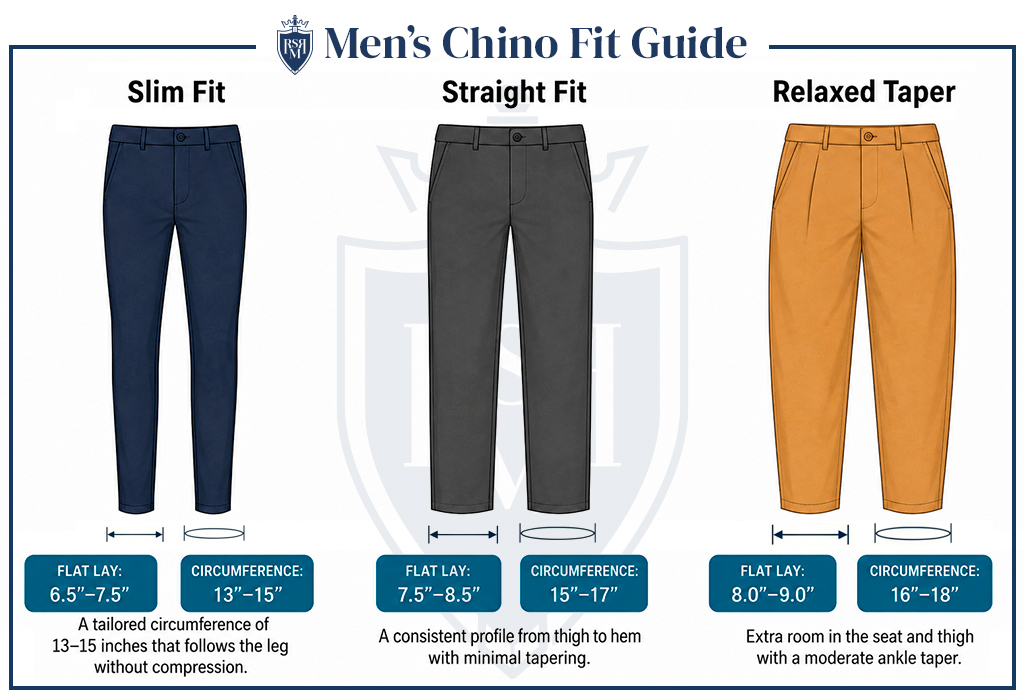
The fashion press loves to throw around words like “relaxed” and “modern” and “elevated” without telling you what they actually measure. Brands do the same. One company’s “slim” is another company’s “athletic.” So before we go anywhere, let me give you numbers a tailor would actually use.
- A slim-fit chino typically has a leg opening (measured flat across the bottom hem) of about 6.5 to 7.5 inches. Doubled, that’s a 13- to 15-inch circumference at the ankle. The thigh measurement is close to the leg without compressing it. Classic examples: J.Crew’s 484, Bonobos slim, Banana Republic’s slim Aiden.
- A straight-fit chino runs about 7.5 to 8.5 inches across the hem — call it 15 to 17 inches in circumference. The leg goes from thigh to hem with little taper. Think Dockers Alpha straight, Levi’s XX Chino standard, Carhartt WIP Sid.
- A fuller, relaxed-taper chino — the cut that’s having its moment — usually runs 8 to 9 inches across the hem (16 to 18 inches around) but with a meaningfully wider thigh and hip. Madewell’s Relaxed Taper, for example, sits at a 13.25-inch leg opening — wider than a slim, narrower than true wide-leg trousers. Relaxed at the thigh, tapered through the calf, lands at the ankle.
- A wide-leg trouser is a different animal entirely. Anything with a leg opening over 9 inches flat (18+ around), no taper, full thigh — that’s not what we’re talking about today. That’s a separate decision. Read more: Are wide-leg pants for men stylish?
The takeaway: when you read “fuller chino,” what you’re really looking for is a relaxed thigh with a slight-to-moderate taper. Not a parachute. The volume sits up high — through the seat and thigh — and the leg cleans up by the time it hits your shoe.
Where Slim-Fit Chinos Still Win

When I started fitting bespoke clients in the early 2000s, slim was still controversial. Then it took over. From roughly 2010 to 2020, slim was the default — and the default got pushed too far, into spray-on territory, and that’s the version of slim everyone now wants to declare dead.
Real slim, fit to your actual leg, isn’t dead. It still wins in three specific places.
- The office, with a sport coat or blazer. A slim-cut chino keeps the proportion clean when you put a structured jacket on top. Fuller pants under a fitted jacket make your top half look small and your bottom half look mushy. If you wear a navy blazer over chinos for client meetings — and a lot of you do — slim is still the safer choice.
- Smaller frames. If you’re 5’7″ and 145 pounds, fuller chinos can swallow you. The volume needs a body to push against. Lean and shorter guys generally look sharper in slim or slim-straight cuts because the silhouette stays defined. I’m 5’8″ myself, and I keep one rotation of slim-straight chinos in my closet for that exact reason.
- Boots and dressier shoes. Slim chinos sit cleanly over a Chelsea boot or a chukka, or a leather sneaker without bunching. The narrower opening tucks visually around the shoe instead of breaking on top of it. If 70% of your shoe rotation is dress-leaning, slim is doing more work for you than fuller is.
The trap with slim is when guys confuse “slim” with “tight.” You should be able to pinch about an inch of fabric at mid-thigh between your fingers. If the pant pulls horizontal lines across the front when you stand, it’s too small. Same goes if you can see the outline of your wallet through the back pocket. Slim fit means cut close to the leg’s natural shape — not painted on.
Where Fuller Chinos Win
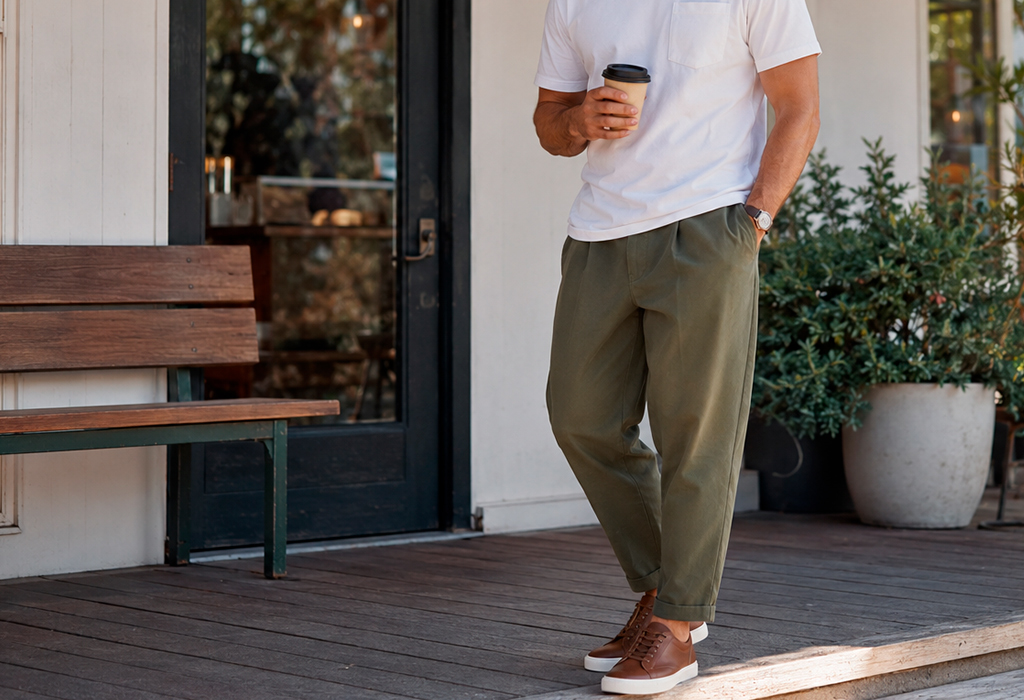
Now the other side. Fuller chinos earned their comeback honestly. Three things drove it.
First, comfort changed. After 2020, men got used to clothes that didn’t dig into them at 3 p.m., and slim fits with no stretch are the worst offenders for that. A fuller cut breathes through the thigh and the seat, which is why guys who’d retired their slim chinos kept reaching for the relaxed pair.
Second, the rest of menswear got fuller too. Shirts loosened up. Sport coats softened. Sneakers got chunkier. When everything around the pant is bigger, slim chinos start to look spindly by comparison — like a coffee straw stuck under a sandwich.
Third, body types that always struggled in slim — guys who lift, guys with athletic legs, guys carrying 20 pounds more than they did a decade ago — finally have a flattering option that isn’t “size up and accept the pooling at the knee.”
Where fuller chinos genuinely outperform slim:
- Built-up legs. If you squat, cycle, play hockey, or just have your dad’s quads, slim chinos compress your thighs and balloon at the calf. A relaxed-taper cut gives the thigh room to exist, then cleans up below. Bonobos’ athletic fit was the first mainstream answer to this, and the relaxed-taper boom is the broader version of the same logic.
- Casual settings, especially weekends. Saturday brunch, dropping your kid at practice, dinner at a friend’s place — fuller chinos read more relaxed than slim without crossing into sloppy. They also sit better when you’re sitting, which sounds obvious until you’ve spent four hours at a kid’s birthday party in a slim cut.
- Heavier fabrics and heritage colors. Olive, ecru, dark khaki, brown, faded navy — fabrics with weight (10 oz cotton twill or higher) drape better in a fuller cut. The pant moves like a real trouser, not a Lycra blend pretending to be one.
- Pleats — if your build can carry them. A single forward-pleat on a fuller chino reads classic, not costume. They add room exactly where you want it (seat, thigh) without adding bulk where you don’t. Skip pleats if you’re under 5’8″ or under about 165 pounds — they tend to overwhelm shorter or leaner frames. Read: Pleats pants.
The trap on the fuller side is going too wide. A relaxed taper is not the same as a wide-leg trouser, and the second you cross into 9.5″+ leg opening territory with no taper, you’re fighting a much harder styling battle. Stay in the relaxed-taper zone — fuller through the thigh, narrower at the hem — and you’ll look intentional instead of trendy.
How to Decide: A Question Set That Actually Helps

Forget the “what’s trending” question. Run through these instead.
What does 70% of your week look like? If most of it is desk work with the occasional client meeting, lean slim. If most of it is remote work, kid logistics, side hustle, or a creative-industry job where the dress code is fuzzy, lean fuller. Build for the bulk of your life, not the edge cases.
What’s on top? Tucked oxford with a blazer over it? Slim. Untucked overshirt and a heavyweight tee? Fuller. The pant should rhyme with the volume of your shirt and outerwear.
What’s on your feet? Dress shoes, low-profile leather sneakers, sleek Chelsea boots — slim. Chunky leather sneakers, white trainers, ranger boots, loafers worn casually — fuller works just as well, and often better.
What’s your build? Tall and lean: both work, slight edge to slim for dressier and fuller for casual. Athletic with built-up legs: fuller, with a tapered leg opening. Shorter and slim: slim. Carrying weight in the midsection: fuller is more flattering than slim, and the wider thigh balances the front profile.
What’s your age, roughly? I hate making style about age, but it matters here. Under 30, you can wear either credibly. 30 to 45, you’re the sweet spot for both — most of you should own a pair of each. Over 50, fuller cuts almost always read better than slim, because slim on a 55-year-old man tends to emphasize whatever softness has settled in.
If you can answer those five questions honestly, the decision usually makes itself.
How to Transition From Slim to Fuller Without Looking Like You’re in Costume

This is the part most articles skip, and it’s where the email I started with comes in.
If your closet has been built around slim-fit pants for ten years, you can’t just swap in fuller chinos and call it a day. The rest of your outfit was calibrated for slim. Drop fuller pants into it and the proportions break — exactly what happened to that reader.
Here’s the transition sequence I walk guys through.
Step 1: Add fuller chinos to the casual rotation first, not the work rotation

Buy one pair of relaxed-taper chinos in a versatile color — olive or stone or a faded navy. Wear them on weekends only for the first month. Don’t try to wear them to the office yet. The casual setting forgives a learning curve. Conference rooms don’t.
Step 2: Adjust your tops before you adjust anything else

The single biggest mistake men make with fuller pants is keeping their slim-cut shirts. Your proportions go sideways instantly — like a Q-tip turned upside down.
When you go fuller on the bottom, your top needs more room too. Not oversized. Not boxy. Just relaxed, with a hem that hits at mid-fly when untucked. A boxy-cut tee, a boxier OCBD with a slightly cropped hem, an overshirt instead of a slim cardigan — these are the moves. Your existing slim-cut pieces aren’t wrong, they’re just not the right partner for fuller pants.
Step 3: Rethink your shoes

Slim pants and minimalist sneakers were a perfect couple for a decade. With fuller chinos, those same shoes can look orphaned — small, fussy, off-balance.
Try chunkier leather sneakers, ranger-style boots, loafers with some sole presence, or even a clean white trainer with a thicker midsole. Same brands, different model. You don’t need a new shoe budget — you need a different shoe choice from what you already own.
Step 4: Get comfortable with the break

If you’re a slim-fit guy, you’ve spent a decade with no break or a quarter break — your pants barely kissing your shoes. Fuller chinos take a fuller break, usually a half-break or a soft full break, where the fabric rests on the shoe and creates one gentle horizontal fold. It feels weird at first. It’s correct. Resist the urge to hem them too short.
Step 5: Mix, don’t replace
Don’t toss your slim-fit chinos. They still earn their place — work meetings, dressier nights, dressier shoes. The right ending state is a closet with both cuts: slim for when you need a sharper line, fuller for when you want ease and presence. Two pairs of each in colors you actually wear is plenty.
When I shifted my own rotation, I added fuller cuts in 2023 and didn’t get rid of a single slim pair. Three years later I still wear both, depending on the day.
A Note on Pleats, Cuffs, and Other Details Guys Get Wrong

A few specifics worth nailing down, because the difference between “intentional” and “trying too hard” comes down to these.
- Pleats. A single forward pleat on a fuller chino is classic and adds room without bulk. Double pleats are harder to pull off — they read either heritage-trad (good if that’s your lane) or Steve Buscemi in Boardwalk Empire (not the goal). Skip pleats entirely if you’re under 5’8″ or lean — they overwhelm a smaller frame.
- Cuffs. A 1.5-inch cuff (turn-up) on a fuller pant is one of the cleanest looks in casual menswear right now. It anchors the pant visually, balances the fuller leg, and reads polished. Don’t cuff a slim chino — the proportions don’t work, and it’ll just look like you forgot to hem. Read: Should men wear cuffed pants?
- Belt or no belt. Fuller chinos sit best at the natural waist or just above the hip — they need a structured waistband to keep their shape. A 1.5-inch leather belt in brown or burgundy almost always wins. Skip the canvas belts and the woven stuff for this style — it pulls the look too casual. Slim chinos can get away with a thinner belt or no belt at all.
- Fabric weight. This is the underrated decision. A 7 oz lightweight cotton twill works for slim but looks limp in a fuller cut. Fuller chinos want 9 to 12 oz fabric — heavier twill, brushed cotton, even a cavalry twill or moleskin in cooler months. The weight makes the drape, and the drape makes the cut.
- Color. Fuller chinos look more intentional in earth tones and heritage shades — olive, stone, ecru, faded navy, dark brown, chocolate. Slim chinos are more forgiving with bolder or brighter colors because the smaller silhouette absorbs the color easier. Tan and khaki work in both cuts but lean cleaner in slim.
The Real Test

Here’s the test I give clients when they can’t decide between two cuts in a fitting room. Stand in front of a full-length mirror. Take a photo from three angles — front, side, three-quarter. Then walk away and look at the photos five minutes later.
If your eye goes straight to the pants, the cut is wrong — too tight, too baggy, the wrong shape for your build. When your eye goes to your face, your shoulders, the overall silhouette — and the pants just sit there doing their job — the cut is right.
Pants are infrastructure. They support the rest of the outfit. The second they become the thing you’re looking at, something’s off.
This applies to slim. It applies to fuller. It applies to whatever shape comes next in five years when fashion writers tell us straight-leg is the new fuller.
The cut that wins is the cut that disappears.
What to Buy First (If You Only Buy One Pair)

If you’re starting fresh and can only afford one pair of chinos in the next month, here’s how I’d play it based on your life:
- Office every day, sport coat-friendly: slim or slim-straight in dark navy, around $90–120. Bonobos slim, J.Crew 484, Banana Republic Aiden.
- Hybrid remote/office, business casual: straight fit in stone or olive, $90–150. Dockers Alpha straight, Bonobos straight, J.Crew 770.
- Mostly casual, weekend-leaning: relaxed taper in olive or ecru, $90–180. Madewell Relaxed Taper, Banana Republic Tapered, Buck Mason Ford.
- Built-up legs, athletic build: athletic fit or athletic-taper, $98–150. Bonobos Athletic, Lululemon Commission Slim (yes, despite the name — the cut is closer to athletic-taper), Tapered Menswear chinos.
Pick the one that matches the bulk of your week. Wear it for a season. Then add the other end of the spectrum once you know which gaps you have.
Read more: Chino Pants For Men – The Ultimate Buying Guide
The Bottom Line

Slim-fit chinos and fuller chinos aren’t enemies. They’re tools. The guy who owns both, who knows which to reach for on which morning, looks more put-together than the guy chasing whichever cut is currently winning the internet.
Choose based on your build, your life, and what’s already in your closet — not based on what a fashion blog told you was over. If you’ve been in slim for a decade, your transition to fuller works best as an addition, not a replacement. And if you’ve never owned slim, a well-cut slim chino is still one of the most versatile pants a man can buy.
Don’t chase. Build. Two pairs in each cut, in colors you’ll actually wear, and you’ve got the chino part of your wardrobe handled for the next five years — whatever the runways decide to do.
If you want a structured way to build the rest of your wardrobe with the same logic — own less, but own the right things — I put together the RMRS interchangeable wardrobe foundation guide that walks through every piece category the same way I just walked through chinos. It’s free, and it’ll save you from making the same expensive mistakes I see clients make every year.