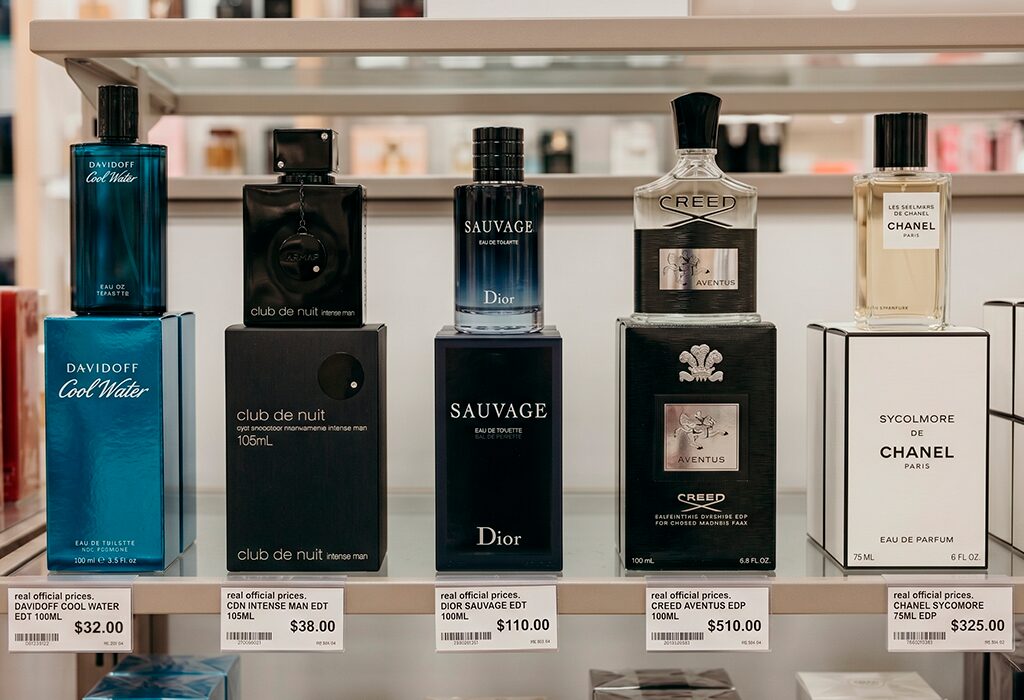
You’re standing at the Nordstrom fragrance counter. The guy two spots down is spraying a $30 bottle of Nautica Voyage. A man on the other side is testing something in a crystal decanter with a $480 price tag. Same store. Same hour. Sixteen-times difference.
Is the expensive one sixteen times better?
Sometimes. Sometimes not even close.
I’ve been collecting fragrances seriously for the better part of two decades, and a few years ago I got so fed up with the marketing in this industry that I started Mission Fragrances to do it differently.
Along the way I’ve learned something that still surprises most guys: the same master perfumer — the people in the trade call them noses — will sometimes compose a $20 drugstore fragrance and a $300 niche bottle in the same year. A cheap fragrance can genuinely outlast a luxury one on your skin. And a $500 “exclusive” can smell shockingly safe.
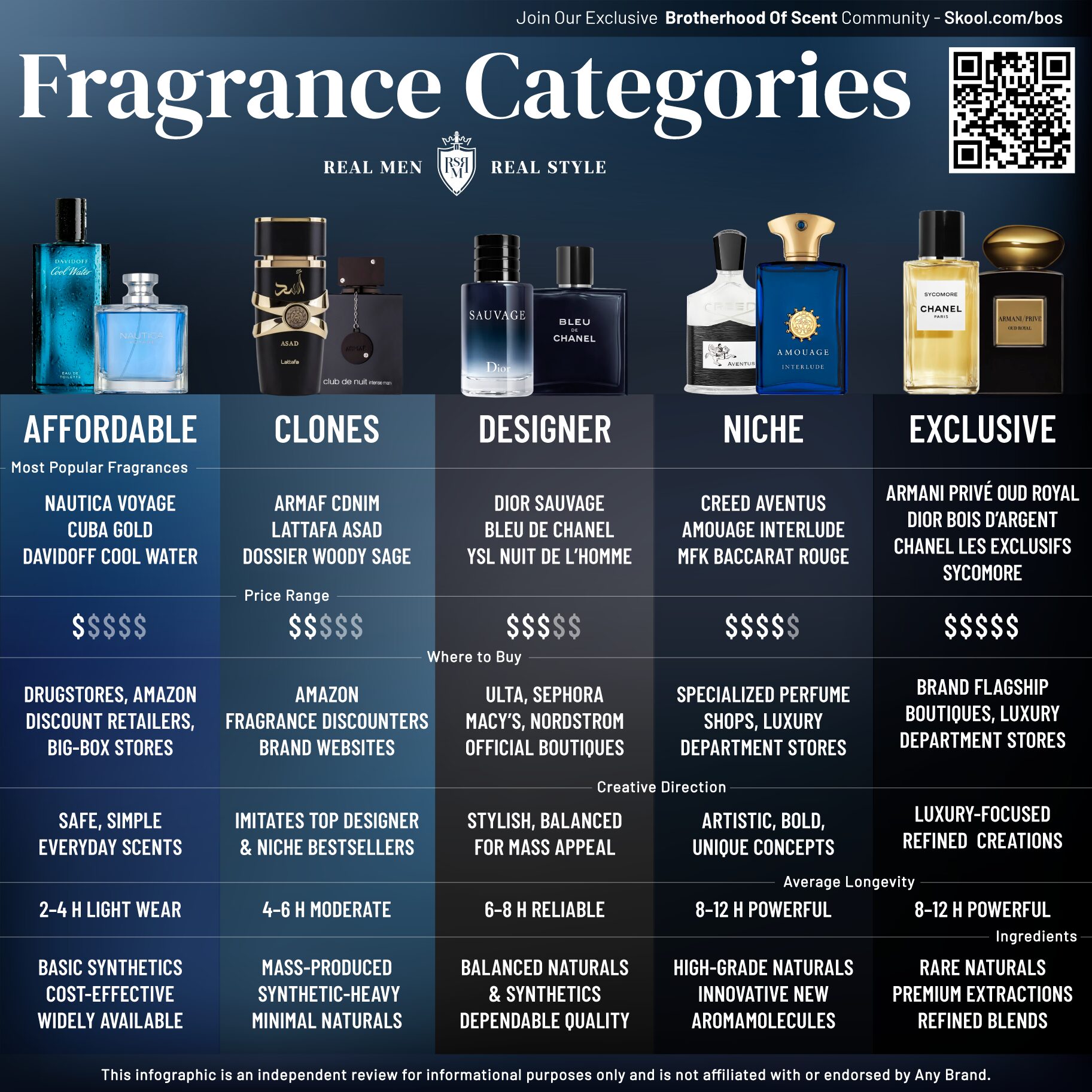
There are five fragrance categories worth knowing. Affordable. Clones. Designer. Niche. Exclusive. Each one runs on its own logic. Once you understand them, walking into a fragrance counter stops being intimidating and starts being interesting.
One thing I want you to hold onto the whole way through, gents: price is not a proxy for quality. Prestige is not a guarantee of performance. The bottle on the top shelf isn’t always the best one.
1. Affordable Fragrances
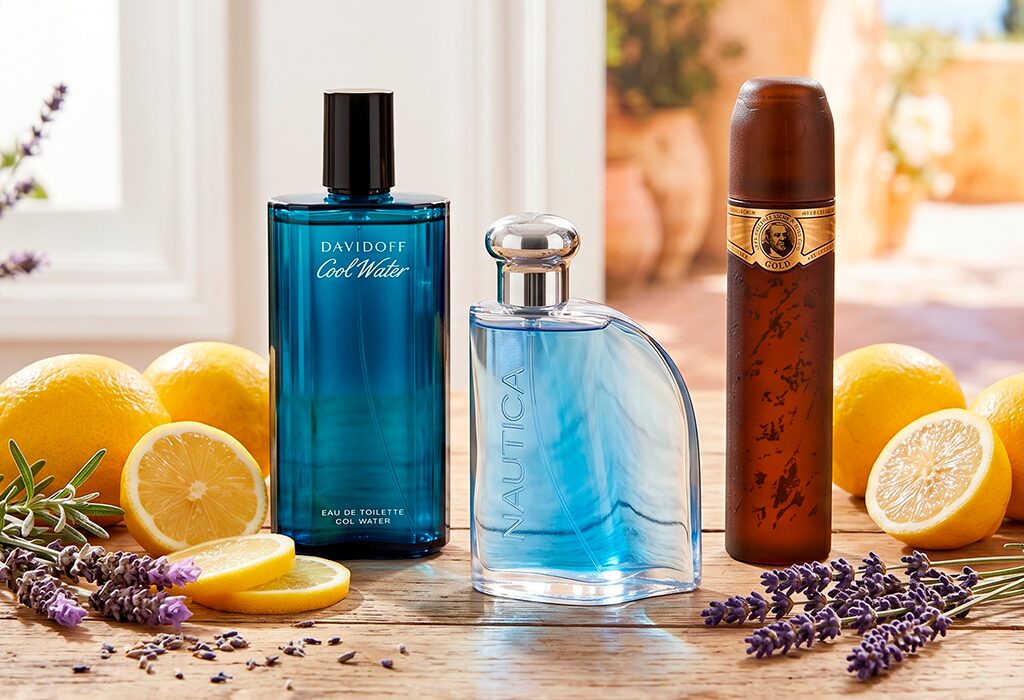
Walk into any Target, Walmart, or TJ Maxx and this is what you’re looking at. Under $40, sometimes under $20, sold everywhere. These are the fragrances the industry calls “mass market,” and the brief given to the perfumer is almost always the same: make something broadly pleasant, cheap to produce, and safe for every nose in the room.
That sounds like a recipe for mediocrity. Usually it is. But not always — and this is where affordable fragrances get interesting.
Davidoff Cool Water. Launched in 1988. Basically invented the modern “fresh masculine” genre and still holds up almost forty years later. If you’ve ever smelled a generic men’s aquatic and thought “I know this smell” — you were probably smelling something Cool Water inspired.
Cuba Gold. A warm, smoky oriental that somehow smells rich for almost nothing. Not sophisticated. Not remotely complex. But wear it to a November date night and nobody’s asking about the price tag.

Nautica Voyage. A crisp aquatic that punches well above its price point. Composed by Maurice Roucel — who, by the way, is also the man behind Musc Ravageur for Frédéric Malle, a niche fragrance that retails for ten times as much. Same nose. Same talent. Different brief, different bottle, different world.
Now here’s what most guys don’t realize about this category. Some of these fragrances will absolutely outlast an expensive bottle on your skin. The workhorse synthetic molecules in cheap fragrances — certain musks, certain ambroxan variants — are tenacious regardless of what the bottle around them costs. Skin chemistry doesn’t care about your marketing budget.
What you don’t get at this tier is evolution. Cheap fragrances tend to smell the same at hour one and hour six. The opening is the whole show. Niche fragrances change on your skin like a good bourbon changes in the glass. Affordable ones just… stay.
That’s not a deal-breaker. It’s just the tradeoff. Know what you’re buying.
2. Clones and Dupes

A clone, also called a dupe, is a fragrance engineered to approximate a more expensive one at a fraction of the cost. Houses like Armaf, Lattafa, Alhambra, and Dossier have built entire businesses around this model, and I’ll be honest with you — some of them do it remarkably well.
Lattafa Asad is another one worth knowing. Dense, resinous, warm. Inspired by Dior Sauvage. Spot-on at a fraction of the price.
Dossier Woody Sage takes its cue from Jo Malone Wood Sage & Sea Salt. Clean, green, salt-edged. A surprisingly respectable take on a niche classic.
The best-known example is Armaf Club de Nuit Intense Man — CDNIM, if you spend any time in the fragrance forums. It’s a clone of Creed Aventus, which is the most influential men’s fragrance of the last twenty years and costs around $400. CDNIM costs about $30. Smoky, fruity, birch-forward, sharp pineapple opening. Is it Aventus? Not exactly. Is it 80% of Aventus for 8% of the price? Pretty much, yeah.

I’ve heard guys in the Brotherhood of Scent community argue for hours about whether CDNIM is actually better than Aventus. It’s not a crazy argument. The clone houses know their customers compare performance head-to-head against the original, which means they often over-engineer for longevity and projection. Some clones wear harder than the thing they’re imitating.
Here’s where the gap shows up, though — and I want to be straight with you on this, because the clone world has a lot of hype. A great fragrance isn’t just a set of notes. It’s how those notes move across the hours. The way the opening sheds into the heart, the way the heart settles into the dry-down, the way the last whisper at hour eight still feels like it belongs to the same story. That’s where clones typically lose. You get the photograph. You don’t always get the film.
Fair warning — if you blind-buy a clone based purely on “smells like Aventus” reviews, you might get home and realize you bought the poster, not the movie. Sample first. Always.
3. Designer Fragrances

This is where most men live, and for good reason. Designer fragrances — the stuff with Dior, Chanel, Armani, YSL, Tom Ford, Gucci on the bottle — run $60 to $200, sit on the main floor at Sephora and Nordstrom, and represent the overwhelming majority of what the average guy has ever sniffed. The creative brief at this tier is usually “broadly excellent,” and the best houses hit it.
Dior Sauvage EDP, composed by François Demachy, is probably the most complimented men’s fragrance of the past decade. A spicy-woody powerhouse with serious projection. If you’ve walked past a guy in a suit and thought what is that, there’s a real chance it was Sauvage.
Bleu de Chanel Parfum, Olivier Polge’s most refined version of the Bleu line, is the office-safe, date-safe, meeting-safe fragrance I’d hand to a man who owns exactly one bottle and wants it to work everywhere. Woody, aromatic, modern. Quiet confidence in liquid form.
YSL La Nuit de L’Homme, composed by Anne Flipo, is the one I’d hand a man on his way to a dinner where he wants to be remembered. Spicy, dark, warm. Genuinely seductive. Flipo, by the way, is one of the most respected noses working today, and this fragrance is one of the reasons why.
Now here’s where I have to be honest with you, gents, because the designer tier cuts both ways. A $120 bottle with a $15 million celebrity campaign behind it can smell like nothing in particular and fade before lunch. Don’t buy on the billboard. You’re shopping for juice, not for the face next to the juice.

On the other side, though — some of the greatest fragrances ever composed live in this tier and always have. Dior Fahrenheit, launched in 1988, is a petrol-violet-leather construction unlike anything before or since, and it’s still studied in perfumery schools today. Guerlain Habit Rouge, launched in 1965, is considered one of the founding pillars of modern men’s perfumery. Giorgio Armani Acqua di Giò redefined the aquatic genre in 1996 and every aquatic on the counter today is essentially a child of it. Chanel Pour Monsieur has been a benchmark of restrained masculine elegance for over sixty years.
Sixty years, gentlemen. The bottle on the counter has outlasted most marriages, most careers, and most of the fashion trends that came and went around it. That’s not marketing. That’s a fragrance earning its reputation one wear at a time, over generations.
4. Niche Fragrances
Now we get to the part of the map most men haven’t walked.
Niche fragrances run $150 to $500 and live in specialized perfume boutiques, dedicated niche retailers, and a handful of luxury department stores that carry curated selections. But the price isn’t really what defines niche. What defines niche is the why.
Where the Niche World Came From

By the 1970s, the global fragrance industry had consolidated around the big fashion houses. Formulas were engineered for the widest possible audience — safe, smooth, commercially tested. In 1976, a French chemist named Jean Laporte decided he’d had enough of it. He opened a small boutique on the Rue de Grenelle in Paris and launched L’Artisan Parfumeur, widely considered the first modern niche house.
His philosophy was radical for the time: use the finest naturals, give perfumers actual creative freedom, and make fragrances that could “both delight and shock.” His first release, Mûre et Musc, became a cult object in Paris within a year. Distribution was tiny. Marketing was almost nonexistent. The product was the point.
That’s the seed every niche house today traces back to, directly or indirectly.
What the Niche World Actually Does

The creative range inside niche is enormous. I’ll walk you through three directions it tends to go.
First, the ingredient obsession. Diptyque’s Philosykos is essentially a three-part meditation on a fig tree — the leaves, the fruit, the wood — and that’s the whole fragrance. Fig isn’t a note in the supporting cast. Fig is the composition.
Second, the poetic and evocative. Serge Lutens’ Ambre Sultan doesn’t just smell of amber; it evokes a place, a heat, a memory. Lutens writes about his fragrances the way a poet writes about a city he left decades ago. The perfume isn’t a product. It’s a metaphor made physical.
Third — and this is where niche gets genuinely wild — the provocative. État Libre d’Orange’s Sécrétions Magnifiques was designed to be unsettling. It evokes the raw edges of the human body in ways polite perfumery would never attempt, and when it launched it sparked a global argument about what a fragrance is even allowed to say. People left rooms wearing it. That was the point.
My Honest Take on Niche Right Now
Something has shifted in the niche world over the last decade, and it’s worth being honest about — because it changes what you’re actually buying when you spend $300 on a “niche” fragrance in 2026.
The luxury conglomerates moved in. LVMH acquired Maison Francis Kurkdjian. Puig took on L’Artisan Parfumeur — the house Jean Laporte founded in 1976 as a deliberate break from exactly that kind of corporate world. Estée Lauder brought Le Labo into its portfolio. One by one, the independents became part of something larger.
And some of these fragrances crossed fully into the mainstream. Creed Aventus went from a thing your European friend quietly recommended to a bottle in every airport duty-free. Baccarat Rouge 540 went from a perfumer’s cult release to one of the most recognizable fragrances on TikTok. That’s not a loss — it’s a shift. These houses reached a much wider audience, and a lot more men got introduced to genuinely well-made fragrance because of it. But it also means “niche” today sits closer to mainstream premium than it did ten years ago.
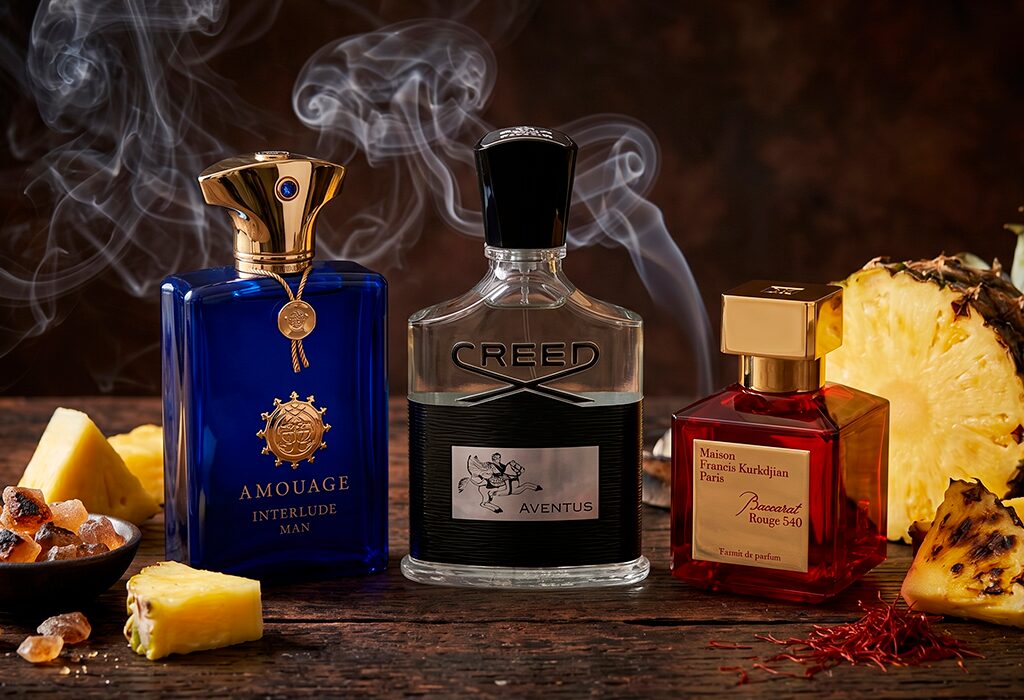
Three niche fragrances worth knowing, if you want a feel for the map:
Amouage Interlude Man — a dense, near-baroque construction of frankincense, oud, and leather. Demanding. Extraordinary. Not for every occasion, and not for every guy, but if it lands for you, nothing in the designer world will scratch the same itch.
Creed Aventus — the fragrance that put niche on the map for a generation of men. Polarizing in the community now because every batch smells slightly different and because the clone universe has more or less caught up. But genuinely iconic.
Maison Francis Kurkdjian Baccarat Rouge 540 — a remarkable amber-saffron-red musk accord unlike anything in the designer space, even now that you smell it on every fourth guy under thirty.

A fair warning on niche, though — and this is the piece most guys don’t hear until they’ve spent real money. Not everything with a $400 price tag and a crystal stopper is genuinely breaking new ground. MFK’s Aqua Media Cologne Forte is a beautiful green fennel and bergamot fragrance. It’s also composed by Francis Kurkdjian, the same nose who composed Elizabeth Arden Green Tea back in 1999 — a $20 drugstore bottle with noticeably similar DNA. Same hands. Very different price points. Many wearers find them nearly identical.
Sometimes you’re paying for rare materials and extraordinary depth. Sometimes you’re paying for a crystal bottle and a story. Your nose has to be able to tell the difference.
The Quiet Confidence of Wearing Something Uncommon
There’s something niche offers that’s harder to quantify but real. When you walk into a room wearing something nobody else in that room owns — something chosen because you chose it, not because a billboard told you to — it changes how you carry yourself.
I’ve seen it in my clients. I saw it in the Marines, honestly, in a completely different form — the guy whose boots were actually shined and whose cover sat exactly right stood differently from the guy who’d thrown his kit on in the dark. Distinction isn’t a smell. It’s a signal you send to yourself first.
5. Exclusive Fragrances
This is the category most often confused with niche, and the difference matters.
Exclusive fragrances are the ultra-premium sub-lines of the major fashion houses. Armani Privé — Giorgio Armani’s private collection. Chanel Les Exclusifs. Dior La Collection Privée. Guerlain L’Art et la Matière. Tom Ford Private Blend, which has blurred the line so much it almost sits in its own category now. These are $200 to $600-plus, sold only at brand flagship boutiques and a handful of luxury department stores.
What separates them from niche is the intent. Niche fragrances are the creative vision of independent houses and individual perfumers. Exclusives are the same in-house perfumers who compose the main line — Demachy at Dior, Polge at Chanel — but given rarer naturals, higher budgets, and briefs without commercial constraints. The fashion house saying: this is what we can do when nothing holds us back.
When I was training at the Savile Row Academy, the tutor used to make a distinction between a ready-to-wear suit and a bespoke suit from the same tailoring house. Same hands. Same traditions. Entirely different level of execution, because the brief was different. Exclusive fragrances are the bespoke version of designer fragrances. That’s the cleanest analogy I know for it.
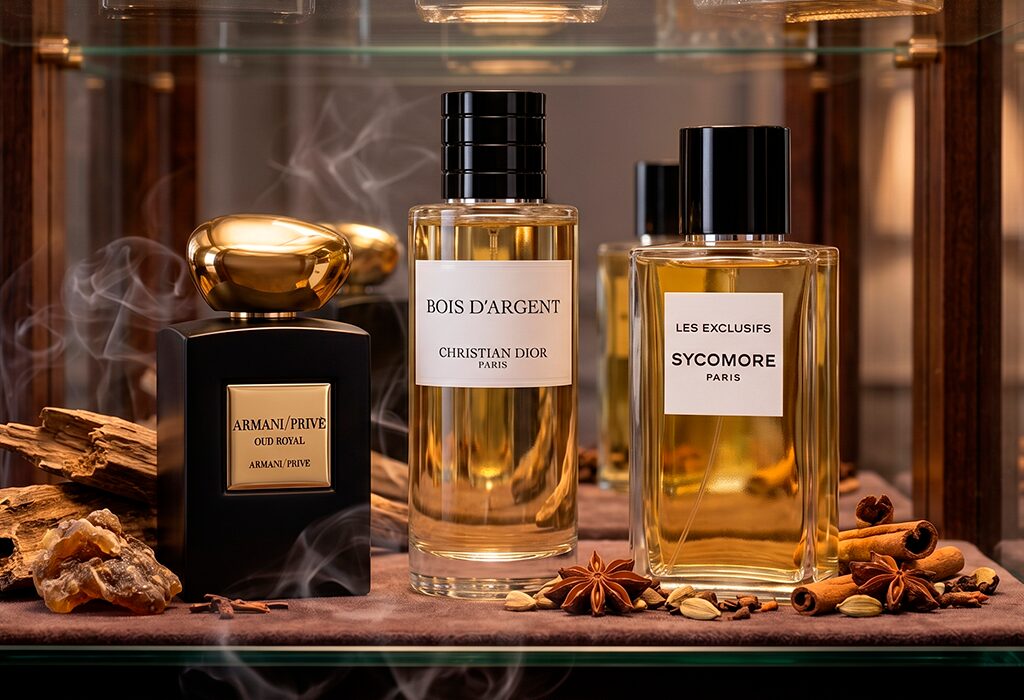
Three worth knowing:
Armani Privé Oud Royal. A rich, smoky oud with Middle Eastern gravitas. Refined in a way the main Armani line never attempts.
Dior Bois d’Argent. François Demachy again. Iris, patchouli, white musks. The fragrance is architectural — precise, cool, deliberate. It doesn’t shout. It doesn’t need to.
Chanel Les Exclusifs Sycomore. A cool, dry vetiver composed by Jacques Polge. Widely considered one of the finest vetiver fragrances in existence at any price point.
Here’s the honest part. The exclusivity premium is real — but the brand premium is real too, and they aren’t always the same thing. At this tier you’re generally getting an excellent fragrance. You’re also paying for a name, a boutique experience, and the prestige of the house at its most serious. The ratio of juice quality to price varies.

Performance isn’t guaranteed to be extraordinary either. Some exclusives — a Chanel Les Exclusifs Eau de Cologne, for instance, built in a true cologne style — are intentionally restrained. Sits close to the skin. Whispers, doesn’t announce. That’s a design choice, not a flaw. But it also means you’re not buying “more fragrance for more money.” You’re buying a specific vision, executed at the highest level the house can execute it.
If that’s what you want, the exclusive world is the top of the mountain. If what you want is a fragrance that turns heads in an elevator, you’ll do better staying in designer and spending the saved money on something else.
What to Do With All of This
Here’s what I’d actually do if I were starting my fragrance journey over today — because after twenty years of this, and after building Mission Fragrances from the ground up, I’ve watched hundreds of men go through the same learning curve. Most of them waste a lot of money on the way.
Don’t buy five full bottles trying to figure out what you like. Sample first. Every serious fragrance retailer sells decants and samples for $5 to $15 — a week of wearing a fragrance on your actual skin, in your actual climate, at your actual body temperature, will teach you more than any review you’ll ever read.
Start with one designer that genuinely suits you. Wear it for ninety days. Learn what its opening smells like, what its heart smells like, what it does on a hot afternoon versus a cold morning, what your wife or girlfriend says about it after the eighth wear, not the first. Then and only then, expand.
Try one clone. Put it head-to-head against the original on opposite wrists. Decide for yourself whether the 80% is enough for you, or whether you want the real thing.
Sample niche before you buy niche. I lost $280 learning that lesson. Don’t repeat my homework.
And try an exclusive at a flagship boutique the next time you’re in a big city — Chicago, New York, Paris, wherever you end up. Walk into a Chanel boutique, ask to smell Sycomore, and take your time. You’re not obligated to buy. You’re building your nose, and your nose is the only tool that matters in this entire game.
Categories give you context. They help you understand what kind of bottle you’re holding and roughly where your money is going. But they don’t tell you whether a fragrance is any good on you. Only your skin, your wife, and your own honest evaluation do that.
The goal isn’t to own the “right” category. It’s to build a fragrance wardrobe that earns its place on your dresser — one bottle at a time, chosen carefully, worn confidently.
Also read: