Some horror films aim to shock. Primate wants to keep you uneasy long before anything goes wrong.
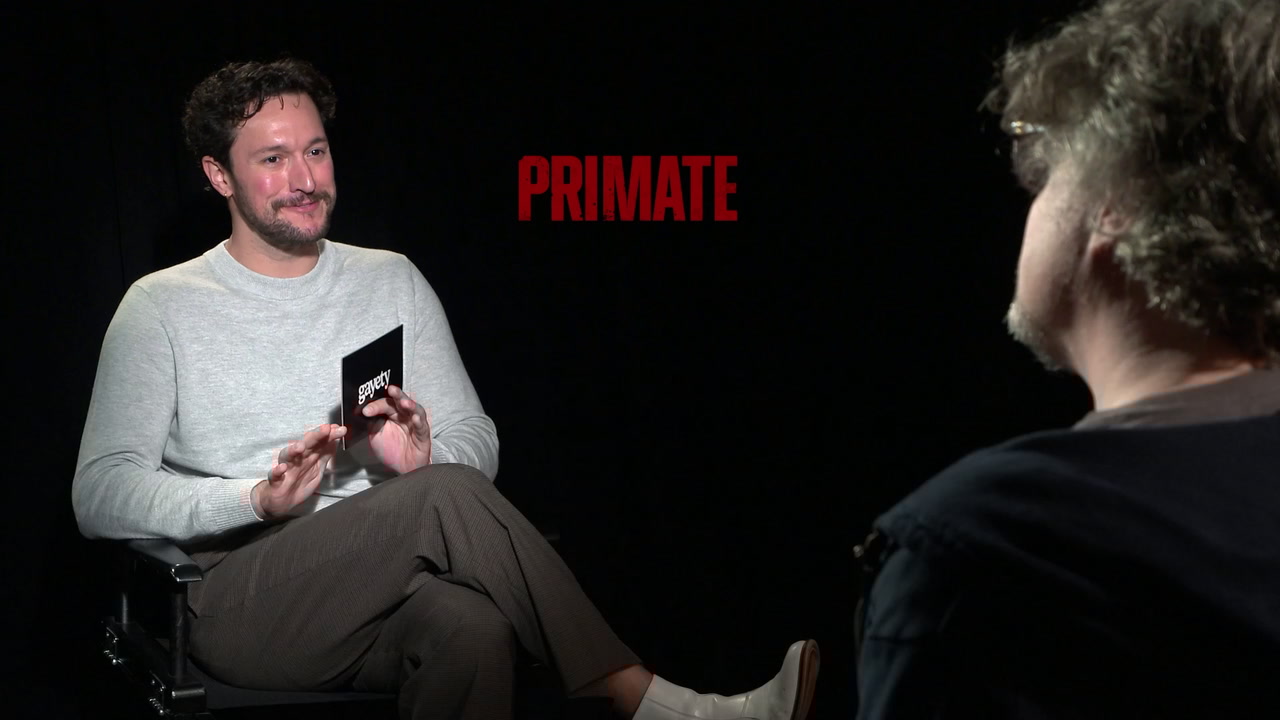
In an interview with Gayety, the film’s director unpacked the choices behind Primate’s sustained tension, its throwback horror DNA, and the real-life incident that informed one of the movie’s most unsettling sequences. The result is a creature feature that favors dread over excess and restraint over spectacle.
A Homecoming Gone Wrong
Set against the deceptive calm of a Hawaiian island, Primate centers on Lucy (Johnny Sequoyah), who returns home after a year away following her mother’s death. The visit reopens old wounds with her younger sister Erin (Gia Hunter) and raises new concerns about their father Adam (Troy Kotsur), a primatologist frequently absent while promoting his latest book.
Lucy’s attempt to reconnect is complicated by Ben, a chimpanzee treated as part of the family but clearly not well. Introduced early through unsettling physical cues and a foreboding lesson on hydrophobia, Ben’s presence casts a shadow over what should have been a carefree reunion.
The director said that pacing was intentional from the start. Rather than relying on constant escalation, the film stretches discomfort across scenes, allowing tension to build quietly before erupting. That approach keeps the audience alert, even during moments that appear safe.
Old-School Horror, Modern Restraint
While Primate embraces creature-feature roots, its tone avoids winking parody. The director cited classic horror structures as a guiding force, particularly films that understood how to work within confined spaces and limited stakes.
That philosophy extends to the movie’s practical effects, which ground the horror in something tactile. The director emphasized that keeping Ben physically present, rather than leaning on digital shortcuts, made scenes feel unpredictable. The audience isn’t watching an abstract threat; they’re watching something that occupies real space.
The result is a film that finds humor without deflating fear. Moments like Ben’s customized Speak & Spell device nod to genre history while maintaining tension, a balance the director said was crucial to keeping the film from tipping into novelty.
When Horror Mirrors Reality
The most talked-about scene, a harrowing sequence involving Hannah’s character trapped in a car, carries an added weight. As the director confirmed, it was influenced by the 2009 attack of Travis the chimp on Charla Nash.
Rather than recreating the event, the director approached it as emotional reference. The goal was to translate the shock and helplessness of that tragedy into a fictional context without exploitation. By grounding the scene in realism, the film invites the audience to confront how fragile control can be when wild instincts surface.
That connection to real life, the director said, is what makes the moment linger. It isn’t just frightening, it feels plausible.
Small Scale, Lasting Impact
In an era crowded with oversized horror spectacles, Primate distinguishes itself by keeping its focus narrow. The island setting, limited cast, and contained conflicts sharpen the suspense rather than dilute it.
As the director put it, horror doesn’t need to be loud to be effective. Sometimes, it just needs to feel close.