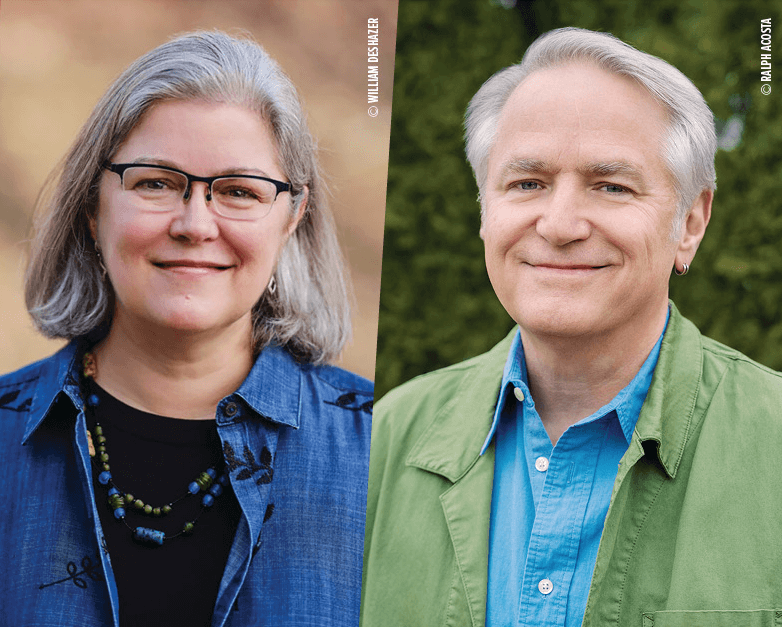
Children are born with a sense of curiosity, and their instinct to explore is something that author Margaret Renkl and her brother, the illustrator Billy Renkl, have taken care to support in their own children and now their grandchildren: “What we tried to cultivate in all of them was a sense of wonder,” Billy says. That approach is one of many things the siblings share—along with credit for several books and a deeply held love of the natural environment.
Those passions converge in The Weedy Garden: A Happy Habitat for Wild Friends, the sibling duo’s first picture book together, in which Billy’s colorful collage illustrations and Margaret’s lilting words guide readers through the book’s namesake garden. Every page reveals a variety of plants and the creatures who make homes among them, and the book ends with back matter that includes information about wildlife, as well as an engaging art exercise.
The Renkls’ fascination with the natural world is well documented. In her acclaimed memoir in essays, Late Migrations, Margaret wove observations about the world outside of her suburban Nashville home into reflections about family, which were punctuated by Billy’s collage work. For Margaret’s second book, The Comfort of Crows, Billy crafted art to pair with each of her weekly backyard devotionals.
“Everything I’ve ever done with words has been different iterations of the same thing,” says Margaret, who also writes about the American South’s flora, fauna and politics for the New York Times. She believes all writers experience a version of this: “We are obsessive creatures, and we circle the same subjects but from different perspectives and [with] different aims. That’s been true since I could hold a pencil. I’ve been loving the wild world since I was in diapers.”
Writing for children was something new, and she found it more difficult than she expected, , she says. “There are so few words, and each word has to carry so much weight.”
A text exchange with fellow author Kate DiCamillo helped unlock the process for Margaret. DiCamillo—whose works include The Miraculous Journey of Edward Tulane and Because of Winn-Dixie—said that picture books are the hardest form she writes in. DiCamillo suggested that one “think of it as a poem with page turns,” Margaret recalls. “That opened it up for me. I went to graduate school to learn how to be a poet; I wrote poetry exclusively until I was 34 years old. I can think in the compact lyrical language of a poet.”
As for Billy, illustrating a children’s book isn’t a first for him, though working with his sister in this context was a slight pivot. Billy previously illustrated the picture book When You Breathe by Diana Farid, a process he describes as a sort of second graduate degree. During that project, the art director offered guidance but kept Billy and the author separate so Farid’s preconceptions didn’t influence his work. “And, obviously, that wasn’t going to go on with Margaret,” he says.
“We have been collaborating for a very long time, starting when we were in grade school,” Billy explains. He is 18 months younger than (and one grade behind) his older sister. “Margaret would write a book or booklet and I would do drawings and we would give it to our grandparents for their 50th wedding anniversary or whatever. We worked on the same publications in college and in graduate school. This just seemed like one more iteration.”
“We were a built-in buddy system at a time in history when parents just said go play and left us to our own devices,” Margaret adds. The siblings’ easy banter is impossible to miss during our video interview.
“Billy might not agree with me, but I do think I have gotten somewhat less intrusive in the process with each subsequent book,” she says, eliciting laughter from her brother. “I have strong opinions about the identities of plants and animals and whether they would be in the same place at the same time,” Margaret explains. “My opinions about artwork are very mild or even nonexistent.”
“I think some of the best artwork that is being made today is being made for books aimed at children.”
The siblings are both attuned to what’s growing on their own properties. Margaret focuses on what’s blooming, producing seeds or berries to feed migratory songbirds. Each season offers food to care for those animals, resulting in a yard that she says is “more weedy than garden.”
Billy’s house, on the other hand, offers a more classically defined garden. Both are attracted to cultivating plants native to the region, since those not only feed wildlife but also tend to be hardier in the local climate. But Billy admits he incorporates noninvasive nonnatives because he “can’t quit peonies.”
“I do understand that there’s a tremendous value in Billy’s way of gardening that’s different from mine,” says Margaret, whose yard includes signs from the Xerces Society for Invertebrate Conservation to help educate curious neighbors. “People in Clarksville, Tennessee, drive by Billy and Susan’s house so they can see those flower beds in bloom.”
“But there are plenty of what my neighbors think of as weeds,” says Billy, who has a sign of his own making that explains his yard. “There’s a sea of brown-eyed Susans, and I had a neighbor drive by and stop and roll down the window and suggest that I pull them up, that they were all weeds, and I’m like, ‘You know, my wife has brown eyes and is named Susan, so . . . on your way! We’re not doing that.’ ”
Although both Billy and Margaret live in Tennessee, Billy’s illustrations in The Weedy Garden include plants that would be noninvasive across North America, and reflect not only plants and animals described in the text, but also Billy’s real-life observations. For example, the clover depicted in the book is a painted cyanotype of a photograph he took of clover at his house. (He’s particularly drawn to illustrations that began as analog media.) “My yard is all over that,” he says of The Weedy Garden, in which the turquoise door to his art studio and his backyard fence also make cameos.
Billy points to illustrators Sydney Smith, Sophie Blackall and Melissa Sweet as inspirations for his style. “The pictures don’t [just] thinly represent what’s going on in the text. They have their own life,” he says of the books he admires most.
While staying compatible with the text, The Weedy Garden’s illustrations also go above and beyond by showcasing a child’s perspective. For example, Billy offers a top-down look at a turtle among wild strawberries because as a kid, “you would put your hands on your knees and bend over and look straight down on them.”
The book is a work of art, which has become a norm for the Renkls, whose earlier collaborations were printed in full color on heavy paper—a rarity in adult publishing.
“Children are sometimes taught to be afraid of the natural world when that’s the very last thing they need to be taught. They just need to be supported and celebrated for understanding their kinship with the other living things in their world.”
“Sometimes I think some of the best artwork that is being made today is being made for books aimed at children and their parents, or their caregivers, or their loving aunts. And it’s so affordable. It’s like having a coffee table book for $20,” Margaret says. “That is one of the most amazing things about working with a children’s publisher—because every single thing they do is beautiful and is meant to stand the test of time.” Picture books often have to withstand the use of several generations of young readers and are “meant to be a family treasure, every one of them.”
The Renkls aim for The Weedy Garden to encourage children to foster love and empathy for the world around them, and to realize that they also constitute part of an ecosystem. “The whole thing is grounded on asking the child to use their imagination as a way of encountering nature,” Billy says. “They can think about what it means to be a bumblebee. That’s what I was trying to amplify in the images by taking a child’s point of view . . . with the kind of wonder Margaret’s text suggests.”
Margaret hopes for parents and caregivers to remember that the outdoors can offer kids something beautiful. “Children are sometimes taught to be afraid of the natural world when that’s the very last thing they need to be taught. They just need to be supported and celebrated for understanding their kinship with the other living things in their world.”
Photo of Margaret Renkl credited to William DeShazer. Photo of Billy Renkl credited to Ralph Acosta.