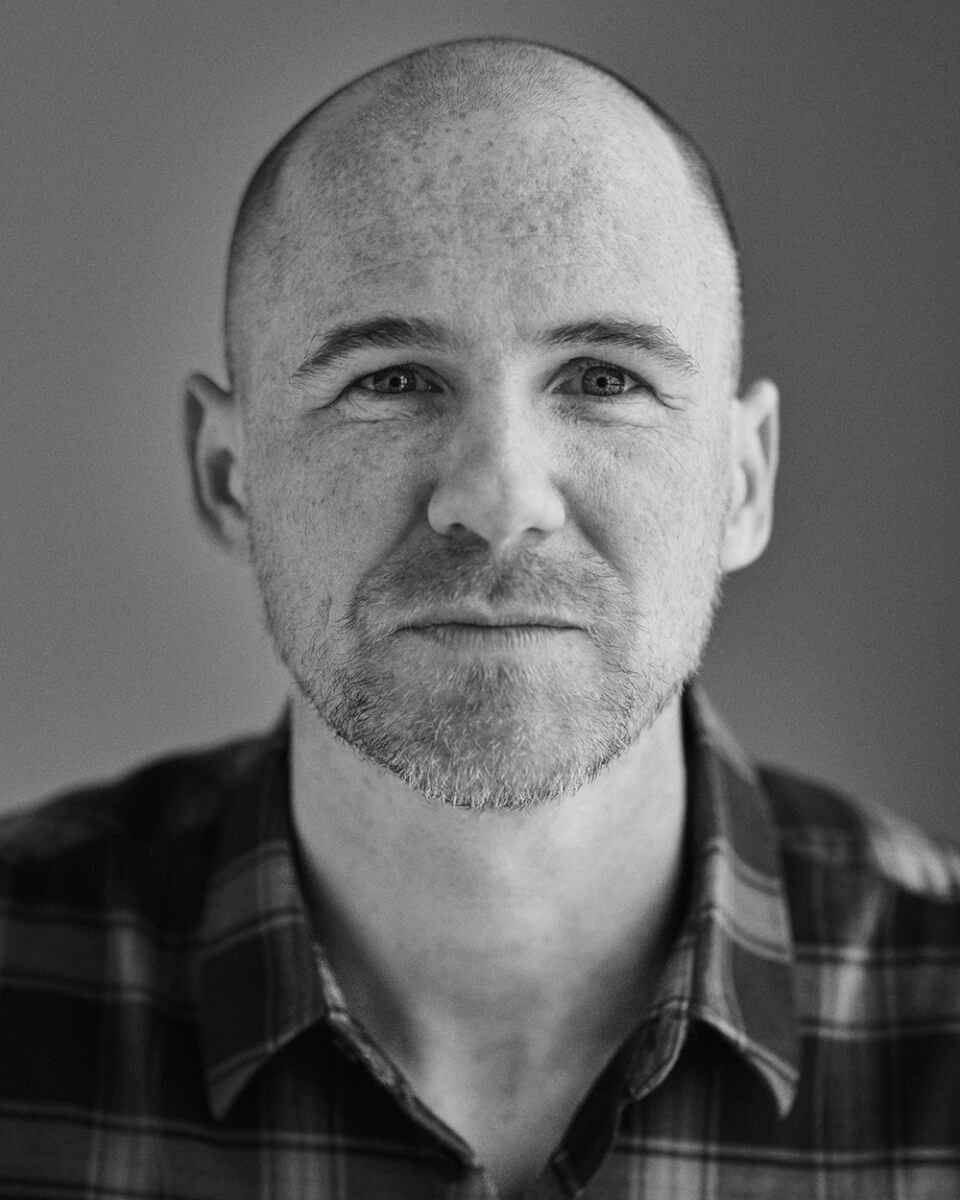
The day after Gabriel Tallent moved to Utah, he told his then-girlfriend, “If we’re going to be in Utah, we’re going to learn how to climb.” They headed to a local outfitter to buy some gear, and, as Tallent says, “We’ve been climbing ever since.”
Tallent is speaking via video call from the basement of his Salt Lake City home, where weights are visible behind him and a power rack sits in the corner. He regularly strength trains here, but climbing has been put on hold for the moment as Tallent and his wife chase after their three young sons—3-year-old twins and a 5-year-old. “It’ll come back once these guys are a little older,” Tallent says with an anticipatory smile.
In the meantime, rock climbing abounds in Tallent’s latest novel, Crux, an immersive story about two high school seniors from impoverished families, Dan and Tamma, who spend every spare hour testing their skills in the Mojave Desert and dreaming of escaping to Canyonlands after graduation. As Tamma puts it, “hidden in those canyons are some of the wildest, most epic trad climbs in the world. . . . The bravest deeds, wildest campfire parties, strongest whiskeys, and most brazen runouts will be ours. Tales of our misadventures will race across the nation, going crag to crag, sprinter van to sprinter van, campfire to campfire.”
That sort of youthful yearning infuses the book, which Tallent notes is a “completely different ride” from his acclaimed first novel, My Absolute Darling. His debut featured Turtle, a 14-year-old girl trying to escape physical and emotional abuse from her survivalist father. During that book tour, many readers shared their own stories of abuse with the author, an experience he describes as “a profound emotional harrowing of my soul.” Ready for a change of pace, Tallent recalls pitching his second book as a “weird little literary climbing book that will give me permission to have just the weirdest possible characters and spout dick jokes.”
“I’m just running out of strength. I’ve been holding on to the same little edge for a long time. If you had handed me a cup of coffee, I couldn’t have held it.”
Readers will hardly find the novel little at 416 pages, although they will likely charge through its compelling chapters. Tamma is indeed memorably quirky—and foul-mouthed—although ultimately endearing in the face of dire obstacles that she admirably navigates. While most, including Dan’s parents, label her a homely “trailer-trash leftover, a dumb burnout with no hope and no prospects,” Dan loves “everything about her,” seeing her as “some kind of genius,” as well as “graceless, frolicsome, and indestructible, like you’d imagine a newborn moose might be.”
Dan and Tamma’s mothers were once best friends, although they had a mysterious falling-out. Dan’s mother, Alexandra, published a bestselling novel at age 18 but has been unable to write anything since. With the family financially unstable, Dan’s parents want their athletically and academically gifted son to go to college, but he just wants to climb.
The climbing aspect of the novel lifts these dramas into a, shall we say, higher realm, and Tallent leans heavily into this world, throwing lingo left and right, including the colorful names of climbing routes. (One of Dan and Tamma’s favorites is “Fingerbang Princess,” which becomes the subject of Dan’s memorable college essay.)
Tallent’s passion for climbing and linguistic flair bring this world alive—even for those whose only climbs have been flights of stairs. However, getting there was far from easy; Tallent spent about 10 years wrestling with this book. At first, his manuscript narrated Dan and Tamma’s life beyond high school, instead of just their senior year. “That’s not unusual for me,” he explains. “A lot of times I write some sprawling monster and then end up cutting it down to its core.”
“The problem,” the author says, is “how to tell this story in a way that the reader feels the meaningfulness of it.” He mentions a classic climbing novel, James Salter’s Solo Faces, which he felt was a desolate read, because the protagonist “just climbs and climbs and climbs, sort of abandoning everyone and everything else.”
“We always think about risk as something you do. We don’t attach risk to staying in one place, to not doing things.”
Tallent tried narrating climbs he had done moment by moment, but found the results tedious. He had a revelation, however, after a perilous experience on a route inauspiciously named “The Coffin.” Tallent recounts the situation in fascinating detail, even bringing out gear to illustrate his predicament. When he reached the most difficult section of the climb, the equipment that he needed was below, out of reach. He spent about 20 minutes unsuccessfully trying to jury-rig the gear at hand.
“I was so scared,” he recalls. “I’m just running out of strength. I’ve been holding on to the same little edge for a long time. If you had handed me a cup of coffee, I couldn’t have held it.” He desperately wanted to stay there and try to make what he had work, “but if I do that, I’m for sure going to die.” Instead, he realized the only solution was to forge ahead, going higher and trusting himself not to fall until he reached a safer spot where a crack in the rock widened enough to place his gear. Tallent finally gathered his courage and proceeded up, where he was able to clip in and come down safely. As he descended, he realized, “That’s it!”: The climbing scenes in Crux needed “to zero in on the hard decisions that climbing forces you to make.”
The novel’s title reflects just that. In climbing, the crux is the most challenging part of a route, or, as Tallent writes, “the place where everything inside yourself told you to wait, to stall, to cling to safety, and yet where, if you wanted to live, you had to take that risk.”
“It’s decision-making that goes against the grain of what you want,” Tallent explains, “because there’s something that feels safe about staying there,” he continues. “We always think about risk as something you do. We don’t attach risk to staying in one place, to not doing things.” He elaborates: “Like when you’re writing, you don’t want to write some bad draft, right? . . . But if you don’t write it, you’re never going to get that book done.”
“There’s a default American narrative that if you just chase your dreams, everything will work out. And I don’t think that’s true.”
However, even after this epiphany, the author’s struggles continued. “I had this big sprawling novel about people trying to climb at the highest levels of the sport, and I wasn’t feeling it.” Instead, he tried writing a book about cardiothoracic nursing and the collapse of American healthcare—his wife worked as a thoracic nurse at the time—but his editor didn’t love it. What’s more, his wife was pregnant, they were running out of money and, as a result, Tallent was applying for jobs at E-Trade. “It looked like I just wasn’t a writer,” he says.
He never intended to be one, in fact. Tallent was raised by two mothers, one of whom is writer Elizabeth Tallent, a Stanford professor. Gabriel initially thought he, too, would become a professor, and studied 18th-century cultural history as an undergrad. “Critical theory seemed really urgent and important to me,” he recalls, “and being a novelist seemed like a dreadfully insecure, approaching impossible, career.” However, after college, during what he thought would be a gap year before graduate school, he says, “My Absolute Darling just took over my life. I was scrubbing toilets at Target in Salem, Oregon, and writing and reading in all my spare time. I was too consumed to apply to graduate school. It wasn’t really a decision I made. I just sort of couldn’t stop.”
Despite his literary heritage, he says that his character Alexandra, who suffers from depression and writer’s block, doesn’t resemble his mother, but instead, his own private demons. “I grapple with profound major depression,” he says, adding, “Alexandra could not be more different [from] my mom.”
“Everyone I know who is good at things got good by being humble and hardworking and persevering.”
Tallent further explains: “This is a book about dreams, right? But there’s a default American narrative that if you just chase your dreams, everything will work out. And I don’t think that’s true. I think the question is subtler and thornier and more elusive than that. It’s not sufficient to give that trite response, especially in perilous economic times when chasing your dreams could come with real lifelong financial consequences. . . . And so, I needed there to be some perilous example of the way that the story goes wrong. The specter of Alexandra as this sort of failed novelist who’s not able to engage and provide stability for her kids has nothing to do with my family of origin and everything to do with myself, because I struggled writing this book, and it was not at all clear that it was going to get done.”
In the end, becoming a dad shifted Tallent’s perspective on his novel’s focus. “A lot of sport stories are about people reaching their highest human potential,” he says. “And I . . . realized that wasn’t something I really cared about. For me and my experience of climbing, that wasn’t important. Everyone I know who is good at things got good by being humble and hardworking and persevering. And to me, that’s more interesting.”
The same, of course, could be said about his own writing—he persevered writing both of his remarkable novels. Once “things were a little bit more stable” after his son’s birth,” Tallent says, “I came down into the basement and was like, okay, this is for all the marbles. I’ll write a climbing book that works, or go work at a call center. And so that’s what I did.” Happily, Tallent remains a writer working from home.
Characters Dan and Tamma are so memorable that fans will likely finish the book wanting to know more about their lives after high school. Would he consider a sequel? “If people want that story,” he says, “I have that story.” He also admits that he would love to write another climbing novel. “I think it presents problems,” he cautions, “but if it were doable, I’d love to tackle granite climbing here in Salt Lake.”
Photo of Gabriel Tallent (c) Michael Friberg.